Nana Patekar, 1951–2026: The Voice, the Fury & the Ache Beneath
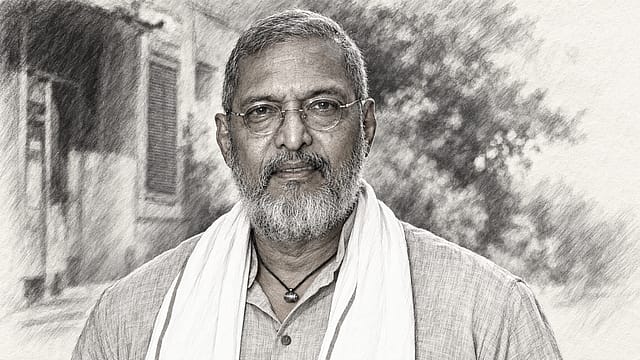
“Control, Uday, control.”
For an actor whose voice could make an entire scene sit up straight, it was a wonderfully unlikely instruction. In Welcome, Nana Patekar’s gangster Uday Shetty kept trying to manage his temper, his circumstances and the chaos around him. The audience, familiar with decades of Nana’s eruptions, enjoyed watching him attempt the impossible.
By then, that voice needed little introduction. The clipped syllables, the sudden acceleration, the way a sentence could seem to gather heat halfway through: somebody could imitate a few seconds of it and listeners would know exactly who was being impersonated. Patekar had become a recognisable rhythm in the everyday language of Hindi cinema.

The Modi Years
02 Oct 2026 - Vol 05 | Issue 40
A Nation Rebuilt
But the voice was only one part of him. In Khamoshi: The Musical, he played a father who could neither hear nor speak. The actor audiences associated with blazing speeches made them watch his hands and his face. He could hold a scene without the instrument for which he was most famous.
Patekar died at 5.20 am on October 8 after suffering a cardiac arrest at his residence. He was 75. Dr Shekhar Salkar, chief of the Department of Oncology at Manipal Hospital, reportedly said CPR continued for 45 minutes without success.
His death leaves an absence much larger than a familiar delivery. Over decades in Hindi and Marathi cinema, he expanded the possibilities of what a leading presence could look and sound like. He brought abrasion, awkwardness, humour and vulnerability into the same frame, sometimes into the same exchange. You watched him because you could not quite predict which would arrive next.
THE BOY WHO PAINTED THE POSTERS
Long before he became the man on the poster, he worked on making them.
Born Vishwanath Patekar on January 1, 1951, in Murud-Janjira, Maharashtra, he studied art in Mumbai. His early livelihood included work on cinema posters, followed by employment as a commercial artist and visualiser. Theatre eventually pulled him away from the security of a regular job.
There was necessity behind those early earnings. In interviews, Patekar recalled a collapse in his father’s fortunes that sent him to work while he was still at school. At 13, he was earning ₹35 a month and receiving a meal a day. Childhood had acquired adult obligations. Rediff.com movies
In December 2024, recalling those years in an interview with Siddharth Kannan, he said: “I started working at the age of 13. So I turned 30 very early in life.”
The experiences stayed with him after money ceased to be the same daily worry. In a 2015 interview, he remembered visiting friends around mealtimes, hoping to be invited to eat. “So for me there can be no fragrance better than that of a chapati,” he said.
It is an intimate detail to carry into the memory of a screen actor. Behind the public reputation for anger was a man who remembered what hunger did to pride. A warm chapati could contain something awards and applause could not give him: the reassurance of having enough to eat.
His father also helped nurture his appetite for performance, taking him to plays and watching his work. Patekar credited theatre director Vijaya Mehta with shaping him. Acting began in a world where recognition could mean a father travelling to see his son perform, well before it meant a crowd recognising his voice.
A FACE THAT CHANGED THE FRAME
Smita Patil encouraged him towards films; Patekar later credited her with helping bring him into Gaman, released in 1978. He had been happy in theatre and uncertain that cinema would have a place for him.
Cinema found one.
His career moved through the urban anger of Ankush, the bruising world of Salaam Bombay! and the menace of Parinda. He could belong to a film’s social landscape while making his own presence impossible to miss. Mira Nair’s Salaam Bombay! cast him as Baba; Vidhu Vinod Chopra’s Parinda gave him the crime boss Anna and his first National Film Award.
The familiar phrase “intense actor” does too little work here. Patekar’s intensity had changes of temperature. A look could be casual and unnerving. A sentence could begin conversationally and end as an assault. His performances made the space around another actor feel less secure.
Parinda also left a painful physical memory. In a later interview, Patekar recalled being burned during the climax shoot and being unable to work for almost a year.
The films that followed gave him a larger canvas. Tirangaa and Krantiveer brought his delivery into the centre of mainstream spectacle. In Krantiveer, his Pratap challenged communal hatred by confronting a crowd with blood that could not be distinguished by religion. The scene used the force of popular cinema to make its argument; Patekar supplied its urgency.
He could sound like a man who had exhausted his patience with everyone in the room. That made his speeches exhilarating, but also gave the roles something more personal than routine heroics. The grievance seemed to have travelled with him into the scene.
He won the National Film Award for Best Actor for Krantiveer and another supporting-actor award for Agni Sakshi. The Padma Shri followed in 2013. The honours acknowledged a career whose strongest signature was already lodged in audiences’ ears.
WHEN THE VOICE FELL AWAY
Then there was Khamoshi.
Sanjay Leela Bhansali’s 1996 film cast him as Joseph, the deaf father of Manisha Koirala’s Annie, with Seema Biswas playing her mother. Annie’s love of music opened a world her parents could not hear.
Patekar’s presence gave that family conflict its weight. Joseph’s love could be protective and constricting; his fear could make him difficult even when the viewer understood where it came from. The performance asked us to stay with an anxious father whose daughter’s life was growing beyond his understanding.
It also offered a fuller answer to the question of his range. Take away the celebrated voice, and the actor remained. There was feeling in the gestures, resistance in the body and hurt in the face. The screen could be quiet while Patekar made the emotional distance between people palpable.
Years later, Ab Tak Chhappan brought another register. As encounter policeman Sadhu Agashe in Shimit Amin’s 2004 film, he worked with a restrained, conversational authority. The role let danger exist without announcing itself at full volume.
A performer remembered for explosions knew how to leave the fuse burning.
THE GANGSTER WHO MADE US LAUGH
Welcome gave a new audience its own Nana.
Uday Shetty was volatile, affectionate, vain and absurdly preoccupied with holding things together. His exchanges with Anil Kapoor’s Majnu Bhai turned two threatening presences into a comic partnership. The joke drew strength from what audiences already knew: these men had the faces and voices for menace, and here they were, getting tangled in embarrassment.
Patekar understood the method. In a 2015 interview, he said: “One should do comedy with a straight face.”
He did. Uday’s anxieties were serious to Uday. That was what made them funny.
The performance also renewed his cultural life. A viewer who had never watched Parinda could recognise Uday Shetty. Clips and imitations carried him into conversations far removed from the original films. Different generations could arrive at the same actor through entirely different doors.
In Marathi cinema, Natsamrat offered something altogether more bruising. Mahesh Manjrekar’s 2016 film cast him as the ageing theatre great Ganpatrao Belwalkar, a man whose command of the stage could not protect him from the pain of family life.
There was a particular poignancy in watching an actor formed by theatre play a performer struggling with what remained after the applause. Patekar gave the role grandeur, but also the indignity and loneliness of being unable to make ordinary life obey the rules of a performance.
THE HURT HE COULD NAME
His own recollections could be painfully unsparing.
Speaking to The Lallantop in 2024, Patekar discussed the death of his eldest son, Durvasa, who had been born with disabilities and died at two-and-a-half. He admitted that his first response had included concern about how other people would see him. He spoke of the child’s short life as a lesson in his own failings.
It was a difficult confession. A father looking back at his vanity, a famous man describing an experience in which he had fallen short of the person he wished to be.
Warmth in a remembrance need not make every recollection comforting. Some of his most human moments came when he could name his limitations.
Nor was his public life free of serious controversy. In 2018, Tanushree Dutta renewed allegations of sexual harassment concerning a 2008 film shoot; Patekar denied them. Mumbai Police filed a closure report in 2019 citing insufficient evidence, which Dutta contested. That episode remains part of his public history alongside the achievements.
There was also sustained work beyond cinema. In September 2015, Patekar and actor Makarand Anaspure established NAAM Foundation in response to drought and farmer distress in Maharashtra. Its work has included water conservation, restoring canals and supporting village development.
The man whose performances gave grievance such a powerful voice also took an active interest in livelihoods far from the film set.
He remained a working actor. His recent movies include Housefull 5, a police officer’s role in Vishal Bhardwaj’s O’Romeo and a cameo in Subedar, starring Anil Kapoor. His long history on screen was still acquiring new entries.
THE MAN WE WILL STILL HEAR
A career can survive in a collection of images. Patekar’s survives in sound, too.
Somewhere, somebody will attempt that delivery: the abrupt stress, the gathered impatience, the sentence that seems to lean forward. Others will return to Joseph in Khamoshi, Sadhu Agashe in Ab Tak Chhappan or Belwalkar in Natsamrat and remember how much existed beyond the voice.
That is the fuller loss. Hindi cinema has lost a performer who could unsettle its glamour, Marathi cinema a formidable actor rooted in its theatrical tradition. Audiences have lost a presence that could make the ridiculous believable and the wounded difficult to forget.
The boy who once worked on film posters grew into a man whose smallest gesture could make us look away from everyone else on the screen.
And beneath all the remembered fury remains that modest, tender measure of happiness: the fragrance of a chapati.
With inputs from ANI & agencies