Madhabi Mukherjee: Satyajit Ray’s favourite heroine revisits the golden era of Bengali cinema
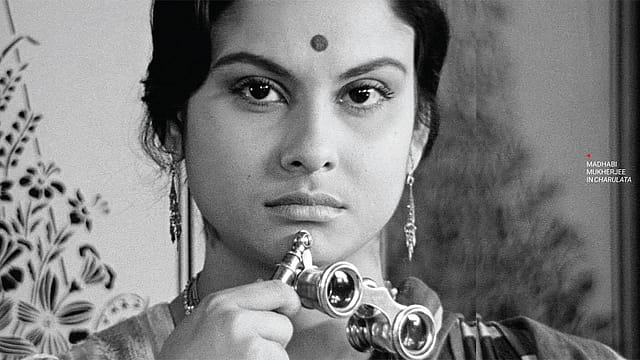
FOR THE PAST several years, since 2021 to be precise, I have thought of profiling Madhabi Mukherjee. That was the centenary year for Satyajit Ray, her director in Charulata, widely held to be his finest work. Then in 2023, it was Mrinal Sen’s centenary, and the thought returned. I wanted to ask her about the ways in which Ray and Sen had cast her—both had given her complex roles, but it seemed that Sen had pushed the envelope farther permitting her to cross the line of bhadra behaviour to perform a character who opts for sex work. Ritwik Ghatak’s centenary was in 2025, celebrations for which are continuing across the cultural nodes of mainland India, this year. This time, the thought was clear: Madhabi Mukherjee, the only living actor who has performed major roles for the once holy trinity of Indian cinema—Ray, Sen and Ghatak. (The other major star who performed in all their works is Utpal Dutt.)In the galleries of film stills and posters that attend each centenary tribute, it is impossible to miss Mukherjee, luminous and unsmiling, sometimes frowning. Here she is in Charulata, brow furrowed at her writing, then in Mahanagar, examining the effect of lipstick on herself, or, staring blankly without eye contact as her husband gets up after eating in Baishe Srabon; only the Subarnarekha image is sometimes a cheerful Mukherjee, captured from the side. “Madhabi has a very bad habit, she frowns constantly in front of the camera,” the writer, filmmaker and artist Purnendu Pattrea is quoted as saying in Madhabi’s Garden (Bloomsbury; 224 pages; `399), the English-language translation of her 2012 memoir, published this year. “A frown looks terrible on such a beautiful face.” Pattrea, nevertheless, would cast her in three of his five films (Swapno Niye, Strir Patra and Malancha).

Madhabi’s Garden marks Arunava Sinha’s 101st translation, and is one among only a dozen non-fiction titles that he has translated. If you consider the writing alone, Mukherjee is no writer. This book is a collection of anecdotes—most likely narrated to the person assigned to record them in the form of written notes—not only about Ray, Sen and Ghatak but also several other figures in Bengali film and stage history, yet it never coalesces to perspective. Perhaps, Sinha had the same idea as me: he wanted to pay tribute to Mukherjee, the woman who is central to the filmographies of Ray, Sen and Ghatak.
PATTREA’S IS A STRIKING observation: Mukherjee’s frown and the frequency of it per photographic evidence. Can you think of any other leading woman frowning prominently for the camera? I notice that there is a trope to the Ray-Sen-Ghatak films: in each of these works, she played the figure of the Indian woman stepping over the threshold between tradition and modernity. And the frown, singular and compelling, helps underlines the persona of a woman with a mind of her own.
But first, a test, because icons should never be accepted on reputation alone. Does the Ray-Sen-Ghatak hallmark hold up as a framework of relevance today? My answer is yes. For one, notice how their legacy continues to be celebrated in festivals, scholarship and writing across the world, including marquee film festivals like Cannes. Would there be painstaking restorations of their films, and ceremonies to mark their centenaries, if the work did not hold up? Second, is their particular history. Ray, Sen and Ghatak were all born in the first half of the 1920s, the decade Gandhi took control of Congress and gave a new momentum to the National Movement. All three had come of age in 1947—Ghatak a couple months after Independence—as the new nation was born. By virtue of the time they worked, their films projected the lived realities, dreams and anxieties of the new-born nation. They were literally the generation that made India.
Mukherjee, who acted in lead roles in their most notable films, then gave shape to the understanding of the new Indian woman—a full and equal citizen in a society with a formidable legacy of inequality, hierarchy and patriarchy. Line up the films Mahanagar (1963) and Charulata (1964) (Satyajit Ray), Baishe Srabon (1960) and Calcutta 71 (1972) (Mrinal Sen) and Subarnarekha (1965, Ritwik Ghatak), and you shall see in them all a woman actively negotiating modernity in a society reshaped by colonialism and its attendant finger-wagging. Often, she is negotiating the threshold between the home and the world—that succinct Rabindranath Tagore phrasing of the boundary separating the private sphere of domesticity and duty from the public sphere of rights and ambitions. This is a generalisation, of course. But it is a useful one because it allows us to see that Mukherjee was repeatedly cast to play a type of character, likely because she was so good at it. Sometimes, this threshold of modernity was between a traditional familial role and personhood—between wifedom and being an individual in Baishe Srabon, or sisterhood and personhood in Subarnarekha.
In Mahanagar, Mukherjee’s first (and my favourite) film with Ray, she is literally the woman who steps outside the home into the world outside. Theirs is a refugee family, and a financial crunch makes her take up a saleswoman’s job. Initially hesitant, she loves the job and discovers a sense of self and dignity that she never quite realised within the family. In a marvellously performed moment of hesitation, she asks her husband whether she should actually sign her name on a letter, and if they use ‘z’ or ‘j’ to spell their family name Mazumdar.
In Charulata, widely considered Ray’s masterpiece that released the year after Mahanagar, we see Mukherjee writing again—and hesitating again, albeit in very different circumstances. This time, it’s not unfamiliarity with the physical act of writing, but about the content of her words. (The Bengali letters on paper look strikingly beautiful in a way our keyboard hand can only sigh over). After lining up a garden path with rejected drafts, Charulata Dasi writes an essay about her childhood memories of her village home that is published in a prestigious literary magazine, and comes to a moment of self discovery. Towards the film’s close, she tells her husband that she could help him run his paper—he would look after the political writing in English and she would oversee other issues in Bengali. She has crossed the threshold of domesticity with her published byline.
In Ghatak’s Subarnarekha, released in 1965 and the finale to his Partition trilogy, Mukherjee is the lead alongside Abhi Bhattacharya, who plays her elder brother and guardian. They are all that remain of a refugee family in post-Partition India and brother and sister are like father and daughter, and also, mother and son. But when Mukherjee falls in love with a childhood companion, who turns out to be from a lower caste, she walks out on her beloved elder brother, her only family, because he objects to his caste status. This too is a crossing into modernity, but here the line is not between domesticity and the world outside, as much as it is the line between submitting to family and realising herself. Mukherjee’s most interesting roles, to me, are the two films she did for Sen.
In Baishey Srabon, one of her first substantial film roles as an adult, she is the much younger, attractive wife of a middle-aged sales agent. It is a reasonably happy relationship at the start that disintegrates as the 1943 famine closes in on them. Sen gives us a private map of the famine, through the effects it has on a two people in a marriage. Mukherjee is unforgettable in one sequence, where she watches her husband devour a meal leaving nothing for her, at first with surprise and then with repulsion. The famine has made an animal out of him, we register through her face. In a lesser performer’s hands, the wife might have seemed spoilt and touchy—after all, subcontinental wives are expected to serve husbands and other men in the family without complaint, without thinking about themselves. Mukherjee’s character displays a selfhood, an individuality, something that is discouraged for women in traditional Indian society.
THEN, THERE IS Calcutta 71, Sen’s quadriptych on the unrest in Bengal at the turn of the 1970s. Mukherjee appears in the segment titled ‘1943’, yet again a story set against the famine. It begins with Mukherjee’s face on a black screen, her brows creased into a quiet frown, the blackness gradually closing in on her. Mukherjee is Sobhana, the elder daughter of a family squeezed out of their own home, living in a building in Kolkata seemingly based on the provision of sexual labour by Sobhana and her adolescent sister, and domestic labour by their mother. A vein of palpable resentment runs through the members of the family that haemorrhages into a confrontation where Sobhana accuses their elderly, white-clad mother of pimping out the daughters to feed the family. She is the heart of the story, a good young woman crushed by the desperation of the famine, and she is reliably superb.
Calcutta 71 also provides a basis to compare Ray and Sen on women. Ray made one film on the famine, Ashani Sanket (1973) where he drew a distinction between the heroine Ananga, played by the Bangladeshi actor Babita, and her neighbour Chutki (Sandhya Roy). Ananga refuses sex work, unlike Chutki who offers sexual labour in order to eat. A good woman, Ray suggests, does not cross that line. Sen suggests the opposite—that it was the indecency of the times that pushed women into unpleasant choices.
Let me return at the end to something I began with—that luminous frown. When I think of Mukherjee, like most others I see her in the image from Charulata, binoculars perched on her nose. I’m grateful to Pattrea for observing how often Mukherjee frowns. Once you notice it, you see it everywhere. Perhaps, she is frowning under the binoculars, slightly?
In two of the films discussed here, Mukherjee’s character kills herself. Her marriage cracks in Charulata and in Calcutta 71, she is a widow who relies on sex work to feed her family. Only one has a semblance of a happy ending, but even in Mahanagar, she loses her job for speaking up for what is right. These are uneasy fates.
The frown, then, feels germane. Modernity, encountered via the colonial project, did indeed bring much to the bhadramahila, the newly-educated wealthy and middle-class woman of the 19th century—education, rights, personhood. But these also brought new anxieties in their wake. The choices that modernity brought for the Indian woman did not come without consequences. I think of Mukherjee peering through her Charulata binoculars, and I read it now as portend—what she saw was a modernity that takes a lifetime of negotiation.