Gerald R Molen, Truck Driver Turned Oscar-Winning Producer of Schindler's List, Dies at 91
TAPE ONE: M-I-R-K-O
January 31, 1999. A house in Los Angeles.
The camera rolls. An old man settles into his chair.
Across from him sits a friend. They share an Oscar. Today, the friend has only questions.
"Your name?"
Branko Lustig spells it.
"Where were you born?"
Osijek. The friend asks him to spell that too.
Then they reach his father. This time Lustig doesn't wait to be asked. He spells it himself, letter by letter, as if setting each one down carefully on a table.
M-I-R-K-O.
Mirko was a head waiter in a hotel.
Lustig had helped set up a foundation to record the memories of Holocaust survivors. He had made a promise: when the foundation hit its target, he would finally tell his own story. More than four years later, it did. His testimony was number 50,000.

Anatomy Of A Stillborn Revolution
20 Nov 2026 - Vol 01 | Issue 01
Whatever Happened To The Cockroach Janta Party?
The man asking the questions was Gerald R. Molen. Everyone called him Jerry.
Molen has died at 91. He died on Monday, his great-niece Rachel Lorraine Pullan announced, and the Hollywood trade papers carried the news on November 26.
Millions have seen his face without knowing it. In Jurassic Park, when Laura Dern kneels beside the sick Triceratops, the vet beside her is Molen. He also produced the film. In Rain Man, he is Dr Bruner, the man Tom Cruise's character must deal with over his brother's care. He co-produced that one too.
Finding his face in a movie is easy. Finding what he did for it takes a little digging.
Start with a café.
THE BOY UNDER THE WAGON
In 1947, Molen's parents lost their farm in Montana and moved to North Hollywood. Jerry was twelve.
They opened a café across the street from Republic Pictures in Studio City.
On one side of the street, a family was rebuilding its life. On the other, men were paid to ride horses in Westerns.
A boy who made friends with the studio guards could sometimes slip through the gate.
In a 2014 interview, Molen remembered where they hid him. Sometimes behind a bale of hay. Sometimes under a wagon.
Picture it. A director calls action on a Western, and somewhere in the shot, flat on his belly in the dust, a farm boy from Montana drinks in the whole business from the height of a wagon wheel.
Ten years later, he walked back through Republic's gates. This time he was on the payroll. When something on set needed moving, Jerry drove the truck.
By then he had married Pat and joined the Marines.

Shortly after their wedding in 1954, the service shipped him overseas for ten months. Pat's obituary recorded what that first separation looked like from her side.
A letter came from Jerry every single day.
Pat went on to work in a bank, sell property and run three businesses of her own in Montana's Flathead area. She travelled with him on film work. Their marriage lasted almost seventy years, until her death in 2024.
When an oral historian sat down with Molen at home in 2005, he could still trace his rise by what he had carried.
Furniture from storage to a soundstage. Horses up into the Hollywood hills for a Western. Once in a while the driver landed in the shot himself.
Remembering Psycho, he described driving for Alfred Hitchcock, with Hitchcock himself in the car.
For a man whose department was transportation, he had found a remarkable seat from which to study directors.
At Universal, he rose to head of transportation. He left the studios in 1967 and later ran transport on his own. In that oral history, he named the two men who wrote letters backing his entry into the Directors Guild: Ron Schwary and Charles Mulvehill.
So by the time Steven Spielberg came along, Molen had run a department, and two men in the business had put their faith in him on paper.
"THE BEST JOB IN HOLLYWOOD"
Molen was fifty when The Color Purple came out in 1985.
He was Spielberg's unit production manager, the man who keeps a film moving day after day. He had already done the job on Tootsie and A Soldier's Story.
Spielberg handed him an associate producer's credit on batteries not included. In time, Molen ran production at Amblin. He produced Spielberg's films and oversaw others the company made.
He called it "the best job in Hollywood".
The kid under the wagon now had producers reporting to him.
Early in 1992, by Molen's account, he and Spielberg were deep in preparations for Jurassic Park when the director brought up another film.
He wanted to adapt Thomas Keneally's book about Oskar Schindler, the German industrialist who saved Jewish workers from the Nazis.
Molen's answer, as he remembered it, was a request for a little time: "OK, let me think about how to do this."
So, between dinosaurs, he began researching Schindler's List.
Part of the answer was a man named Branko Lustig.
Lustig had worked on Fiddler on the Roof, Sophie's Choice and War and Remembrance. He knew how to land an American production in Europe. He also knew how to wait. He told the Croatian magazine Oris that Kathleen Kennedy agreed to see him when he first approached Spielberg's company. The script took two years to arrive. A meeting with Spielberg booked for five minutes ran, as he remembered it, to an hour and a half.
Spielberg remembered a moment in his office when Lustig made his case to Molen. He rolled up his sleeve and showed him the number the Nazis had tattooed on his forearm at Auschwitz.
Molen brought him on.
It's an unforgettable image, but it leaves most of Lustig's credentials out of the frame. Here was a man who could tell a director what happened when a train pulled into Auschwitz, and then supervise the filming of a train pulling into Poland. Molen wasn't hiring a symbol. He was hiring a producer.
The Polish journalist Franciszek Palowski caught up with Molen in Kraków after Spielberg had left. In his book about the production, Palowski recalled Molen staying on for hours, wrestling a budget Universal would sign off on. The biggest construction bill was for a replica of the Płaszów camp. Until the studio agreed, almost nothing could start.
The to-do list ran long. The team had to find a thousand period suitcases. Someone was even hunting for a chequebook of the kind Schindler might have carried. That search, Palowski wrote, came up empty.
Cameras rolled on March 1, 1993. The crew built thirty-four barracks and seven watchtowers for the film. After the World Jewish Congress objected to filming inside Auschwitz, the arrival scenes were shot on replica tracks outside the camp.
At the end of the first week, a letter went to the crew, thanking them for getting through those early days. It was signed by three men: Steven Spielberg, Jerry Molen and Branko Lustig.
Keneally visited the set. One jet-lagged afternoon, on a bus reserved for the filmmakers, he fell into conversation with Molen. By then the novelist had seen Spielberg use breaks in filming to question people who had lived through what he was recreating. Some survivors who saw the footage thought the actors playing prisoners looked too well fed.
In his memoir, Keneally called Molen Spielberg's gatekeeper. Then he gave him perhaps the finest reference anyone in that job has ever received:
"He did not lie, nor did he mind the task."
"TOGETHER WITH JERRY"
March 1994. Harrison Ford opened the envelope for Best Picture.
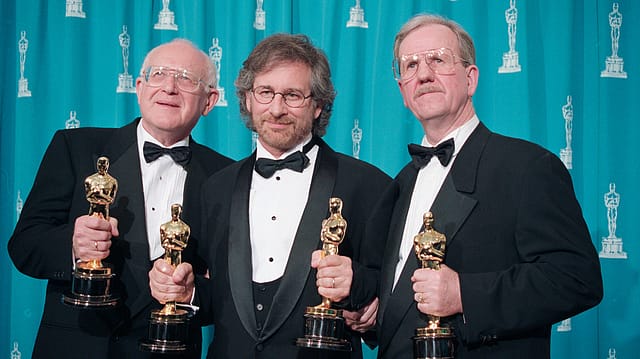
Spielberg, Molen and Lustig walked up together.
At the microphone, Lustig gave the room his camp number. He spoke of people dying in front of him, begging those who lived to tell the world what had happened.
Then, explaining what he had tried to do with that duty, he reached for the name he knew the man beside him by.
"Together with Jerry," he said.
One film could never hold everyone who wanted to speak.
In 1995, Lustig told The Chronicle of Philanthropy about the flight home from the film's Kraków opening. Spielberg came over to talk about the elderly people who had approached them during the shoot. How many survivors were still alive? What would it take to record them all?
Lustig remembered the practical objection that came back: it would be expensive.
Spielberg asked for a number.
Anyone who had worked on Schindler's List with Jerry Molen would have recognised that conversation.
Lustig helped lead the effort. Molen sat on the founding advisory committee. By late 1995, the Chronicle reported, volunteers were taking calls from survivors and their families, and crews were recording at least 64 testimonies a day.
In Los Angeles, one of the volunteers answering phones was Sigi Hart, who had survived ten camps. His children had heard fragments of his story. Recording it gave them a way to hear the rest.
Then came Branko's turn.
THE QUESTIONS JERRY ASKED FIRST
Read the published transcript, and you can feel the care in Molen's questions.
He doesn't rush to the camps. He lingers in the years before them.
Did Branko remember his grandparents? Which side of the family were they on?
And slowly, a lost world reassembles itself. A boy in Osijek walks to synagogue with his grandparents and eats at their table on Friday evenings. His father works at the hotel. His mother has sisters. Each of them enters the record one by one, because Jerry keeps asking about the people his friend loved as a boy.
Years later, Tablet journalist Allison Hoffman reported that Molen still choked up talking about that interview.
Follow the name Branko spelled at the start, and you begin to understand why.
Mirko vanished during the war. Branko and his mother survived. When they went home to look for him, they found an uncle and an empty house.
Then Branko told Jerry how his mother learnt the truth.
A dying man had sent for her.
At roll call in a Hungarian labour camp, he told her, a prisoner had laughed.
An officer threatened to shoot every second man unless someone owned up. The line stood frozen. Mirko stepped forward. He was shot.
The man telling her this, on his deathbed, was the one who had laughed.
On the tape, a son passes on what his mother heard from the only witness. By the time we learn how Mirko died, we already know where he worked, whom he married and how his little boy spent Friday evenings.
Jerry asked about those things first. He made sure Mirko arrived on the record as a man, before he arrived as a victim.
WHAT THE OSCAR COULD SELL
In 2012, Molen's phone rang about another film.
The caller was Dinesh D'Souza, an Indian-born American writer who wanted to make 2016: Obama's America, based on his book about Barack Obama. Molen, then 77, had read it. He told Hoffman he wanted the film to reach Americans who were undecided about the president.
At a conservative gathering, D'Souza invoked Schindler's List, and the audience cheered. A credit Jerry and Branko had earned together was now helping sell an argument in an American election.
Molen had been a Republican throughout his years with Spielberg, a Democrat. He remembered Saturday-night poker during Tootsie, when people could argue politics and still go out to dinner together. He spoke warmly of meeting Hillary Clinton when she visited Spielberg. Years later, he helped produce D'Souza's Hillary's America.
He saw a straight line through it all. Schindler's List had taught him how many people will come to a film about something they would never pick up a book to read. He wanted to use what he had learnt.
The film argued that Obama's presidency could be understood through the anti-colonial politics of his Kenyan father. An Associated Press examination found little evidence for that leap. The elder Obama left when his son was two and visited him only once afterwards.
Molen defended his choice publicly. June Beallor, a founding director of the Shoah Foundation, told Hoffman that he had every right to invoke a film he had produced. She also said, on the record, that she regretted his politics.
The argument followed him home to Montana. In May 2012, he arrived at a high school in Ronan expecting to speak to seniors. The principal cancelled the talk. Molen wrote in the local paper that he had spent three weeks preparing and believed his political views had cost him the invitation.
At a school board meeting, the principal, Tom Stack, gave his side. Callers had objected to Molen's politics, he said, and the teacher couldn't tell him what Molen planned to discuss or how it fitted the class. Students were free to attend Molen's public talk that evening.
That summer, the local paper photographed Jerry and Pat at the Mosaic restaurant in Bigfork, where they ate two or three times a week.
Pat died in 2024.
Nearly three years later, announcing his death, his great-niece remembered a man who started out moving set pieces. She wrote that he had passed on to join his dear wife Pat.
The man who wrote to her every day for ten months had finally closed the distance.
TAPE FIVE, TWENTY-SIX MINUTES IN
Go back to that house in Los Angeles. Go to tape five.
By now Branko has shown Jerry the BAFTA, the Golden Globe, the Oscar and the Emmys. In 2015, he would give his Schindler's List Oscar to Yad Vashem in Jerusalem.
But now he holds up something else, a photograph from Oscar night. He picks it out as his favourite.
There's Steven, and there's Jerry, and there are the three of them on the night they won.
Then Branko moves on to a photograph of the people who helped start the foundation. Once again, he names each of them for the record.
Lustig died in 2019. Now Molen is gone too.
If you want to find Jerry, don't look for the vet in Jurassic Park. Go to tape five, twenty-six minutes in.
The most famous man in that photograph needs only his first name.
The other one gets a proper introduction, even though he's sitting right there, still asking the questions.
Branko calls him "my friend, Jerry".