Emraan Hashmi sheds his bad boy persona
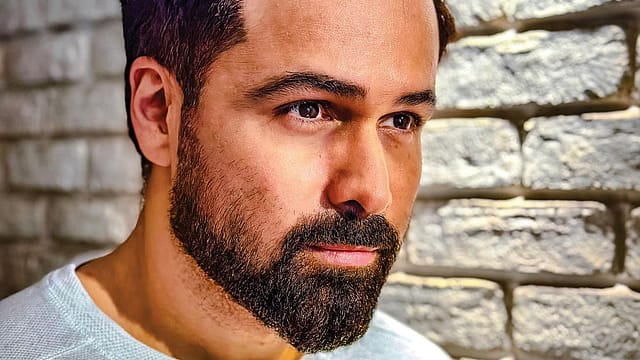
IT’S YELLED AT me wherever I go,” says Emraan Hashmi. “Airports, restaurants, when I travel abroad, it’s the line of last year. I didn’t expect it.” He is talking of the now-famous dialogue from the hit Netflix show The Ba***ds of Bollywood: “Akha Bollywood ek taraf aur Emraan Hashmi ek taraf (There’s Bollywood, and then there’s Emraan Hashmi)”. Bilal Siddiqi, one of the three writers on the show (the others being director Aryan Khan and writer Manav Chauhan) grew up on Hashmi’s films. “I wasn’t allowed to watch them in theatres but they played on cable TV all the time and I remember what a rage he was,” says Siddiqi, adding that he was quite certain that the line was going to land with the audience the way Khan, Chauhan and he had imagined it to while writing it. “We knew there were a lot of people who would relate to that sentiment,” he says.
And how right they were. Hashmi, 46, had agreed to be part of the show before hearing the extent of the role. And when the writers took him through the scenes, he was in splits. But even now, he seems surprised by the love that is coming his way from everyone, after years of being labelled a B-lister, a serial kisser and king of auto rickshaw-walas. The much-loved cameo has come along with a variety of mature performances in Tiger 3 (2023) as a Pakistani patriot turned coup plotter; as a BSF officer battling troubles in Kashmir in Ground Zero (2025); as a neglectful husband in Haq (2025); and most recently as a sharp customs officer in the hit Netflix series Taskaree this year.
It has given him a respectability he didn’t always get because much of his early filmography was studded with erotic thrillers—a particular genre popularised by Vishesh Films, run by his uncles Mahesh and Mukesh Bhatt. The formula of most of these films was simple: Hashmi shows up, mullet haircut and adventurous mouth in place, kisses the heroine, with or without her permission, serenades her with impeccably chosen ballads, and usually kills or is killed by the end of the film. Every time he tried to deviate from the formula, his core audience disapproved, whether it was rejecting movies such as Mohit Suri’s Awarapan (2007), where he plays a brooding hero with nary a kiss in sight, and Dibakar Banerjee’s Shanghai (2012) where he plays a small town soft pornographer with a late-developing moral compass. Parull Gossain, a friend and veteran publicist, remembers accompanying him to the screening of Shanghai in the single-screen theatre in Mumbai, and listening to disgruntled fans who were upset at the absence of kissing scenes.
Hashmi understands the gilded cage of box office triumph. “In this industry, both success and failure can drive you mad,” he tells me. “You have to keep a calm head, enjoy it and move on, pushing forward. You can’t expect a constant high in your career always. There will always be the pits, the falls and the rise, but if you get too demotivated in one of the slumps then it’s a sure shot way of self sabotaging your career. It comes from your inherent love for cinema. I’ve always believed in myself and my films. And I believe, apart from free will there’s also destiny. Sometimes the stars align and sometimes they don’t. Sometimes you might push as hard as you want but things don’t work. You shouldn’t be disheartened. If you’re honest in your work, things change. You just have to hang in there.”
In his case, Covid was a game-changer. “I found discipline in my life, I wanted to be ready. I worked on myself physically, emotionally, mentally, reading scripts, working out. I wanted to do it silently. Most of the hard work has to be done in the shadows. You have to let your work speak for itself. I have never doubted myself as an actor but there are so many things that need to succeed,” he says. His choices changed too, as he slowly climbed his way out of serial kissing hell with movies such as Chehre (2021), a thriller with Amitabh Bachchan; Dybbuk (2021), a horror film; and Selfiee (2023), a remake of Prithviraj’s Malayalam film Driving Licence, with Akshay Kumar. The appreciation started coming his way with Tiger 3, where he played a rogue ISI officer trying to overthrow the democratically elected prime minister of Pakistan, continued with his cameo as Ram Manohar Lohia in Ae Watan Mere Watan (2024), and then with Ground Zero and the Telugu film They Call Him OG (2025) with Pawan Kalyan.

But Hashmi’s early films gave him an edginess that young men admired. Here he was in Aashiq Banaya Aapne (2005) flirting with his best friend’s crush; there he was in Zeher, also in 2005, cheating on his supercop wife; and there he was again in Aksar (2006) seducing another man’s wife on his request. Not your typical Hindi film hero. And then in Jawani Diwani (2006), he decided to own it, by wearing a T-shirt emblazoned with the legendary ‘Serial Kisser’ while playing an aspiring singer who, yes you guessed it, cheats on his fiancé. All while singing soulful songs in the voice of Himesh Reshammiya or the late KK.
Suparn Verma who directed him in Haq says he is one of the most measured actors he has worked with. “He understands the material whether it is being said or unsaid. He doesn’t only understand the technical aspect of the lens but also the extent of body movement and emotion he needs to show. He comes from a secure space, it is all about the scene and I love the way he breaks it down. He tried out a few variations of his character Abbas in court and got what I wanted immediately. Some actors spoil you for life. Emraan Hashmi is one of them,” says Verma.
Hashmi is quite self-aware. “I have a certain resilience,” he says, “a certain confidence in myself, and have never sought external validation. You seek it from your own narrative,” he adds. It comes from his upbringing, he says, which was quite distant from the noise of Bollywood movies, even though his grandmother was the famous actress of yesteryear Purnima. She didn’t have much hope from him, when she saw his first photoshoot with Amisha Patel for a film by Tanuja Chandra, Yeh Zindagi Ka Safar (2001). It was so bad that Patel refused to work with him (Jimmy Shergill starred in the film). Mahesh Bhatt recalls Purnima throwing those photos away saying he lacked presence.
Indeed, Hashmi has come a long way from those days, says Bhatt, who was persuaded to hire him as an assistant upon the insistence of Purnima, his mother’s sister. Hashmi’s father was in Air India, and the boy had just completed his undergraduate studies from Sydenham College. “She held a gun to my head and said I must do something about this boy,” recalls Bhatt.
Bhatt did, casting him in Footpath (2003), as Aftab Shivdasani’s excitable gangster friend, and then the lead in Murder (2004) opposite a ready-to-shed-her-inhibitions Mallika Sherawat, as her former lover-turned-stalker and blackmailer. The movie, with its kissing and lovemaking scenes, went much further than most Hindi films of that time. It also set the template, forcing Hashmi to repeat himself if he wanted to remain successful. Now that he has broken free of what had once become a trap, he is free to explore different kinds of men. He says, “The hyper-masculine man works for some reason in cinema right now. It works in our culture too, like the angry young man did for Bachchan. Right now you have to be morally ambiguous to get ahead in life. But it is everywhere, in social media, news channels, so why are films alone put in the dock?”
Hashmi lives quietly but comfortably in Mumbai’s Pali Hill with his wife of 20 years, Parveen Shahani, and his son Ayaan, now 16, who was diagnosed with cancer in 2014 and around whose recovery Hashmi wrote a book with Siddiqi called The Kiss of Life (Penguin, 2016). Siddiqi has known Hashmi since 2014, when he was introduced to him by writer S Hussain Zaidi. “Emraan was gracious enough to launch my first novel, Bard of Blood. After that I worked on his book. He starred in the Netflix adaptation of Bard of Blood (2019),” Zaidi says. “Professionally and personally, he’s like an elder brother who I turn to for advice even on the silliest things. Emraan has been an integral part of my life.”
Just as he has been for so many people, a guilty pleasure which has finally been widely accepted.