Dhurandhar: The wave that has engulfed the box office and the popular consciousness
Lajpat Nagar IN DELHI IS A RABBIT WARREN OF SMALL HOUSES, grocery stores, and food outlets, bordering one of the city’s oldest second-hand furniture markets. It was in one such house, B-62, that Aditya Dhar grew up, now immortalised as the name of the studio he set up five years ago with his brother Lokesh. The clip accompanying the studio announcement shows two boys sitting in front of a black-and-white television attached to an antenna, as it was during the 1980s, watching an animated film.
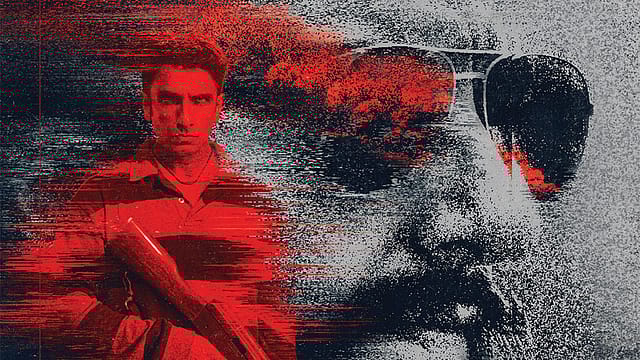
The journey from there to one of Hindi cinema’s most sought after directors, after delivering two hits in a row, totalling ₹2,350 crore and still counting, has been a long and arduous one, full of false starts and unexpected outcomes. Dhurandhar, released last year, and the latest, Dhurandhar: The Revenge, with a combined budget of ₹350 crore, have become part of the national conversation, a cultural moment that may have polarised emotions but has also united moviegoers in discussion. Using a storyline that fictionalises recent events to fit into a nationalist myth, hyping it with intelligently remixed classics, and choosing an unusual ensemble of actors to further the narrative, Dhar has created a cinematic phenomenon that has become fodder for social media memes and the subject of a million on-ground arguments about the nature of propaganda. From veteran FTII-trained Rakesh Bedi’s iconic dialogue in the film, “Bacha hai tu mera (You’re my child)”, being used by Delhi Police in a helmet drive, to making it to an Amul advertisement, the movie’s impact is everywhere.
Dhar has, in short, become the nation’s storyteller, telling it the tale it wants to hear at a time of great uncertainty. Like another more powerful storyteller, he is weaving a narrative of India as a tough state that knows the art and science of neutralising its enemies either by killing them with all manner of weaponry or leaving them to die by slow poisoning. This kind of fabulism is followed by the military industrial complex in America and used to justify their wars across the world, from Vietnam to Afghanistan, from Born on the Fourth of July (1989) to Zero Dark Thirty (2012).
The two part film that follows the structure of a streaming series, Dhurandhar and Dhurandhar: The Revenge chronicles the factional life of Jaskirat Singh Rangi, who is sentenced to life imprisonment, but is picked up by spymaster Ajay Sanyal (representing National Security Advisor Ajit Doval), trained in the dark arts of espionage and plonked down in the middle of Lyari, a part of Karachi notorious for its gang wars. There, as Hamza Ali Mazari, he is expected to become the king of jungle and emerge as a critical asset, destroying the Pakistan deep state’s diabolical designs on India, stretching from 26/11 to Operation Sindoor.

While the first part of Dhurandhar dealt with Hamza’s inflitration of the Lyari gang, becoming the most important aide of Sher-e-Baloch, Rehman Dakait (Akshaye Khanna), who is part of the network that exports drugs, guns, fake currency and terror into India, in the second part, Dhar traces Jaskirat’s transformation into Hamza on Sanyal’s watch, and his eventual demolition of the ISI network in Pakistan. But as the films acknowledge, the Pakistan deep state is a network that was built in the aftermath of its humiliating defeat in the 1971 war (which makes Indira Gandhi the eventual hero, as it was also she who set up RAW under Rameshwar Nath Kao) and it is one which will continue to inflict damage to India by a thousand cuts.
The two movies cinematically settle scores with Pakistan for all the havoc it has wreaked in India, from the IC814 hijack in 1999 to the 26/11 assaults of 2008 to the Uri attack of 2016. It also cleverly, and controversially, links demonetisation to fake currency emanating from Pakistan. And through it all, it links all these acts of terror to Bade Saab, who turns out to be a much diminished Dawood Ibrahim (just in case we missed it, Dhar puts up the infamous photo of Dawood above his bed—yes, subtlety is not his strong suit).
Pop Culture Phenomenon
Dhurandhar is the creation of a committed filmmaker who has a sound grasp of language, popular cinema and music. Dhar, now 43, grew up in the era of Boney M’s ‘Rasputin’ and ‘Tamma Tamma’, two songs which underline key moments in Dhurandhar: The Revenge. Not much of an academically inclined student, he spent time watching movies and TV, and playing cricket while studying at Guru Harkishen Singh Public School in Vasant Vihar, and later did Hotel Managment from IHM Bangalore. Like many millennials, his artistic sensibility cuts across genres, allowing him to use the Usha Uthup song ‘Ramba Ho’ (from Armaan, 1981) as the soundtrack to a gunfight, and Khaled’s Didi (1991) as a Baloch celebratory song. Music is in his DNA—his mother Sunita Dhar was a disciple of sitarist Debu Chaudhuri and performed on All India Radio and on stage. She became Dean of the Department of Music and Fine Arts at Delhi University between 2000 and 2003 which saw the family moving into a spacious accommodation on campus. The veena riff in Raga Khamas on the Dhurandhar: The Revenge song, ‘Phir Se’, by Carnatic prodigy Ramana Balachandran may well be a tribute to her.
While filmmaker Priyadarshan has been quoted as saying that Dhar was cheated on a place in the Under-19 Team India, there is no record of him playing cricket professionally. It is true, however, that when Dhar moved to Mumbai in 2006 to make a career in the movies, he struggled for years. He was an assistant director to Priyadarshan on Aakrosh (2010) and Tezz (2012), writing dialogues, and also wrote lyrics for fellow Delhiite Kabir Khan’s Kabul Express (2006) for songs like ‘Kabul Fiza’ and ‘Banjar’. He didn’t always get credit for his work, most spectacularly with the biopic of an athlete which he helped bring to fruition and which he took to a well known director. When a project finally clicked, ‘Raat Baaki’, a romcom with Fawad Khan and Katrina Kaif, as part of a three-part deal with Dharma Productions, Pakistan struck in Uri, killing 19 Indian soldiers. Pakistani actor Fawad Khan had to be dropped. ‘Raat Baaki’ went into developmental hell before Dhar produced it as Dhoom Dhaam (2025) under his own banner starring Yami Gautam who was by then his wife. He turned adversity into an opportunity, wrote Uri: The Surgical Strike and pitched it to Ronnie Screwvala. With a budget of ₹44 crore, it made ₹345 crore at the box office in 2019, making “How’s the josh” a national catchphrase.
Uri was the film where he began scripting a story that fit into a pattern that suits the establishment. It also began his creative use of Ajit Doval’s character with Govind Bhardwaj played by Paresh Rawal in the movie masterminding the strike. The fascination with Doval reached its peak with Ajay Sanyal in Dhurandhar who picks Jaskirat for the job in Pakistan. Yet there was a gap between Uri and Dhurandhar. That was when he was developing ‘The Immortal Ashwatthama’ with Vicky Kaushal but had to cancel it because of budget constraints. It was a fruitful time as a producer though—he produced Article 370, for which he had given the story; Dhoom Dhaam, which he had written; and Baramulla, which he had also written the story for. Article 370 and Baramulla, both directed by Aditya Suhas Jambhale, shed light on Dhar’s other obsession, Kashmir. As a Kashmiri Pandit, Dhar may not have directly experienced the pain of the exodus of his community from the Valley but he has enough extended family that can vouch for the feeling of helplessness that they felt when they left their homes in 1990, never to return.
A New Action Hero
This trauma humanises the killing machine that Hamza is. When he goes home at the end of Dhurandhar: The Revenge as Jaskirat, his family doesn’t see him or recognise him. As the song ‘Phir Se’ by Arijit Singh plays in the background, the lyrics echo the sentiment: “Phir se naina bhare/Samjhe te hum/Gham hai khatam/Dil hi na mane” (My eyes fill with tears again/I had thought my sorrows are over/But the heart doesn’t agree). The lyrics of folk singer Satinder Sartaaj in the Jasmine Sandlas anthem also make sense: “Saanu sariyan visar gaiyaan rahvaan/Ve kehde paase jaiye sajana” (I’ve forgotten every path I once knew/So which way should I go now, my love?). Like the Kashmiri Pandit, Jaskirat too can never return home. Home will always remain as a recollection now, with the ghosts of terrorism still haunting the Valley, which is the story of Baramulla.
One could argue that few people have weaponised a community’s pain as effectively as Dhar. But the facts are undeniable. Kashmir has been the greatest casualty in the undeclared war between India and Pakistan and the Kashmiri Pandit community has lost the most, their homeland, their memories, their history. As the Nusrat Fateh Ali Khan qawwali, also used most effectively in Dhurandhar’smusic director Shashwat Sachdev’s cross-cultural soundtrack, says: “Jaan se guzarte hain/Dil pe zakhm khaate hain/Jurm sirf itna hai/Unko pyaar karte hain (We go through life/enduring wounds to the heart/Our only crime is this/That we love you)”.
Hamza is a new kind of action hero, a brutalising force with the soul of a balladeer, a Zen Buddhist in warrior gear, one who cries when he is burning his keepsakes, one who panics when faced with a friend from his past, and one who orders tea for two to honour an old friend. Ranveer Singh’s characterisation of Hamza and Jaskirat is neatly done, showing great control on his breath and mastery over his emotions. It adds to an impressive filmography full of genre-bending characters: the wannabe wedding photographer from Delhi in his debut Band Baaja Baraat (2010), the errant heir apparent in Dil Dhadakne Do (2015), the evil Khilji in Padmaavat (2018), the quietly ambitious slum rapper in Gully Boy (2019), and the exuberant rich brat in Rocky Aur Rani Kii Prem Kahani (2023).
Singh’s Hamza is cunning when he has to be, ready to sacrifice his family, and not above betraying his friends when he has to. Says Ram Gopal Varma, whose films Satya (1998) and Company (2002) have been influences on Dhar: “He has set fire to the hero template in Indian cinema. His is the old style fireside storytelling with multiple climaxes to tie up all loose ends.”
The Story behind the Scenes
It wasn’t easy to make Dhurandhar. If Dhar dreamt it, Jyoti Deshpande, President, Jio Studios (Media and Content Business, RIL) gave it wings. As she says: “Dhurandhar was never an easy film to greenlight because it defies every conventional norm. Typically, decisions are driven by genre, star power, and cost and commercial viability, but this film didn’t readily tick those boxes. The real challenge was mounting a large-scale film, expensive, adult in tone, with significant violence, largely set in Pakistan, and featuring predominantly Muslim characters with a narrative that was front-footed and harder than any other film had ever attempted in the past.” But these, she adds were what made it “clutter-breaking and epic.”
Deshpande considers Dhurandhar to be as much a success for the audience as the producer. If Dhurandhar has taught us anything, it is that the audience is far more evolved than we often assume. They are ready for complex narratives, longer formats and unconventional themes, as long as the storytelling is truly immersive. The film’s success reinforces our belief that theatrical audiences today are seeking experiences, not formulas.”
Deshpande spent considerable time with Dhar during the scripting and pre-production/casting and then during editing and post-production. Principal photography was handled by Lokesh (Dhar’s brother and co-founder of B62 Studios who worked with UTV for distribution in the US). Jio Studios has partnered with Dhar on all their productions so far: Article 370, Dhoom Dhaam and Baramulla. They developed ‘Ashwatthama’ together and hope to make it one day.
Dhar was able to make everyone involved believe in the film, live its vision, breathe its philosophy and inhabit its world, Mukesh Chhabra, the casting director, endorses that. Dhar’s brief was incredibly clear and at the same time, challenging in the best way. Says Chhabra: “We actually spent almost four months just thinking about every single character before we even began auditions. We did extensive research, collecting data from across India—from all kinds of actors—so we could find faces that felt real. The idea was to create a mix of authenticity, blending real people with slightly fictionalised characters.” The best part is, he says, “there’s no confusion. It was just the two of us taking decisions, very instinctively. He believes strongly in his vision, and that clarity reflects in the work. We went through a massive amount of data—countless faces—while also keeping certain reference images in mind. At the same time, we were quietly looking for new people who matched those faces, without revealing what we were casting.” Chhabra also notes casting moments that happened organically. “For example, Mustafa— who was initially around in a different capacity and training with Ranveer— ended up becoming part of the cast (as a fellow spy Rizwan). Aditya immediately took the call and encouraged him to step in as an actor. That spontaneity, combined with preparation—that’s what made this journey so special.”
The films have breathed fresh life into the careers of many actors, from Akshaye Khanna who stole the show as Rehman Dakait in the first film, to comedic actors Rakesh Bedi and Gaurav Gera who performed their mostly serious roles with élan to young actor Udaybir Sandhu who lost 12kg to play Pinda, Jaskirat’s friend, over a period of time.
Impact on Hindi Cinema
Varma says the attention to detail is because Dhar is extremely emotional, someone who feels strongly about every character. “Everyone in the film gets their moment,” he points out, and “he is the first person to give credit to his team. Most directors tend to treat character artists as labourers. He speaks to everyone with equal patience, explaining their role.” He compares his stylisation of violence to Oliver Stone in Natural Born Killers (1994). “It is at once celebratory and psychological, putting you in a trance with its sharp use of music.” It is also a throwback to the movies of the ’70s and ’80s, says filmmaker Rohan Sippy, when multistarrers were the norm. Sippy worked briefly with Dhar and calls him an old school auteur, who can visualise his film in its entirety and bet big on it.
If this moment feels important for the industry it is because Dhar has broken most of the rules held dear so far. He has also buried forever, or at least for now, the idea that cinema could be a prayer for peace. A film like Veer-Zaara (2004), made by a man who still believed in united Punjab would be impossible now, as was evident in the poisonous reception for Sriram Raghavan’s anti-war epic Ikkis last year. The generation of filmmakers represented by greats such as Yash Chopra and Manmohan Desai is gone, as are those who drew inspiration from them. Dhar represents the millennials who have entered the film industry carrying their own scars, stories and sounds. Just as Anurag Kashyap redefined the Juhu-Bandra kind of filmmaking with his iconic two part Gangs of Wasseypur in 2012, Dhar has questioned the accepted grammar of filmmaking.
The industry tried to co-opt Kashyap with Bombay Velvet (2015) and then spat him out when it failed, leaving him to find his way back with indie films. Right now, the bosses of Bollywood are looking at their inventory and trying to see how to offload movies that look dated, even childish in comparison. It isn’t going to be easy. As Sippy says, switching horses midstream is difficult, and the idea is not to replicate Dhurandhar but to make something new.
Dhar has also not gone out of his way to curry favour with the industry, and the rightwing ecosystem that has adopted him has been particularly harsh on filmmakers and critics it perceives as anti-national, because they have spoken or written against his work. Perhaps Dhar should remember his own advice. “Your duty is to uphold dharma/Never to claim the reward/Let not the promise of victory guide you/The battlefield summons/ be relentless in action.” It is the opening placard of Dhurandhar: The Revenge and is from Chapter 2, Verse 47 of the Bhagavad Gita.
Something for Dhar to recollect as he savours his much deserved success.