Dhurandhar: Framing the New Nation
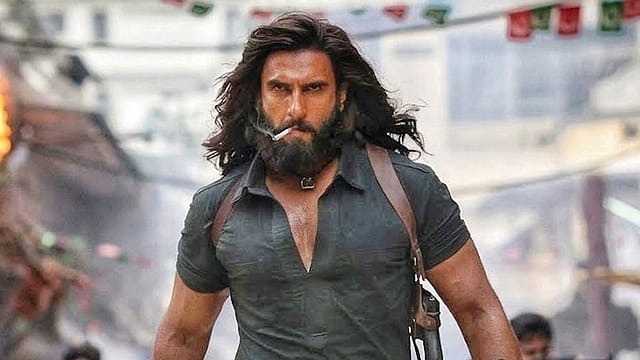
THE AUDIENCES thronging multiplexes to see the film Dhurandhar and the swiftness with which screening halls scheduled multiple screenings a day underline the irrelevance of cinema critics who have found to their dismay that their efforts to curate public sensibilities has failed spectacularly. The three-and-a-half hour movie is a tour de force that holds audiences spellbound throughout with just a few outbreaks of appreciative laughter at the light touches in an otherwise taut film. But Dhurandhar does more than deflate the egos of overrated cultural commissars. It is, all at once, an exposé of how political calculations and timidity hobbled India’s fight against terrorism and an unapologetic expression of an audacious new self-belief that is redefining the form and content of national identity and popular culture.
To begin with, the art of the film is gripping. The action unfolds almost entirely in Karachi’s sprawling Lyari neighbourhood and the sets and locations render the setting convincingly, transporting viewers into the congested lanes and the brutal violence unleashed by rival criminal gangs. The seamless convergence of the gangs that rule Lyari and Pakistan’s Inter-Services Intelligence (ISI) that uses criminal overlords in organising terrorism against India could not have found a better backdrop. Car chases and excessive gore run the danger of coming across as over the top or even kitschy but that never happens. Dhurandhar is a remarkably well-made film and every frame is like an unputdownable book whose pages the reader keeps turning till the end. The romantic interludes are the only diversions though these too are skilfully woven into the plot.
To deride Dhurandhar as propaganda exposes the bias of the onlooker. If a film espousing a robust nationalism— Bharatiya Janata Party (BJP) stalwart LK Advani had coined the term prakhar rashtrawad (being intensely nation first)—is propaganda then many films like Saving Private Ryan or Zero Dark Thirty might be similarly classified. The truth is that labelling a film that runs contrary to elite tastes as ‘propaganda’ is lazy and betrays a politicised mind. It never strikes the purveyors of such opinionated commentary that they practise the very intolerance they accuse ‘majoritarian’ narratives of perpetuating. Then again, there is a sense of loss and displacement as films like Dhurandhar mercilessly rip the subterfuge and dissembling that dress up claims to superiority of a particular aesthetic that is actually a doctrinal tenet. Aditya Dhar’s film is an exhilarating gust of fresh air that loosens the imagination and opens closed minds.
Despite cinematic licence, Dhurandhar is convincing because its makers have paid attention to the details of real-life events. The development of the character of ISI’s Major Iqbal essayed by Arjun Rampal is based on the shadowy handler of 26/11 plotter David Coleman Headley, a Pakistani American, who surveyed the targets of the Mumbai attacks. Major Iqbal finds mention in the affidavits filed by the Federal Bureau of Investigation (FBI) that resulted in Headley, previously Daood Gilani, being awarded a 35-year sentence for the 2008 Lashkar-eTaiba (LeT)-ISI plot and for planning a terror attack on Danish newspaper Jyllands-Posten for publishing offensive cartoons of Prophet Muhammad. A ProPublica report in May 2011 stated that during his testimony, Headley revealed Major Iqbal deployed him on five reconnaissance visits to Mumbai to scout targets that included a Jewish Chabad House where the 26/11 gunmen later shot dead three American rabbis. Major Iqbal is described as a slightly podgy, moustached chain smoker and while the well-built Rampal is obviously different, he brings out the ISI role in using criminal gangs to plan terrorism against India effectively. The Lashkar Karachi control centre that directed the Mumbai massacre in real time is accurately recreated.
The charge that Dhurandhar is “communally” motivated and targets a particular religious group reveals a deep political divide and heightened polarisation in the India of today. The debate replicates itself in several discussions, whether about the study and portrayal of Muslim invasions and Islamic rule in the medieval India or the appraisal of leading figures of India’s independence struggle, such as Jawaharlal Nehru and Sardar Patel. Indeed, it can be argued that foreign rule, first in the form of Islamic conquerors and then followed by British colonialism, continues to shape and inform attitudes and our understanding of nationhood. Yet, the allegation that Dhurandhar is a divisive trope and equates an entire community with violence is puzzling. The crime of the filmmakers may lie in providing an unvarnished account of terrorism unleashed by Pakistan-based organisations like Lashkar which are wedded to the cause of India’s destruction. Lashkar’s particular interpretation of Islam, replete with religious slogans, and the general radicalisation of Pakistani society are brought out plainly as is the hatred for ‘Hindu’ India. There is no suggestion that all adherents of a religion—certainly not Muslims living in India—support the barbarous deeds or ideology of the killers. In fact, the film in good measure dwells on the internecine politics and violence in Karachi as the patron-client relationship between Rakesh Bedi’s Jameel Jamali and Akshaye Khanna’s Rehman Dakait (who is a Baloch) turns into rivalry and Jamali resuscitates disgraced cop Chaudhary Aslam (played chillingly by Sanjay Dutt) to finish Baloch. The same goes for Baloch’s confrontation with Pathan criminal lord Arshad Pappu.

The ‘red screen’ readouts as the actual voice recordings of satellite phone conversations between the Karachi control centre handler—believed to be Lashkar operations in-charge Sajid Mir—and the Mumbai gunmen play out are graphic but not a gratuitous flourish intended to incite audiences. It is a numbing record of what Pakistan did to India that fateful November in 2008 and serves to bring out the inadequacy of the Manmohan Singh government’s response. The Congress-led United Progressive Alliance (UPA) government settled for a diplomatic blitz and a long freeze in ties with Pakistan rather than military reprisals. Yet the film is also critical in dealing with the Vajpayee government’s handling of the 1999 IC 814 Kandahar hijack and the December 13, 2001 attack on Parliament. The plan to infiltrate Pakistan’s criminal-terror network scripted by intelligence official Ajay Sanyal, based on intelligence czar Ajit Doval, is taken up only after the Parliament attackers almost succeed. Sanyal’s efforts to present a plan that radically alters India’s reactive approach to terrorism is dismissed by a character who portrays former Research & Analysis Wing (RAW) chief AS Dulat, known for his dovish views and who backs the misplaced Aman ki Asha (hope for peace) initiative that sought to build cultural connections with Pakistan.
The Kandahar hijack remains one of India’s darkest hours and BJP has been regularly reminded of the capitulation that saw the late Jaswant Singh accompany three terrorists, including Maulana Masood Azhar, who went on to set up the Jaish-e-Mohammed (JeM), and Daniel Pearl’s killer Omar Sheikh. The response to the attack on Parliament was more forceful resulting in Operation Parakram, a nine-month long mobilisation on the western border, but that is not touched on in the movie.
The 26/11 carnage was a very serious blow to India and there was an intelligence warning as made out in Dhurandhar about an impending attack by sea. The target was not specified—nor does the film claim it was—but the tip-off did say that a small boat was being used to transport a group of terrorists. The film makes it more dramatic by depicting the infiltrated Indian agent played by Ranveer Singh being witness to the training of the terrorists in Karachi. Yet, the larger point remains. The Karachi control room dictated the actions of the terrorists right down to wanting to hear the victims at Chabad House beg for their lives and the sound of the gunshots that killed them. The Indian response played to Pakistan’s expectations that after the passage of time, prodded and pushed by the US and other nations, the two sides would begin talking again.
As things turned out, UPA did not pay a price for 26/11. Congress returned to office with a tally of 206 seats in mid- 2009 that was a considerable improvement on the 145 Lok Sabha seats it had won in 2004. Manmohan Singh chose to read the popular mandate as an endorsement for his pro-engagement policy and not only did he meet then Pakistan Prime Minister Yusuf Raza Gilani but agreed to a reference to Pakistan having “some information on threats in Balochistan and other areas” in a joint statement—a suggestion of India’s role in the unrest. The joint statement had to be denounced in the face of a fierce backlash which saw BJP roundly criticising the government but did not lead to substantive changes in India’s security posture.
THE IMPORTANT ROLE accorded to Doval’s screen representation played ably by Madhavan, the reference to the intelligence community’s wait for a “bold leader” and the celebratory cry of “ghar mein ghus ke marenge” can be read as an endorsement of the Modi government. The prime minister has often enough used the “we-will-enter-your-house-to-punish-you” formulation to articulate India’s preparedness to use military force against terror targets in Pakistan. While Dhurandhar’s release is well timed, coming as it does after Operation Sindoor, its makers could hardly have anticipated events. What the film projects through well-utilised cinematic tools and a script that effectively uses commonplace idioms is the sea change in India’s security doctrine. And the change does not relate to intelligence and military matters. It is about the boldness in breaking the self-imposed shackles that had held back successive governments from developing and using hard-power options against an inveterate foe and an accompanying shift in the national mood. Sometimes films are made at a time when many things come together and capture a seminal moment. Chetan Anand’s 1964 film Haqeeqat brought out the desperate odds Indian troops faced in the morale-sapping defeat in the 1962 war with China and its dispiriting aftermath. The 1973 film Zanjeer that launched Amitabh Bachchan as the “angry young man” brought out the resentment of an era over an increasingly corrupt and failing system. Feroz Khan’s Qurbani (1980) caught the popular imagination for its fast-paced crime-thriller action and emerging modernity of India of the 1980s. The 1995 film Rangeela broke the box office and the mould with its trendsetting music and a story of gritty lower middle-class aspiration that replicated the energy of the 1990s. Dhurandhar is a seminal movie that sums up the political-cultural shift that has accompanied Modi’s rise and the concomitant rightward shift in Indian society.
Critics of Dhurandhar do not stop at knocking its cinematic values. They are incensed by its defiance of the left-liberal order long used to ruling by fiat. The omerta imposed by a powerful cabal meant dissenting voices were quickly extinguished while many in tinsel town chose to quietly fall in line fearing an abrupt end to their careers. Over the past few years filmmakers, no doubt encouraged by BJP’s ascendance, have treaded into no-go territories. For a film industry that prided itself on mapping tales of displacement and conflict, Bollywood was blind to the plight of Kashmiri Pandits forced to flee almost overnight as a rising tide of Islamic extremism overran Kashmir Valley. Vivek Agnihotri’s The Kashmir Files (2022) drew audiences who had never been told of the murders and rapes that accompanied the ethnic cleansing of Pandits, the 1990 exodus and their reduction to being refugees in their own country. Article 370 (2024) told the story of the political subversion of Jammu & Kashmir’s accession to India in 1947 and how the region’s “special status” ended up promoting separateness and division—the opposite of what the measure was supposed to achieve. The deep ideological rift Dhurandhar exposes is not going away anytime soon. The opinion that views the advent of the Modi government in 2014 as an unmitigated disaster and believes nothing good has happened since is unlikely to change itself. Its sense of cultural dispossession is profound and the showdown between the two sides is nothing short of a clash of civilisations.