Before Shraddha Kapoor Played Vithabai, Vithabai Turned Down Raj Kapoor
In Mumbai, one Diwali, people bought tickets to see Vithabai Narayangaonkar dance even as rain threatened to wash out the show. They had a proposition for her. If it rained, she could keep the money. It would be their Bhau Beej gift, the kind a brother gives his sister.
It rained. In Marathi biographer Yogiraj Bagul’s account of that evening in 1971, the audience went home chanting “Bhau Beej, Bhau Beej”. Nobody asked for a refund.
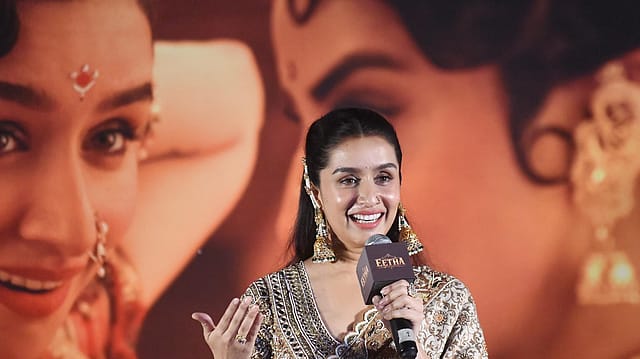
Fifty-five years later, a Mumbai filmmaker is asking people to buy a ticket on the strength of her name again. Laxman Utekar’s Eetha, inspired by Vithabai’s life, is scheduled to open on December 4. Shraddha Kapoor plays the lead. She has been quite candid about where she had to begin. “I didn’t know lavani at all when I signed the film,” she reportedly said in one of her interviews.
Hot Pursuit
27 Nov 2026 - Vol 01 | Issue 02
The Shah Doctrine of Internal Security
Kapoor could sing. Anybody who had seen ABCD 2 or Street Dancer 3D knew she could dance. What would it take for her to play a woman an audience had once paid the compliment of treating as family? Vithabai’s daughter Mangala left us a fair idea. Years after her mother died, she could still sing the words Vithabai had for a man who mistook the price of a ticket for permission to wink at her.
The part Shraddha had to grow into
Shakti Kapoor’s daughter got her first Hindi film, Teen Patti, and an early education in what a famous surname could do for its owner. “Teen Patti gave me a taste of failure,” she recalled. The part that made her a star came three years later. In Aashiqui 2, Aarohi sings in a bar. A famous musician hears her and gives her the break that changes her life.
Shraddha was rather more enterprising on her own behalf. When she heard that the makers of Rock On!! were considering a sequel, she rang producer Ritesh Sidhwani and asked him to consider her. She went on to sing her character’s songs. She had found two things she liked doing and a part that let her do both.

The more revealing entry in her filmography is Haseena Parkar. In 2017, still in her twenties, Kapoor took on the role of Dawood Ibrahim’s sister across several decades. Reviewing the film for The Indian Express, Shubhra Gupta found her convincing as the young wife and mother. As Haseena grew older and more powerful, Gupta found herself noticing the padding in Kapoor’s cheeks and the effort she put into deepening her voice. The character’s grip on the people around her was harder to believe.
Utekar gave her an unusually tough way to revisit that problem. He began filming Eetha with the second half and the climactic song. On the shooting schedule, the young dancer would get her turn later. The woman who had already spent years in command of a stage was required for work first.
Why Vithabai turned down Raj Kapoor
When Vithabai was thirteen, her sisters Keshar and Manorama sang the lavanis and she danced to their voices. Their father Bhau and uncle Bapu ran a travelling tamasha troupe. A child born into this family in Pandharpur in 1935 could acquire quite an education before getting anywhere near the front of a stage. According to Dainik Prabhat, Vithabai had already worked with a theatre company by the time she joined her father’s troupe.
Tamasha could take a village audience through a song, a comic exchange and a full-fledged play in the course of a performance. Lavani gave a woman an extraordinary freedom within it. She could pick out a man, address him as intimately as she pleased and let everybody else in on what she thought of him. It took some judgement to do that night after night before the people who paid her wages.
By the time Raj Kapoor offered Vithabai a film role, she had another set of people to consider. A Pune obituary records that she turned him down. Mangala later told BBC Marathi that about fifty families depended on the troupe. Film stardom, as her mother saw it, would benefit her alone. Vithabai did dance in Marathi films, among them Umaj Padel Tar. What she declined to do was leave the stage for a career in cinema. In 1970 she established a troupe under her own name.
One of the numbers for which people remembered her was Nesali Pitambar Jari, a baithakichi lavani. Vithabai performed it seated. Even exponents of classical music admired her rendition, the Pune report recalled. Consider what that leaves an actor to work with. The audience can hear the words. What makes it worth watching this particular woman sing them?
The woman with the packed suitcase
At her home outside Pune, Shakuntala Nagarkar kept most of her trophies in a drum on the terrace. The things she needed for work went in a suitcase in her bedroom. When Dipanita Nath profiled her for The Indian Express in 2023, it held a nine-yard sari, make-up, jewellery, ghungroos and the pills she took every day. She was being treated for lung cancer.
Nagarkar had her own history with audiences. At a concert in Delhi, she recalled, a classical dancer had slighted her. Nagarkar had been allotted half an hour. An hour into her performance, people were still asking for more. The organisers finally brought it to an end after two hours. Reading her account, you understand why a filmmaker might want Shraddha to spend a week with this particular woman.
Nagarkar gave the Eetha workshop seven to ten days while undergoing treatment, choreographer Vaibhavi Merchant told Variety India. Kapoor also trained with lavani performer Akshay Malvankar. The traditional ghungroos she learnt to wear weighed four kilos apiece. On the second day of shooting the climax, she injured herself dancing barefoot. Merchant recalled a break of roughly six weeks to two months before they resumed, with physiotherapy built into the routine.
Of all the instructions Kapoor received, one sounds simple enough until you try to follow it. In Kapoor’s recollection, Nagarkar told her she could acquire the steps through practice. “But what you have to express through your face, you will have to understand.” Nagarkar died in September, aged 66.
There is a way to hear what she meant. In September 2004, in the village of Kada, historian Shailaja Paik interviewed Mangala Bansode. The daughter sang her a lavani her mother had performed in the 1960s. Its guest is winking at the dancer with his left eye. She has seen him, understood him perfectly and would like him to show some manners. Then comes her reason for being there in the first place. Potasathi nachatey mee. I dance to earn my living.
That is the part in Eetha I’d buy a ticket for. Can Kapoor let us enjoy the cheek of a woman who has caught a man winking, and make us hear the working woman who has had to say this before? Anyone who saw her as Aarohi already knows how readily she can make an audience feel for the girl on stage. Vithabai could make a paying customer think about his own behaviour on the way home.
The baby behind the curtain
The son born during a performance at Shikhar Shingnapur in Satara district was Kailash. He grew up with a rather less sentimental recollection of the woman at the centre of that story than a cinema audience might expect. “My mother was never the soft, cuddly sort,” he told Scroll.
His sister Mangala remembered being on stage when their mother went into labour. Vithabai went behind the curtain while the others continued performing. The audience began calling for her. In Mangala’s account to BBC Marathi, her mother reappeared carrying the newborn. The people who had been clamouring for Vitha took a look at the child and went home. They could see her dance another day.
Another version survives. In 2002, after seeing Vishnu Mathur’s documentary on Vithabai at Mumbai’s NCPA, film critic Meenakshi Shedde wrote that Vithabai returned to the stage and took encores. Mathur had been given a day and a half to film her for the Sound and Picture Archives for Research on Women. His camera barely left her kholi, her room. He did have time to record the way she talked, which may be the greater kindness he did posterity.
She spoke of throwing men out of her green room when they came expecting sexual favours. Her experiences of men in the film industry had given her further cause to prefer the theatre. And then there was Maruti Sawant, the man she had loved. Vithabai could give a fairly unflattering account of her husband and still find precisely the words to explain his appeal. “But if you fall in love with a donkey, then angels don’t interest you.”
What she carried in her name
The name over the troupe was Vitha Bhau Mang Narayangaonkar. Bhau was her father. Mang identified her Dalit community. Narayangaon was the village with which her family had made its name. Each time the troupe advertised a performance, all three went with her.
In June, some of her children and a grandson objected to the title Eetha and asked for Vithabai’s full name. Mangala subsequently said the family accepted the title. A second objection concerned the name of the character on screen, which leaves out both Mang and Narayangaonkar. Utekar has described the film as a work inspired by her life. The choice still carries a consequence for anyone meeting Vithabai for the first time in a cinema. How would they know what she had chosen to carry with her?
Vithabai had explained it herself. During the 1962 war with China, she went to the North-East Frontier Agency to perform for Indian troops. Speaking at a conference in 1996, she recalled meeting soldiers there from the Mahar and Mang communities. Their country expected them to defend it with their lives. Back home, she said, people “would not even allow our bridegroom to pass through the village entrance”.
By then, her own company had folded. Family members told the BBC that Sawant had taken loans in her name and that she was heavily in debt when she left him in 1982. Four years later, a Marathi newspaper columnist found the celebrated artiste travelling on public buses and looking for cheap rooms. In 1990, the year she received the Sangeet Natak Akademi Award for tamasha, she disbanded the troupe. Mangala, who had started working in her mother’s company at seven, had by then set up one of her own.
Vithabai went on to help secure state pensions for tamasha artistes. On January 15, 2002, she died at KEM Hospital in Pune. Dr Banoo Coyaji, a hospital trustee, had seen to it that the charges were kept to a minimum. The bill came to ₹5,900. Her children raised ₹4,000.
In Mumbai one Diwali, her audience had let her keep the price of admission to a show she never gave. In Pune, a local Congress worker named Dhananjay Thorat, the Marathi Natya Parishad and a few admirers of tamasha put together the last ₹1,900. Her children could take her home to Narayangaon.