Art for Life's Sake
When Imtiaz Ali's last film Main Vaapas Aaunga, was released on June 12 this year, it seemed to sink like a stone. “It tanked,” admits Ali. Then, slowly, in the second week, word got around that the film was special, one of the best of the year. Ali started on the first of his 50-odd theatre visits, and found audiences unwilling to leave even after the last song that connects exiles of various kinds.
“They would be talking, crying, in a cathartic group huddle, not only about the film but of their experiences,” Ali says. “It was as if something had calcified within them and was waiting to be broken. People are looking for opportunities to cry about their unresolved feelings. It was therapeutic. It was people telling me, where were you? This is what we wanted. We are told the audience is distracted but here were young people watching the film unblinking,” he adds. The film was simple enough to be consumed despite its sophisticated theme. It got people to research the history they did not know and educate themselves.
In a way, it was perhaps the collective unconscious asserting itself, restoring the primacy of love and belonging to public life, in a sea of divisive, violent and rage-driven movies and shows. When it finally left theatres, it had made Rs 99 crore, on a budget of Rs 70 crore.
No one suffers in love as beautifully as an Imtiaz Ali character, and Main Vaapas Aaunga was proof of that. Based on extensive research and several conversations with Partition survivors, Ali realised that when all other memories faded, these remained true: the tree flowering outside their old home, the girl who would come to their father’s shop, the boy who would pass by their street on his cycle. Beyond the ugly politics, the haphazard borders, and the nasty rhetoric, there was an innocence that remained, no matter where the exiles came from.
This was the love they never forgot, when all else was swept away. “In the movies and books about Partition, I felt this aspect was never mentioned, whether it was by Saadaat Hasan Manto, Ismat Chughtai or Krishan Chander, or in Tamas or Garam Hawa,” says Ali.
This couldn’t have been effected by anyone more committed to romance and identity as Ali is. Ali, 55, has spent much of his career sending his actors off into the unknown, looking for themselves and that particular person who will complete them.
The Jamshedpur-born Ali is now producing another marathon on love, this time in the form of ‘O Saathi Re’, an upcoming series on Netflix, where he reunites with three actors from different parts of his life. There’s Avinash Tiwary, a malleable actor who gave his all to Laila Majnu (2018), a film Ali produced; there’s Aditi Rao Hydari, who got the short end of the stick in Ali’s Rockstar (2011); and Arjun Rampal, his hostel mate from Hindu College, where Rampal studied economics and Ali studied English.
'O Saathi Re’ takes its name from a particularly maudlin song by Kishore Kumar for Amitabh Bachchan in the tearjerker Muqaddar ka Sikandar (1978). “The idea was that if remixed songs have such a hold on us, why not a rearranged series which take the same emotion but update it for today’s times. It’s a feeling that is vintage,” says Ali, adding what he likes about Hydari is her total surrender to her character. She works with her total heart and mind. “She’s a dreamer but also smart, a real believer,” says Ali. The series begins in a courthouse, where a couple has come to get divorced. Due to the bureaucratic process, they have to spend some time together. Conversations begin, and things come to the surface. Through flashbacks, they explore what happened and why they want a divorce.

This will be the third production from Window Seat Films, Ali’s production house, born of his ability to write scripts faster than he can direct them. “This way, I know, they will at least get made,” he says. ‘O Saathi Re’ is directed by his brother Arif, who directed two seasons of She (2020-2022) on Netflix. “But I directed a few scenes of ‘O Saathi Re,’ just to get a sense of the relationships.” clarifies Ali.
Ali’s men are usually tortured beings, like Janardhan in Rockstar who thinks he needs to have his heart broken to produce great art, or Ved in Tamasha (2015) who is forced to be something he is not, his corporate tie literally acting like a noose. His women are also made to jump through the hoops before they find the love of their life, whether it is the bubbly Geet in Jab We Met (2007) who becomes a hollow shell of herself when let down by her boyfriend, or Meera in Love Aaj Kal (2009) who waits patiently for the playboy Veer (Saif Ali Khan) to realise he loves her.
Ali’s body of work reaffirms one’s faith in filmmakers, in their artistry and their integrity, even as he aims to tell the best story possible rather than put together the most saleable project probable. But he has his regrets, most notably on When Harry Met Sejal (2017), a movie he would like to remake as a series, which traces Harry’s journey from Punjab to Canada, and then to Europe, and what made him a man who was constantly in search of love to fill the gaping void left in him from a place he used to call home. “It was supposed to be a tender romance about a man who has been let down by a series wicked girls. I would have liked to see more of that world explored in a non linear way,” Ali says.
Ali remains an old fashioned, seat-of-the-pants filmmaker, more concerned about telling the story rather than think of the movie as a mathematical venture. “We are here because we wanted to make films for the love of it, not thinking of it in a strategic sense,” he says. “You cannot reverse engineer a script to ensure it is a success. But the industry obsession with box office numbers has trickled down to audiences, who also seem to be more concerned with numbers rather than revel in the happiness of listening to stories.”
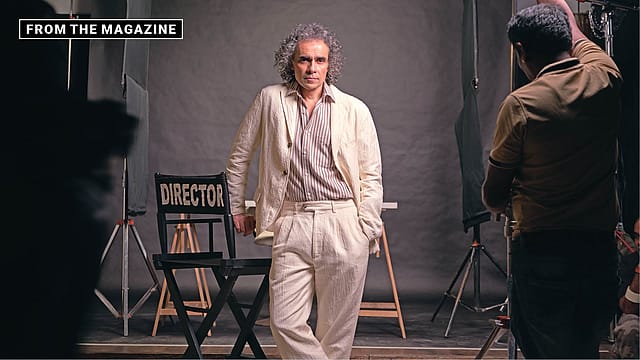
Ali has become a bona fide brand beyond cinema, in the consumable, marketable style the world understands. Here he is in an ad for home furnishings with actor Mrunal Thakur, there he is in a fashion magazine wearing Christian Louboutin trainers and verses form his songs on his shirt, and there he is again judging a short film contest for phone brand. A campaign for a sound company, a curated collection for a men’s fashion brand, and an appearance as himself in 2025’s Metro: In Dino directed by Anurag Basu, and Ali clearly is enjoying stepping out of his comfort zone. “I feel very embarrassed by the way I look. I feel it’s too rough and I don’t comb my hair. And I don’t look in the mirror. I’m a bit of a nervous personality. I will never get over that,” he jokes, self consciously touching his salt-and-pepper curls, describing his trademark look of unruly hair, loose trousers and kolhapuri chappals or Onitsuka Tiger sneakers. “However, most of the things I do is for friends. My first instinct is to refuse. There was a time I did some ramp walking. That was only because I felt this is the last thing I would feel comfortable doing. I can jump off a cliff with a rope tied to my ankle but I can’t walk the bloody ramp. So I did it as a way to embrace my fears. Now it’s coming out of people’s ears. This photo shoot I did for a fashion magazine is so stylish now people think I wear clothes in a carefully constructed manner in a way that is described as casual yet classic,” he says with a laugh.
Ali is one of a new breed of writer-directors who came to Mumbai via Delhi, infusing a fresh new idiom to his characters, starting with the runaway bride in his first film Socha Na Tha (2005), starring Abhay Deol. Among others who came to Delhi via university or advertising were Anurag Kashyap, Shoojit Sircar, and Dibakar Banerjee.
As a boy would love to watch movies at the two theatres attached to Karim Mansion in Jamshedpur, where he lived with his aunt. He could go there whenever he wished, and watch films from the projectionist’s box.
His films are infused with that imagination as well as his life experiences, which he tries to infuse in the actors he takes under his wing, whether it was Vedang Raina and Sharvari in Main Vaapas Aaunga or Ranbir Kapoor, who has often spoken of the transformative experience of work-ing with Ali, who would take him to Nizamuddin Dargah in Delhi and make him sit there for hours to absorb the spirituality for Rockstar. Or of freeing Alia Bhatt of the Juhu-Mumbai trap in the movie that got everyone to notice her, Highway, in 2014.
Though Ali developed his love of theatre in DBMS English School, in Jamshedpur, it was in Hindu College, Delhi, that it bloomed. He was part of Act One, the theatre society set up by NK Sharma, and he travelled through the country, experiencing the sights and smells of India—and also developing a lifelong love for planes, trains and automobiles which his characters are forever taking on their unending journeys, many into Punjab which resulted in one of his most acclaimed movies, Amar Singh Chamkila for Netflix in 2024.
Writing and directing the life of a man who was ready to die for his art, now that is something right up Ali’s street of all or nothing.