Ancient Myths, Modern Blockbusters: Why The Odyssey Speaks to Us Today
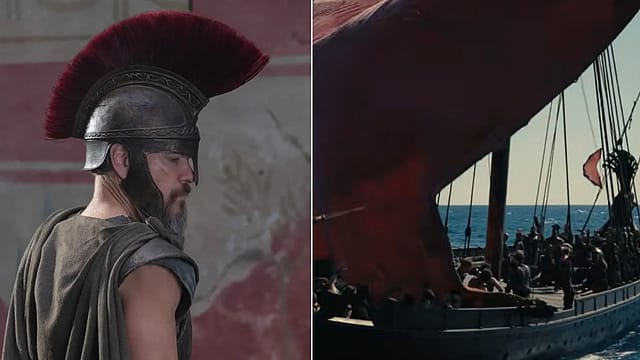
The film of the summer in London and worldwide has undoubtedly been Christopher Nolan’s The Odyssey, which grossed over $1 billion at the box office in the first month worldwide (₹100 crore in India in the first week and the same again in the second) and has sparked an interest not only in the text but also in learning ancient Greek. It has also created a new group of ‘experts’ who haven’t read the text but have seen all the reviews. They mostly divide into those who discuss Homer’s epic and those who discuss the film. This is not a review, nor am I claiming any great expertise, though I first read (part of) the Odyssey in Greek 50 years ago, but rather a look at why this 3000-year-old epic that was once regarded (and I hope still is) as one of the foundations of European culture has found a new audience today.
The Odyssey, whose Greek text is now taken to be the product of oral performances rather than composed by a single person called Homer, is usually dated to around the eighth century BC. The language shows traces of older and diverse forms of Greek, but is set in the late Bronze Age—that is about the 15th-12th century BC or the Mycenaean period. Although the Greek text is largely fixed, it has been translated and retold many times, whether as novels (the most famous being James Joyce’s 1922 Ulysses, the Latin name of Odysseus), poems (Derek Walcott’s Omeros, 1990) or episodes in novels such as Madeline Miller’s Circe (2018). There have also been earlier film versions, such as Ulysses directed by Mario Camerini in 1954 in which the hero is played by Kirk Douglas—later used in a scene in Cinema Paradiso (dir. Guiseppe Tornatore, 1988). A more recent version is the wonderful The Return directed by Uberto Pasolini (2004).

Zeroing In on ECI
09 Oct 2026 - Vol 05 | Issue 41
Constitutional legitimacy versus political opportunism
The story takes place after the Trojan War and hence after the Iliad. It tells of the return from the Trojan War of Odysseus, King of Ithaca, the heroic soldier, renowned for his strategic acumen, and skills of persuasion and cunning. He was favoured by the war goddess Athena because of his athleticism and cleverness. He is most famous for his plan to use a wooden horse to smuggle Greek soldiers into the walls of Troy. The horse is not mentioned in the Iliad, the epic of the war, but it is in the Odyssey; however, the long version is not found until Virgil’s Aeneid. The Odyssey is about the hero’s journey home to Ithaca, through adventures where he has to use his skills to confront monsters (Cyclops, the Sirens, Scylla and Charybdis, and the Laestrygonians), seduce goddesses (Circe, Calypso), and embark on a journey to Hades. He alone of his men reaches home to kill the suitors who have been living in his palace, in the hope that he will never return so one of them can marry his wife, Penelope, and take the kingdom, deposing his son, Telemachus.
Odysseus himself tells much of his story, showing again his skill with words, and his willingness to do anything to get home, even if it takes him 20 years. He is shipwrecked and suffers many storms en route, as he becomes the enemy of Poseidon, God of the Sea, after killing his son, Polyphemus the Cyclops. Athena remains close to him and persuades her father, Zeus, Poseidon’s brother to help him indirectly.
Christopher Nolan is one of the most successful commercial film directors of all time, behind only Stephen Spielberg and James Cameron. His films are known for their epic scale, complex narratives and, although blockbusters, great sophistication. The Odyssey is very much part of his grand style, a technological feat, using non-linear narratives with great performances by major stars. It is an amazing new version of the Odyssey.
Much has been made of details which can be jarring, such as the Viking-style longboat; the palaces from a much later era; Agamemnon dressed as Darth Vader; Penelope (Anne Hathaway) sitting to weave and wearing bright colours. This is not a history lesson but a film and is unmissable as such. What I missed however were humour and wit in the flat dialogues which could have done so much more.
The battles with the monsters are gripping, and the violence in particular that unfolds during the last half hour. This is when Odysseus returns in disguise and is recognised by his servant, Eurycleia, as she washes his feet and notices his scar, and his faithful dog, Argos, who is made to live on a rubbish heap, waiting for his master’s return, lifting his head and wagging his tail feebly before dying (handkerchief alert).
Other brilliant high spots include Circe turning Odysseus’ men into pigs by pulling and twisting their faces after they pigged out (yes) on some horrible food, though she seemed more cat lady than seductive witch. The Cyclops snacked on Odysseus’ men, but I almost felt sorry for this cheesemaker who they didn’t bother to find out could speak, and so blinded him in his sleep. I was rather disappointed not to see any gods manifest apart from Athena who didn’t look like her traditional depictions, seeming more like Odysseus’ conscience rather than a goddess.
What the film fails to do is to help to understand a very different place and time. Odysseus seemed a (post) Christian European, rather than a Greek hero. He was tormented by guilt for breaching what the film calls ‘Zeus’ Law’, or rather xenia, the laws of hospitality which apply to both host and guest (the word xenos means stranger and guest, connected to xenophobia, fear of strangers). He has visions of the desecration of the Athena’s Palladium temple in Troy, when Ajax raped Cassandra (here shown as the beheading of a statue). Yet he has no angst about killing the Cyclops or Penelope’s suitors who were treated as guests in his home.
Greek warriors had a different set of values from those which at least some of the audience share today, based on Enlightenment and subsequent values. They sought qualities including arete (virtue, excellence) through bravery and athleticism, time (public honour), kudos (acclaim) while avoiding aidos (shame). In the Iliad, Odysseus and others approach Achilles to ask him to return to the war when he is sulking in his tent, his honour slighted. He refuses and says his mother, the Nereid named Thetis, had told him there were two fates he could choose. One is to fight and die but achieve everlasting fame, and the other was to return home, live long and have no glory. He chose the former.
Nolan shows Odysseus briefly consulting Agamemnon and others who emerge from the underworld, but he chooses not to show Odysseus’ visit to Hades where he finds his mother has died in his absence and he meets Achilles. Achilles says that he wished he had taken the second option and would rather be a poor farm worker on earth than king of the underworld.(The Iliad takes place over 51 days of the 10-year war, its main subject being the quarrel between Achilles and Agamemnon over honour. It ends with Hector’s funeral and Achilles’ death is foretold, although he does not die in the Iliad.)
In contrast, Odysseus has accumulated time (honour) not just through his bravery and fighting skill but also through his cleverness and cunning. The story of the Odyssey is about how he deploys all his skills to survive impossible odds, to get home to his family and his kingdom, managing to combine the two alternatives—glory or long life at home—that were presented to Achilles.
Readings of the Odyssey, and other ancient epics, are ways in which we can access eternal human issues as well as learn to understand the values of different times and places. We mustn’t flatten them by judging people by our contemporary values. And yet some things seem less different than they might. Achilles’ mother tells him he can win aphthiton kleon which can be construed in Proto-Indo European as the same form as the Sanskrit word, akshitamsravas, both meaning ‘eternal glory’, found in Rigveda 1.9.7. Is it significant that the number of the suitors is 108 and that they have to win the bride in a sort of swayamvar that involves stringing a mighty bow? Just a thought.