Vande Mataram for Muslims: A truncated version of the national song could hurt Congress
WHAT DO INDIAN Muslims find objectionable in four of the six stanzas of ‘Vande Mataram’? The objection is to the third, fourth, fifth and sixth stanzas of India’s national song. These four stanzas refer to India as the motherland. Muslims object to defining India in spiritual terms as an inner deity signifying idol worship in a temple. These are considered haram in Islam. They are explicit in the third and fourth stanzas. But it is the fifth stanza which Muslims regard as the most provocative to the tenets of Islam.
The translated text by Sri Aurobindo of the fifth stanza in ‘Vande Mataram’ makes an unambiguousconnection with Indian goddesses: “Thou art Durga, Lady and Queen, with her hands that strike and her swords of sheen. Thou art Lakshmi lotus-throned, and the muse, Saraswati…” Islam is monotheistic. It forbids Muslims bowing before anything or anyone other than Allah. During the freedom struggle, ‘Vande Mataram’ became a focal point. The Indian National Congress was aware of Muslim objections to the last four stanzas of Bankim Chandra Chattopadhyay’s song.
Muhammad Ali Jinnah was an added complication for Congress. The All-India Muslim League headed by Jinnah condemned the polytheistic idolatory the song championed. Two events now took place in quick succession.
Jinnah’s All-India Muslim League met for its annual session in Lucknow from October 15-18, 1937. It passed what came to be known as the Lucknow Declaration, launching a campaign against ‘Vande Mataram’ as a future national song.
In order to appease Jinnah, the Congress Working Committee (CWC) immediately set up a sub-committee headed by Jawaharlal Nehru and comprising Subhas Chandra Bose and Maulana Abdul Kalam Azad. The sub-committee passed a resolution on October 28, 1937 that only the first two stanzas of ‘Vande Mataram’ (which refer to India’s geographical landmarks) should be sung.
But Jinnah wasn’t appeased by the CWC sub-committee resolution cutting ‘Vande Mataram’ down to its first two stanzas. He demanded a total ban on the song. The stalemate continued for two years. Mahatma Gandhi stepped in to break the stalemate. He knew the cost to the cause of Indian freedom of communal tension between Hindus and Muslims.The Mahatma’s compromise formula was to drop the entire song at venues where individuals (even one individual) objected to the song. Jinnah rejected this compromise as well. Instead, his Muslim League passed the Lahore Declaration in 1940 demanding Pakistan. Seven years later, Jinnah got Pakistan amid communal bloodshed and permanent rancour.
In India, the Constituent Assembly met for its final session on January 24, 1950, two days before India became a Republic. At the Constituent Assembly’s final session, ‘Vande Mataram’ was officially recognised as India’s national song and ‘Jana Gana Mana’ as the national anthem. But for the next 75 years, only the first two stanzas of ‘Vande Mataram’ were sung at official events. That changed in August 2026 when the BJP-led NDA government passed legislation to make singing all six stanzas of ‘Vande Mataram’ mandatory at official events.
Crucially, the new law, passed on August 11, 2026, does not make it mandatory for individual citizens to sing ‘Vande Mataram’ but to merely listen without disruption as per the Prevention of Insults to National Honour (Amendment) Act, 2026.
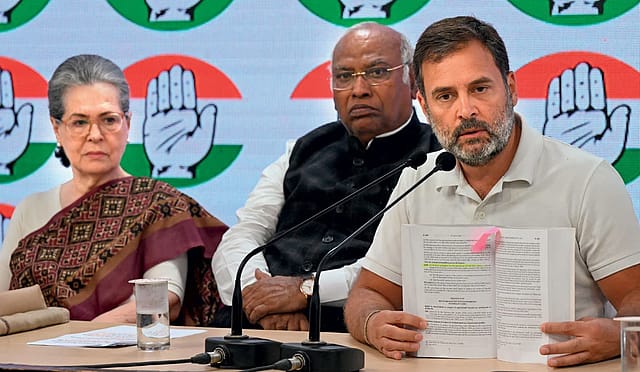
The controversy around ‘Vande Mataram’ has done exactly what the government expected and the opposition feared: sharpening the divide between Hindus and Muslims. The opposition relies on Muslim votes for over half its vote share. Congress dependency on Muslim votes is even greater. Without Muslim votes, it would be extinguished. Taking a leaf out of the CWC sub-committee’s 1937 resolution, the CWC met on August 19, 2026 to declare that only the first two stanzas of ‘Vande Mataram’ would be sung at Congress party events.
The issue will be fully exploited during the Uttar Pradesh Assembly election due early next year. ‘Vande Mataram’ has an emotional appeal to most Indians. With Congress taking a hard stand against the full rendition of ‘Vande Mataram’, it could be seen as approving Jinnah’s pre-Partition politics of Muslim appeasement. That could exact a political price in 2029.