Zero-sum Era: De-globalisation follows the logic of war
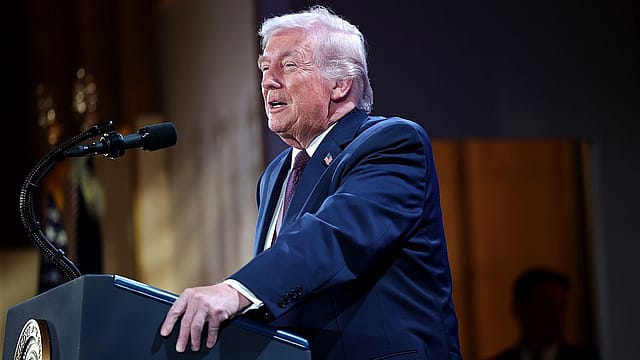
THE END OF GLOBALISATION began in the first term of US President Donald Trump, but after a longish period of slow burn, that world order— geoeconomic as much as geopolitical— is in ashes. The match was lit early in Trump’s second term, as the US unleashed unprecedented economic warfare on the world, bombarding friends and foes with tariffs. Now, the pyre burns in the Strait of Hormuz, even as much of the world gasps for a steady and affordable supply of energy. Globalisation was about win-win. The de-globalisation on display is lose-lose.
Globalisation had its share of critics, most of whom frowned on the apparent inequality of the system, between nations and within nations. Of course, the rich countries grew richer but so did many poor countries. Globalisation enabled China to rise to become the second-largest economy in the world and a serious power rival to the US. It also enabled India to become the fourth-largest economy in the world and an important middle power. As the two countries which had the most number of people living in a state of poverty, China’s and India’s rise also lifted from poverty more people than at any prior period in history.
Of course, there were nations which did not succeed, large parts of Africa for example. But the blame for that cannot be laid at the door of globalisation. Domestic conditions did not create an enabling environment to benefit from the global zeitgeist. There would also be examples of people within nations who got “left behind” but again this was because their own countries did not invest sufficiently in their human capital. Globalisation benefitted those who could harness its upsides while mitigating its downsides.
For all its flaws, it will be missed. The Trump tariffs did much damage to the free movement of goods and supply chains in many parts of the world. But it was a disruption that could still be managed. The genie that has been unleashed in the war on Iran will be harder to deal with. It certainly won’t go back into the bottle.
In the tariff wars, the world saw that there was only one country which could stand up to America’s unilateralism—China. That is because it had leverage with a near-monopoly on the supply of rare earths and many critical minerals. After Iran, the notion of what constitutes leverage has changed. In a free-for-all world, stripped of even a pretence of rules and order, Iran has shown that it is possible even for the apparently weak to exercise leverage over the strong. And this isn’t about a missile arsenal. Instead, it’s about its ability to control or disrupt a key economic corridor: the Strait of Hormuz. The Islamic Iranian regime has been around for 47 years, in a constant struggle with America, Israel, and Arab countries. But Hormuz had never been weaponised, until now.
When the world descends into disorder, key sea routes, land routes, even air corridors can be weaponised, imposing a high cost on an adversary or even friends. In many ways, instruments which choke the global, regional or national economy are as potent, if not more, as weapons.
This is not to suggest that every country will viciously turn on the others. But a precedent has been set. From an age of rules and cooperation, we have arrived in an age of no-rules and weaponisation of economics.
Globalisation followed the logic of the market economy: everybody gains when there is free trade in goods and services and free movement of people. De-globalisation follows the logic of war which is a zero-sum game: one country’s gain has to be at the expense of another. When disrupting others to promote one’s self-interest becomes the guiding philosophy of a world order, it weakens everyone over time, never mind the nationalist rhetoric. The world is heading down a slippery slope.