Unruly Kingdom: Leadership mess mirrors the UK’s slow growth
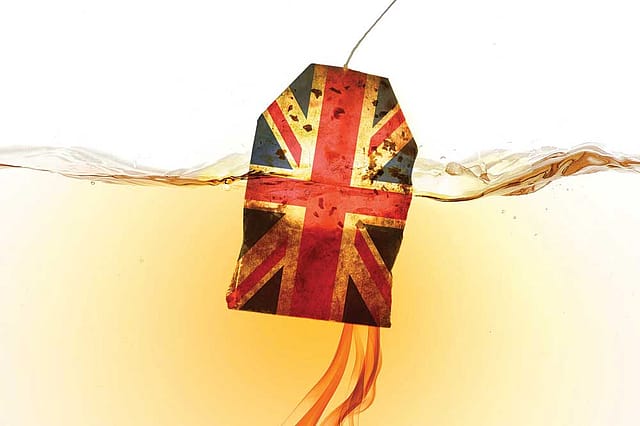
THE UK, THE WORLD’S fifth-largest economy, is set to get its seventh prime minister in 10 years. It’s a dubious record. Especially when you consider that voters have chosen single-party majorities in that period. In that way, it’s different from Italy’s past, infamous record of a frequent turnover of prime minister owing to fragile coalition governments. Neither the Conservatives (2016-24) nor Labour (2024-present) have had to deal with multiparty coalitions. It’s just that the top man (there have been four) or top women (there have been two) can’t retain, for very long, the confidence of their MPs and the public. Were they all unfit for the highest office? Unlikely. More likely, it’s because it is a very difficult task to lead a country in decline.
An argument can be made that the UK has been in a long decline. After all, it was the preeminent global power for much of the 19th and early 20th centuries until it was upstaged by America. Today, it’s a middle power at best. As an economy, it was first overtaken by America and then by Germany and Japan in the post-war years. And, more recently, by China. India was bigger, too, until recently when the rupee lost value. Unlike the US, China, Germany and Japan, the UK has no great manufacturing sector to speak of. In fact, if it were not from London’s status as a global financial centre, the UK’s relative decline may have been even more acute. The prosperity of London and the south hide the much bigger decline that has happened in other parts of the country.
But the long arc of history isn’t the only explanation. A more recent event from 10 years ago has precipitated the decline— Brexit. It also started the processions of prime ministers. The parts of the country which voted more overwhelmingly for an exit from the European Union (EU) werealso the parts that were more deprived, where standards of living had stagnated or fallen. A motley group of politicians— some believers in British exceptionalism, other believers in political opportunism, painted membership of the European Union as the primary cause of the UK’s woes—its immigration policies, its bureaucracy, its domination by Germany and France. They narrowly won the argument, but it turns out that the EU wasn’t the villain of prosperity.
The UK economy has grown slower than the EU in the 10 years since Brexit. The UK has lost a competitive edge in what remains one of the two largest markets in the world. At the same time, it has been blindsided by Donald Trump on deepening its economic ties with its “natural ally”—the UK has always felt culturally more at ease with the US than continental Europe. On its own, with neither manufacturing nor market, the UK will struggle to grow at a decent rate.
Ironically enough, in its welfare state, the UK is much more like the Europe it chose to distance itself from. That is a huge fiscal burden and doesn’t leave enough resources for productive investment by the government. Its utilities, which are privately owned, charge market fee on the use of water and energy. After the Russia- Ukraine war and the Iran crisis, energy, in particular, has become much more expensive. For a government, there is nothing worse than slow growth and rising costs.
In a tight spot, the spotlight inevitably falls on the leader. And the leader invariably falls. The populists on the left and the right offer no solution but do offer distractions. The former may nationalise utilities and provide cheaper energy and water. The latter may crack down on immigration. The populists can perhaps buy time for themselves, but for their country, it is time for reckoning. What will it take for Britain to be great again?