Tunes of Democracy: Why did Bhojpuri songs result in the defeat of a party?
Another recent instance reflecting the close relations between songs and politics concerns the celebration of 115 years of VD Savarkar’s iconic patriotic poem turned into the song ‘Sagara Pran Talamalala’ (‘O Sea, my soul yearns for you’), for which Union Home Minister Amit Shah gave an inspiring speech unravelling the relationship of songs and nationalism. This could be read as an intervention to reinterpret our cultural heritage with a new nationalist optics.
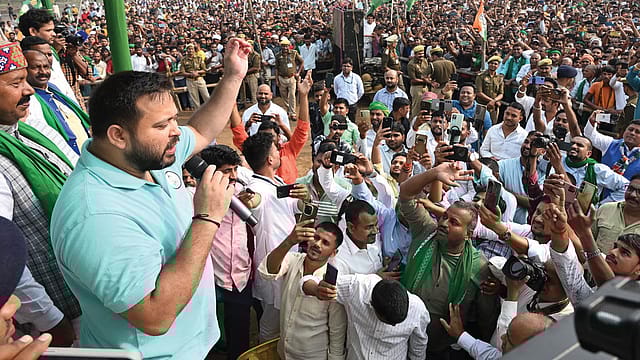
A third instance indicating a different relationship between songs and politics was demonstrated during the recent Bihar Assembly election. News reports after the results analysed how some songs sung by a few Bhojpuri singers also contributed to the Rashtriya Janata Dal’s (RJD) defeat. Feedback was received that some Bhojpuri songs sung in favour of RJD ultimately created a negative image of the party and its leader Tejashwi Yadav among the voting public. As a result, RJD issued legal notices to 32 star Bhojpuri and other folk singers. According to some RJD leaders, lyrics like “Aayegi Bhaiyya ki sarkar, banenge Rangdar” and “Marab sixer ke chhaw goli chhti me, Lathiya ke jopr se laltenawa” hurt the image of the party. Songs which glorified violence, evoked casteism and feudal pride, while praising RJD politics, fitted well with the ‘Jungle Raj’ image of RJD. An important RJD leader said that such songs helped in producing counter-polarisation against RJD.
It’s interesting to unravel how a song known for its entertainment value could also cause the defeat of a strong political party like RJD. It reminded me of the use of these songs by Prime Minister Narendra Modi at various rallies to rekindle memories of Jungle Raj in the public’s mind—memories of Lalu Prasad which were transferred to Tejashwi.
Why did Bhojpuri songs result in the defeat of a party? Political analysts say elections are all about perception and narratives. These songs contributed to the negative perception of RJD and its leader. The songs circulated on platforms like YouTube and had lakhs of views, expanding the impact on the larger public.
Even if a section of Bihar’s population felt pride in these songs, among the larger non- Yadav population, they generated fear based on the assumption that RJD would return to power and criminals and goons would become dominant. The songs projected the rangdars (mafia who extort money from ordinary people at gunpoint) as icons and sang their praises. The songs also created the impression that becoming rangdars should be an aspiration of the youth and claimed RJD’s return to power would fulfil that aspiration.
As politics becomes more complex, to understand it, we need to read and touch its delicate threads. We have entered a time of psycho-political mobilisation in which cultural devices, media perceptions and image craft are going to be central to electoral politics. The meaning of politics has expanded to include intangible cultural forms for messaging and mobilisation.