The Stories We Inherit: Love and memory shape kinship across generations
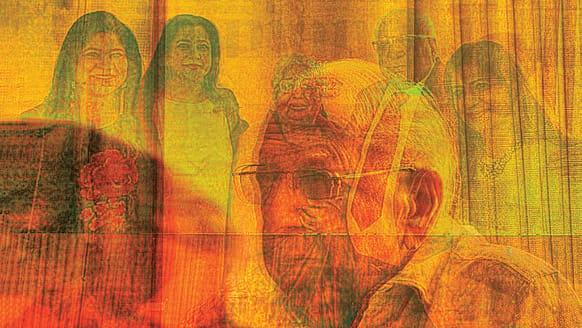
BEFORE BIJI UNCLE says anything, his eyes have already entered the conversation. He comes into a room with the most beautiful, disarming smile, but also with the quiet alertness of a lifelong journalist. His gaze travels gently— registering who is present, what they are wearing, what remains unsaid, who is restless, who is radiant. He seems to take the political, personal and emotional pulse of a gathering before offering it the benediction of his voice.
Biji—Brij Lal Bhardwaj to the professional world—is my maternal grandfather Chaman Lal Bhardwaj’s younger brother. Yet family arithmetic has its own mischief. He was closer to my mother’s generation than my grandfather’s, while his daughters— Manjula, Anupama and Neelima—were our maasis but felt like our friends. Neelima, younger than I, was nevertheless my aunt. Childhood thus taught us early that kinship is not a straight line but a luxuriant banyan: roots descend, branches cross, generations play hide-and-seek.
Our great-grandmother Saraswati Devi had children across so many years that mother-in-law and daughter-in-law were once pregnant together. She could nearly have raised an Indian cricket team. That astonishing vigour gave us not merely numbers, but an inheritance of nearness: a vast family that has argued, eaten, mourned, celebrated and remained connected.
At Biji Uncle’s home, affection arrived plated. Adarsh Aunty, a teacher and magnificent hostess, made memorable matar paneer and kheer. Her table was sumptuous without show, abundant without anxiety. She died a few years ago, but taste is memory’s most tenacious archivist; one spoonful recalled can reopen an entire dining room.
Biji Uncle’s other archive is India itself. Born in Lahore, he remembers tongas to school, Anarkali Bazaar, Basant kites above the family rooftop, mangoes and cold milk beside the canal, and his father’s shop on The Mall, where Western music played and a boy touched the piano. Then came the Partition: schools closing, slogans curdling the night, departure for Simla and a home left behind.
Yet he never narrates Pakistan as though Partition divided humanity itself. For him, Partition built a toxic fence across a geography where people had loved, laboured, dreamed and desired in kindred ways. When I reached Lahore, I rushed to Anarkali because Biji, my grandfather and my nani had burnished it in memory until it shimmered like folklore.
His life became a front-row seat to a nation forming itself. At Hindu College, influenced by Ram Manohar Lohia, he became Prime Minister of the College Parliament. He worked at the Indian Express while studying, then spent more than three decades at the Hindustan Times. He reported courts and crime, industry in Kanpur, land reform, the Congress split, and Kashmir, where bombs struck Srinagar airport and dogfights scarred the sky. Aviation carried him across continents; journalism returned him to Lahore, took him into Afghanistan as Soviet power receded, and trained him to look beyond official versions of history.
The names of Biji and his elder brothers, Manohar Lal and Chaman Lal, once opened doors wherever journalism was respected. To me, more importantly, they opened the door to language. I wrote for my school magazine because Nana had written and Biji still wrote. They taught me that words were neither decoration nor debris, but duty: thought threaded into garlands, carrying witness, wisdom and wonder from one generation to another.
Now, in his nineties, Biji still writes, questions, remembers and arrives. In him I see my grandfather’s continuum and understand what elders give us: not nostalgia, but navigation. That is why I write of him now, while he can still read it. Elders are bridges built of stories. If we listen while they are still speaking, we inherit not only where we came from, but how to remain human while going forward.