The Provincials Are Withering Away
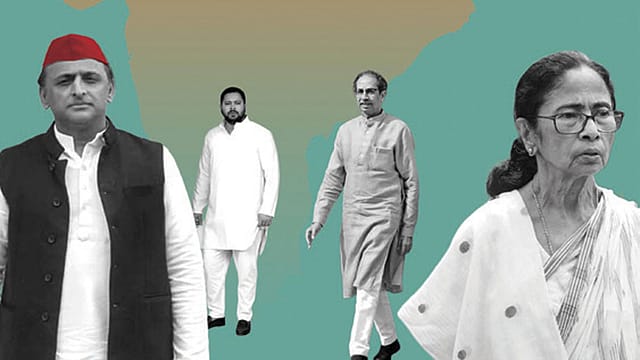
THE MAMATA MELTDOWN, accompanied by the farce of a split, tells a story larger than the sudden rise and steady decline of Trinamool Congress. Till May 4, Mamata Banerjee was the last of the Furies who challenged the maligned machismo of Indian politics. For a while she was the true thunder from the east, inspiring those who were looking for a credible face for the confederation of liberals. She looked the part: the frail avenger in crisp cotton defying the gravity of resentment in nothing more magical than standard-issue flip-flops. As the satrapies seemed shaky elsewhere in India, she alone stood there as a figure of infallibility. The feet of clay were adequately covered.
The fall was a bathetic denouement of a political thriller that began fifteen years ago in a Bengal impatient with communists. The feisty Mamata stole socialism from the superannuated socialists. She brought a new idiom to salvation politics by upgrading the sub-rural thuggery of the communists—and adding communalism to it. She was not alone in this redeemer project. In the south, Dravidian politics, for so long, was led by action heroes and scriptwriters in dark glasses. And then Jayalalithaa came along, in pure Kanchipuram. The kitsch had gone more kinetic. Beneath her measured sophistication lurked the stoicism of a woman who suffered and survived. She would make Dravidianism fulltime theatre. In the north, Mayawati took the politics of social justice to an equally kitschy realm, and, for her too, the me-alone aura was a shield against what she would have called the cruelties of upper castes. The three of them may not have lived parallel lives in power; their politics exuded female chutzpah.
Beyond such gender appeal, Mamata’s fall further clarifies the retreat of grassroots provincialism in general. The Hindi heartland, once the playground of Lohia’s children, is no longer an ideal place for socialists to implement their alternative vision, which anyway is not solely anti-Congressism. And the cow-and-spittoon performance of the man who made Badlands a synonym for Bihar is a distant memory. Lalu Prasad may have passed the formula to the son, but the heir is presiding over a pale version of the socialist machine that his father controlled during Bihar’s darkest age. Lalu’s breakaway comrade and Indian politics’ constant bargainer with an elastic morality, Nitish Kumar, is still there as a socialist standing, but he seems to have abandoned his regionalism for a rewarding nationalist cause. And in UP, the inheritor of Mulayam’s socialist legacy, enriched by the Muslim vote bank of course, is struggling to preserve his already shrunken fief in the land of Yogi Adityanath’s unforgiving nationalism. The ideas of alternatives with regional flavours are losing their market value as BJP, in its dominance over geography and cultural affinities, resembles Congress during the party’s Indira Gandhi days. The south is still stubborn, true, and it is giving Congress a second chance. The Vijay wave is more personality cult than anti-Dravidianism.

The political diversity is intact in rhetoric only. The cultural consolidation underway makes Indian politics more monolithic. The politics of many Indias is increasingly unsustainable. It is as much a failure of the satraps, socialist or otherwise, who had reduced India to a size smaller than their minds, as it is a mark of BJP’s nationalist appeal across the regions. The provincials have proved to be incapable of changing with an India that has shed its cultural inhibitions. The language of liberation and social justice with regional restrictions has become incompatible with the cultural attitude of the BJP-dominated India. It is not unity in diversity; it is about one big idea riding over diversity.
In such an India, Mamata Banerjee is an outdated subversive who had lately nothing in her armoury except paranoia. The nationalists were camping at the gate, waiting for the right moment to storm in. Without her noticing, Bengal had outgrown her—and regained its cultural confidence. After the soulless socialism of the comrades and the violent regional assertion of Trinamool Congress, it is as if Bengal has come home. A variation of the process is in full swing in Maharashtra, where Shiv Sena, as originally imagined by Bal Thackeray, cannot market its Maratha masculinity. This dissolution of exceptionalism is inevitable when the argument for an easily sharable Indianness—or call it the normalisation of cultural politics—sells faster in Narendra Modi’s India. The provincials don’t dare to be openly nationalist. They seem to be unaware of an India turning them redundant.