The Eternal Conversation: An ancient text offers wisdom in the age of information
EVERY FEW YEARS, someone declares ancient texts irrelevant, celebrating technology, speed, disruption and progress, as if wisdom itself has an expiration date. Yet in moments of confusion, grief, uncertainty and hope, millions still turn to the same sources their grandparents consulted. Among them, the Bhagavad Gita remains a steadfast companion.
My relationship with the Gita began in childhood under the guidance of Krishna Chaudhary, mother of Dr Kavita Chaudhary and a revered educator who taught Rajiv and Sanjay Gandhi, the sons of former Prime Minister Indira Gandhi. A neighbour and family friend, she taught me how to read the entire Gita in a single sitting of four to four-and-a-half hours. Decades later, I still return to it regularly. Each reading reveals something new, not because the text changes, but because we do.
The Gita is not a book of answers but a conversation of questions. It wrestles with duty and doubt, fear and faith, action and acceptance. Though set upon the battlefield of Kurukshetra, it speaks to students, entrepreneurs, parents, artists, and citizens seeking to live with integrity amid modern life’s noise.
I first encountered Vijay Prakash Mishra while researching a writing project. What impressed me was his ability to move gracefully between worlds. A member of the Lucknow Public School family of educators, he could discuss Shakespeare and English literature with ease, then transition effortlessly to Kabir, Hindi poetry, or Krishna’s cosmic revelation. Our conversations were rooted in ideas and sustained by a shared belief that great texts continue to illuminate human experience.
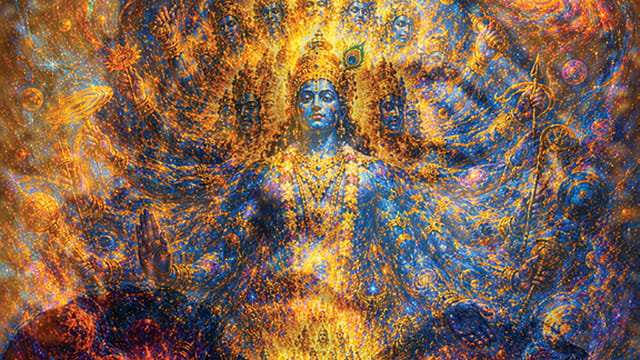
This preview of his forthcoming Virat Krishna Chalisa draws inspiration from the 11th chapter of the Bhagavad Gita, among the most breathtaking passages in world literature. It is here that Arjun receives the Vishvarupa Darshan—the vision of Krishna’s Universal Form.
For me, this chapter has always been less about spectacle than scale. It reminds us that the divine is not confined to a sculpture on a shelf, an image in a temple, or a ritual performed at dawn. The divine is presence and power, force and feeling, companion and continuum. It is the thread connecting birth and death, creation and dissolution, memory and mystery.
Mishra seeks to capture that immensity in verse. In one passage he writes, “Ugeu hazaar bhaanu ek saatha, Vishwaroop vistaareu maatha,” evoking the brilliance of a thousand suns rising together as Krishna reveals his cosmic form. Elsewhere, “Aadi na ant, na madhya, anantaa” reminds readers that the divine transcends beginning, middle, and end. These are poetic attempts to grapple with infinity.
The chalisa moves beyond the familiar image of Krishna as the flute-playing cowherd and beloved friend. Here, Krishna emerges as the boundless force encompassing creation, preservation, and destruction. The playful becomes profound. The personal becomes planetary. The beloved becomes boundless.
Its relevance today lies in its insistence that wonder still matters. We can map galaxies, sequence genomes and connect continents in seconds, yet many feel adrift. Information expands while wisdom contracts. Data accumulates while meaning diminishes. Works such as Virat Krishna Chalisa invite us to pause before the immeasurable and recover humility before existence itself.
The volume is further enriched by blessings from Jagadguru Rambhadracharya and an introductory note by Shri Pawan Ji Maharaj of Maa Sharda Shaktipeeth, Maihar Dham, placing the work within a living tradition of devotion, scholarship, and spiritual inquiry.
The enduring power of the Gita lies in its universality. Across centuries and civilisations, it continues to ask a question both simple and profound: How will you live with courage, clarity, compassion and conscience?
That is why the conversation continues. Works inspired by the Gita do more than preserve tradition; they renew it. They carry ancient wisdom into contemporary lives and remind us that Arjuna’s astonishment remains our own. Standing before a universe too vast to comprehend, we are invited not merely to worship, but to wonder.