The Chinese Patient
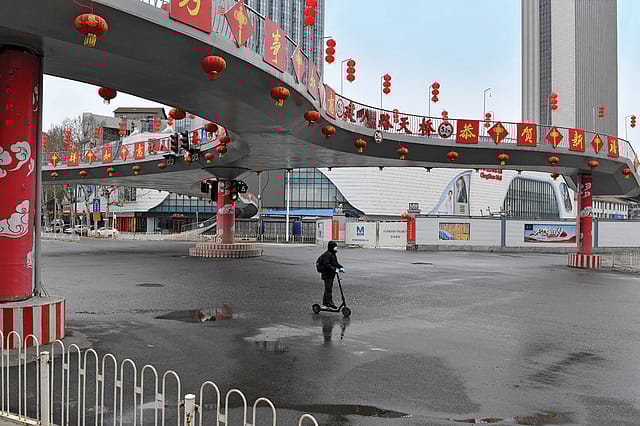
RECENT ARTICLE IN the Wall Street Journal raised eyebrows in both Beijing and Washington. Writing from the Chinese capital, Brian Spegele warned: “In cities and small towns across China, two seemingly contradictory facts are simultaneously true: China is closing the gap with the US for global technological dominance, and yet big parts of its economy are a mess.
“Locally pioneered electric cars zip past deserted apartment blocks. Factory robots run by artificial intelligence churn out products that jobless college graduates cannot afford. State technology funds throw billions of dollars at money-losing startups even as the national debt surges to unprecedented levels.”
So, just how sick is the Chinese economy? Dazzled by China’s technological prowess, there seems little that can hold China back from catching up with the US in economic and military power. US President Donald Trump has admitted as much by positioning the two countries as the new G2.
Look deeper and China’s faultlines appear. Domestic demand has collapsed. The real estate sector, once the central pillar of the Chinese economy, is crumbling. The wealth of most Chinese is tied up in real estate. With housing prices falling, middle-class Chinese are preserving cash rather than spending it.
The Chinese government has compounded the problem by pouring billions to stimulate different sectors of the economy. The result: over 125 Chinese electric vehicle (EV) manufacturers compete fiercely for market share, driving passenger car prices in China down and dozens of EV makers into bankruptcy.

The Abandoned Kejriwal
01 May 2026 - Vol 04 | Issue 69
Brain drain from AAP leaves Arvind Kejriwal politically isolated
With the supply of products—cars, laptops, consumer durables and homes—surpassing demand, China has been forced to increase exports, dumping discounted products in markets across the world, including India. Exports to the US are still hit by high tariffs, leading to a glut of low-priced Chinese exports flooding other geographies.
The US military attack on Venezuela has deepened China’s problems. Venezuela shipped most of its daily crude oil output of 9,00,000 barrels to China. With US oil companies likely to take charge of Venezuela’s oil fields which have reserves of 303 billion barrels—the world’s largest—a source of cheap discounted oil could be closed for Beijing. President Trump, shortly after the attack on Venezuela, mollified Beijing (whose critical rare earth minerals the US still needs) by saying he would not cut off all oil supplies from Venezuela to China because he has “a good relationship” with Chinese President Xi Jinping.
But Trump’s stated goal of the US running Venezuela and making the Western Hemisphere its exclusive backyard could dilute China’s growing influence in Latin America where Beijing’s Belt and Road Initiative (BRI) has invested heavily.
Will Trump’s military attack on Venezuela prompt Xi to advance China’s plan to launch an ambitious assault on Taiwan as early as 2027? If the Western Hemisphere is America’s backyard, China would argue that the Indo-Pacific is China’s backyard. An economic blockade of Taiwan is China’s most likely preliminary move to test whether the US has the appetite to intervene militarily in the defence of Taiwan.
While geopolitics occupies minds in Washington and Beijing, China’s weakening economy poses a more immediate worry for Xi. As Mint reported on December 29: “Fresh economic data adds to evidence of China’s economy weakening. Data issued by its National Bureau of Statistics showed profits for big Chinese industrial firms slumped 13.1% from a year earlier in November, worse than the 5.5% fall in October. It’s yet another sign that all isn’t well in China’s economy.”
China’s GDP in 2025-26 is set to grow at 4.5 per cent. Economists believe the data hides more than it reveals and real growth could be closer to 3.5 per cent. Why has Chinese economic growth fallen from over 9 per cent in the last decade to less than half of that? The answer lies in a structural deficit in the Chinese economy. With local demand collapsing, a demographic cliff looms ahead for China. The country is shrinking and ageing. The fertility rate of Chinese women has plunged to 1.03, less than half the 2.1 replacement fertility rate required to keep a country’s population stable.
Fewer consumers buying fewer products make China increasingly dependent on exports to keep the economy growing. The other engine of economic growth—consumption— is sputtering. As it ages and shrinks, reviving domestic consumption is the only long-term cure for China’s economic malaise.