The Beijing Theatre: Donald Trump, Xi Jinping and the illusion of a reset
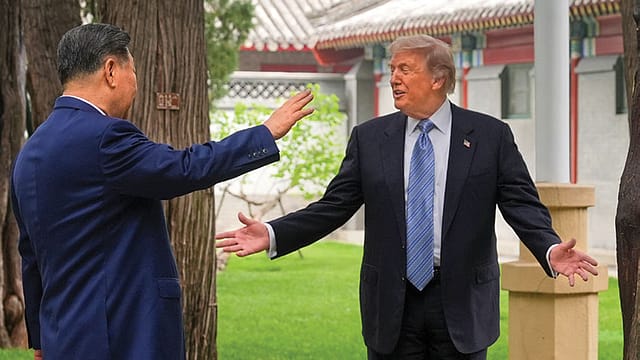
DONALD TRUMP’S second state visit to China was meant to signal a reset in one of the world’s most consequential bilateral relationships. Instead, it revealed the deeper structural realities shaping the contemporary international order: a rising China increasingly confident of its leverage, and an America struggling to reconcile the impulses of economic nationalism with the demands of strategic competition. Though wrapped in the language of “historic deals” and “great chemistry”, the visit underscored how the balance in US-China engagement has evolved since Trump’s first trip to Beijing in 2017.
The symbolism surrounding the visit was unmistakable. Beijing orchestrated the event with characteristic precision-military honours, lavish banquets, carefully curated cultural settings, and repeated invocations of “mutual respect” between great powers. Xi Jinping sought to project continuity and calm at a moment when the global system remains deeply unsettled. For China, optics matter because optics shape narratives, and narratives shape perceptions of power. In hosting Trump with imperial grandeur, Beijing was not merely welcoming a foreign leader; it was demonstrating that China remains central to global economic and geopolitical stability despite mounting tensions with the West.
The context leading into the visit was fraught. Trump’s return to the White House had revived the muscular ‘America First’ agenda that defined his earlier presidency. Tariffs were once again weaponised as instruments of economic coercion, and Washington intensified pressure on Beijing through restrictions on trade and technology. China retaliated not with rhetoric alone but through targeted export controls on rare earth minerals and other critical materials essential for advanced manufacturing and defence production. This was a reminder that the era when China could be viewed merely as the ‘world’s factory’ is over. Beijing now occupies commanding positions across strategic supply chains, giving it leverage that previous administrations in Washington underestimated.
By late 2025, both sides had reached a fragile détente. Certain tariffs were suspended, some export restrictions were softened, and channels of dialogue reopened. But this truce was tactical rather than transformative. Trump entered Beijing seeking headline-grabbing commitments that could be sold domestically as victories for American workers and farmers—massive agricultural purchases, Boeing aircraft orders, energy exports, and greater market access. Xi, meanwhile, aimed for strategic stability, reduced pressure on Chinese technology firms, and above all, reinforcement of Beijing’s red lines on Taiwan.
In substantive terms, China appears to have extracted greater value from the visit. Trump emerged claiming success, touting billions of dollars in agreements involving soybeans, beef imports, energy cooperation, and aircraft purchases. Yet, many of these announcements lacked specificity, implementation timelines, or independent confirmation from Chinese authorities. The credibility problem facing Washington stems not merely from China’s reluctance to deliver but from the broader reality that structural economic tensions cannot be
resolved through transactional bargaining alone.
Perhaps the most consequential dimension of the visit concerned Taiwan. Xi Jinping reportedly conveyed in explicit terms that Taiwan remains the “most important” issue in bilateral relations and warned that mishandling it could lead to “collision or conflict.” Trump’s response afterward was carefully ambiguous, even deferential at times. His references to Taiwan as a “small island” and his refusal to offer unequivocal reassurances reinforced perceptions that Beijing had successfully imposed its narrative on the issue.
This matters because Taiwan is no longer simply a bilateral dispute; it is the central flashpoint in the emerging Indo-Pacific order.
For America’s allies and partners, ambiguity from Washington raises troubling questions about the credibility of US commitments. Beijing understands this dynamic well. It seeks not necessarily immediate reunification through force, but gradual psychological and diplomatic normalisation of its claims. Every instance where the US appears hesitant strengthens China’s strategic position incrementally.
The timing of certain American concessions further amplified perceptions of Chinese advantage. Prior easing of restrictions on advanced technology exports, including approvals involving AI-related semiconductor sales, alongside reports of delayed or suspended Taiwan arms transfers, created the impression that Washington had softened key positions before securing concrete reciprocal gains. Beijing, meanwhile, retained its leverage over rare earth supply chains without making major structural concessions of its own.
For Xi Jinping, therefore, the visit achieved several objectives simultaneously. It stabilised relations at a moment of economic uncertainty, reduced the immediate risks of escalation, and reinforced China’s image as a patient, disciplined power capable of managing competition on its own terms. Most importantly, it bought Beijing time. Time remains one of China’s greatest strategic assets. Every year that major conflict is avoided allows China to deepen technological capabilities, strengthen industrial self-sufficiency, modernise its military, and expand influence across the Global South.
Trump, however, confronts a far more complicated political and strategic landscape after the visit. Domestically, he must demonstrate that his approach towards China produces tangible results rather than symbolic theatrics. Critics from both political parties have accused him of prioritising optics over outcomes, while China hawks within Washington argue that concessions on technology and Taiwan weaken America’s long-term position.
The challenge for Trump is that the old assumptions underpinning US leverage no longer hold entirely true. During earlier phases of globalisation, Washington believed China’s dependence on export markets gave America overwhelming economic influence. But China’s resilience during successive rounds of sanctions, tariffs, and technological restrictions has demonstrated a more complex reality. Beijing has adapted, diversified trade partnerships, expanded domestic innovation capacities, and weaponised interdependence where advantageous.
This does not mean China has surpassed the US comprehensively. America retains immense strengths in finance, innovation, military projection, and alliance networks. But the relationship has evolved from one of asymmetric dependence into one of mutual vulnerability. That distinction fundamentally alters the nature of negotiations between the two powers.
Moreover, unresolved geopolitical disputes continue to cast long shadows over any temporary stabilisation. Little meaningful progress emerged regarding fentanyl flows, Chinese support networks connected to Iran, or broader concerns surrounding the South China Sea and Indo-Pacific security architecture. The structural rivalry remains intact. Trade truces may postpone confrontation, but they do not eliminate the underlying strategic competition.
The broader significance of Trump’s visit lies in what it reveals about the changing international order. Trump entered Beijing hoping to showcase the enduring potency of transactional diplomacy and economic pressure. Xi used the occasion to demonstrate that China can absorb pressure while steadily shaping the terms of engagement. The contrast was revealing. One side sought immediate deliverables and political messaging; the other pursued long-term positioning.
The visit produced what both leaders needed in the short term but neither could transform into a lasting strategic settlement. Trump secured headlines about deals and jobs. Xi secured stability, symbolic parity with the US, and reinforcement of China’s strategic red lines. Yet, beneath the ceremony and rhetoric, the deeper trajectory of US-China relations remains unchanged: an intensifying contest between two powers locked in competition across economics, technology, geopolitics, and ideology.
The real test will not be the announcements made in Beijing, but the implementation that follows—and history offers ample reason for scepticism. As in 2017, grand declarations may ultimately give way to familiar frustrations. The difference today is that China enters this phase of rivalry more capable and more prepared for prolonged competition than at any point in recent history.