Table Talk About Power
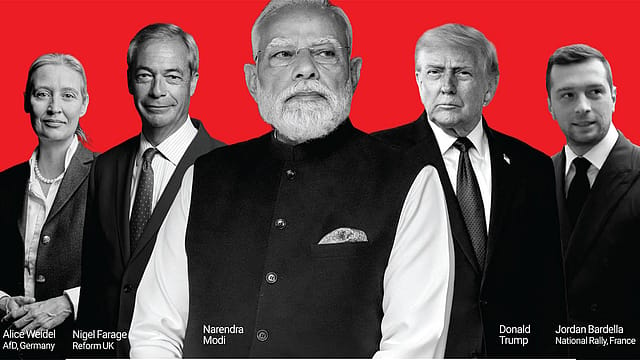
ALL THE TALK seems to be about the table nowadays. About why India, which has never hidden its global aspiration, is not there at a time when the globe is rotating on a fragile axis. About the myopic pragmatism of a leadership that has chosen the margins instead of the vital centre. It is not a lamentation by those who have been heartbroken at the sight of an India ejected from the global high table. Lamentations come from those who feel let down by the idealised. What is happening is a gleeful observation by those who believe that Narendra Modi’s India has no business to be there at the high table anyway.
In this portrait of a country undercut by its own diplomatic incoherence, India is a bystander incapable of anything but a couple of misplaced sound bites. The world is reeling under the worst instincts of autocrats and ayatollahs, megalomaniacs and paranoid nationalists, and from the ever smouldering Ukraine to the still unquiet Gaza to the badly crippled Iran to an America struggling to turn humiliation into honour, it is evident that even the highest table cannot find an enduring solution and a country like India has no wisdom to spare—or so goes the gleeful observation.
This portrait is painted by politics. What makes India an unrealised power, according to its characterisation as a country falling off the high table, is the combined effect of the restrictiveness of its ruling ideology and the moral limitation of its foreign policy. The ideology: Hindu nationalism is an inward gaze, which restricts BJP-ruled India from seeing the future with cultural openness. Aspirational powers travelling back in time, in this portrait of India, are geopolitically ill-equipped to engage with a world caught up in conflicting national interests. The final brushstroke in this portrait is a dismissal: India is out of global sight.
We need to look at the high table grandees and their ideological make-up before coming to the above critique in bad faith. The first totem is the American, whose stock at home is falling to the dismay of everyone in his party except himself, still blinded by the politics of vendetta and me-aloneness. Donald Trump, even a mainstream conservative newspaper like the Wall Street Journal has concluded, has “lost the governing plot.” Increasingly isolated within his own party establishment, unfazed by unethical financial dealings, scarred by an ill-planned war and, as he inches towards a midterm shock, unaware of how his achievements, sparse as they are, continue to be undone by his character flaws, Trump is a lonely old man despite all the noise he makes. A shrunken Trump presidency is a reminder of how rightwing populism soaked in individual vulgarianism has lost its marketability.
Across the Atlantic, the other shrunken leader is on the left, and his fall has been the quickest. Keir Starmer is in such a state that he has become unworthy of an argument about power. And post-Blair Labour is still waiting for a redeemer as much as the post-Thatcher Conservative Party is waiting for a revolutionary. The right, though, thinks that it has got one in Nigel Farage, and after his Reform UK swept the local elections, the orphaned conservatives of middle England and some overawed pundits are certain that he is the next prime minister. Farage’s visceral conservatism is a festival of paranoid nativism—and a rejoinder to conservatives who have ceased to be sufficiently conservative. He is waiting for his place at the high table.
So are the radical populists in Germany and France. They all see the future of Europe ‘purer’ (remigration is the new buzzword) and exclusive—integration is for the nation-averse globalists. What unites the present and future members at the high table is a mindset that puts a premium on a world divided to accommodate narrow national interests. Two other members, the Chinese and the Russian, make the table more unstable. Two regimes with the ruling philosophy of democracy- reduces-national-longevity can only do that. Is the world going to be rewarded by such a high table?
The gleeful dismissal of India as a non-high tablewallah comes from a belief that Modi’s India has no right to play a global role. Forget for a while the creaky high table and think of India as the most stable rightwing democracy. Elsewhere the crisis on the right is a question of legitimacy: power pitted against the same democratic impulses that once launched it. Trump’s America is a perfect case study. Beyond the caricature was the sociology of a resentful political space abandoned by both left and right. Today, the caricature has become the official portrait. He has lost all credentials as a subversive in a rotten bipolar polity. In most of his domestic appearances, he looks like the pastiche of a Marvel comic villain. And the man mythicised as the spiritual guide of national conservatism has made himself redundant in Hungary. NatCons are desperate for a guru after the exit of Viktor Orbán, and if Tucker Carlson doesn’t qualify as one, some are even willing to look east.
There is no need for a legitimacy test in Modi’s India for just one reason: its conservatism with a distinctive cultural content reflects creative democracy rather than restrictive democracy. Modi remains the most enduring—and popular—conservative in power because, unlike his de-legitimised counterparts elsewhere, he is still struggling to win democracy, not to control it. Apostles of alarmism, still lazily beholden to the rhetoric of fettered civil society and crypto-fascism, can only see Hindu nationalism as anti-modern—even anti-democratic. It is not the burden of the vintage Nehruvian who is ideologically trained to resist the twin opiates of religion and nation. It is the cause of the progressives who reject the cultural realignment of India as an exclusivist, regressive project. It is a refusal to accept India’s deviation from the sacred script that had prevailed till Modi stormed in with an alternative story.
In this story conservatism is not theatre but the performance of a gradualist. And that is why the flamboyant nationalist on the stump has a measured style as an administrator. A unifying nationalist is a permanent learner: ‘Modi wins’ means Modi masters another layer of India. He is also patient: Modi is prepared to take the longest route. Winning is yet to become the habit of national conservatives in the West. They have been exhausted by the nation itself. Still some of them are at the high table. The question is whether India needs such a high table to showcase its power to a world with a million disputes.
India has not become smaller by not being there. Neither has it lost its power to get what it wants or to remain open to start a conversation with a new partner. India may have been morally tentative when wars broke out in this century. It has not lost its voice, and it is not a big loss even if that voice is not heard at the current high table.