Shades of Stillness: Soul is the Story in Aamir Rabbani’s Art
THERE IS A QUIETNESS to Aamir Rabbani’s work that does not beg—it beckons. Not loud, not lurid, not lacquered in spectacle. Instead, it lingers. It listens. It leans into longing.
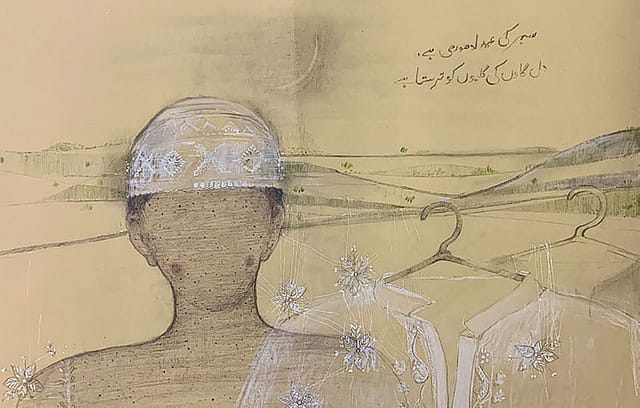
In one of his most tender works—his painting on Eid—a solitary figure stands beside a hanging kurta. The garment is empty. The body is present. The space between them is the story. It is Eid, the festival of embrace, of reunion, of return—and yet here there is absence. A pause. A private ache stitched into public celebration. The kurta does not clothe; it remembers. The gaze does not wander; it waits.
In that stillness, Aamir reveals his rare gift: he paints not the event, but the echo. His art is an archive of ache. Of homes half-held. Of memories moth-soft and persistent. Of men who are not monuments of machismo but vessels of vulnerability. In his canvases, masculinity is not muscle; it is murmur—the tremor before touch, the hush before confession.
Brown paper becomes battleground and balm. Thread becomes testimony. Windows become witnesses.

The Abandoned Kejriwal
01 May 2026 - Vol 04 | Issue 69
Brain drain from AAP leaves Arvind Kejriwal politically isolated
There is rhythm in his restraint. A discipline in his delicacy. He does not shout identity; he shades it. He does not dramatise desire; he dignifies it. Longing in Aamir’s world is not lurid flame but slow ember—persistent, patient, pulsing.
In Threads of Solitude, two travellers share a boat, afloat between cultures. A migratory bird hovers—feathered metaphor for the human hunger to find not merely a place, but a person who feels like place. In Resilient Bloom, a cactus flower becomes sermon: fragility flowering from fortitude. In his homage to Launda Naach, he paints performers who dance at the edges of acceptance, asking us to see splendour where society sees stigma.
His work whispers: See us. Hold us. Honour us.
Aamir paints India not as headline, but as heartbeat. An India of plural prayers and private paradoxes. Of Muslim memory and metropolitan migration. Of stitched inheritance and self-fashioned futures. He understands what it means to stand beside the hanging kurta—to belong and yet be barred, to celebrate and yet be scrutinised.
Yet there is no bitterness in his brush. There is boldness, yes. There is critique, certainly. But above all, there is care.
Care in the curve of a shoulder. Care in the crease of cloth. Care in the empty space that says more than a crowd ever could.
He works in small formats, but his themes are vast: gender and grace, grief and God. He braids the personal with the political, the domestic with the devotional. His figures exist between dreams and daylight, between repression and revelation.
In a time when images are engineered for speed, Aamir insists on stillness. In a culture crowded with noise, he chooses nuance.
The Eid painting remains his quiet manifesto.
Celebration shadowed by separation. Faith framed by fragility. Fabric floating like an unfinished sentence. It asks: What is festivity without
familiarity? What is belonging without embrace?
Aamir Rabbani’s art does not answer loudly. It answers lyrically. Softly. Steadily. Surely. Not spectacle but soul. Not slogan, but story. Not division, but dignity. And in that restraint—resonant, rhythmic, resolute— his work continues to breathe.