Refining the Partnership: The Trump administration brings its pragmatism to New Delhi
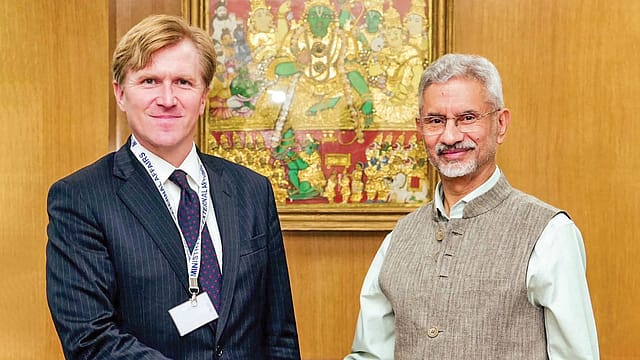
ELBRIDGE COLBY’S VISIT to New Delhi last week was less a routine diplomatic engagement and more a carefully calibrated strategic intervention—one that revealed the evolving grammar of US-India ties. As Undersecretary of War for Policy in the second Trump administration, Colby arrived in India at a moment of systemic flux in global politics. Yet rather than amplifying uncertainty, his engagements pointed to a quiet consolidation: a shift from aspirational partnership to interest driven alignment. For all the despondency surrounding US-India ties under Trump 2.0, this visit underscored why the relationship remains dynamic, seamlessly adapting to the evolving strategic realities.
In his meetings with Indian officials, Colby avoided the temptation of rhetorical excess. Instead, he focused on operationalising commitments already embedded in recent bilateral understandings, particularly those flowing from the Trump-Modi joint statement and the October 2025 defence framework signed by Pete Hegseth and Rajnath Singh. The emphasis was on delivery, not declaration. And this emphasis is telling. For much of the past two decades, US-India relations have been marked by a curious duality: expansive political signalling alongside cautious strategic execution. Colby’s visit suggests Washington is now seeking to close that gap. His approach reflects a broader intellectual shift within sections of the US strategic community, away from liberal internationalist assumptions and towards a more classical balance-of-power logic.
Colby himself embodies this shift. As a principal architect of the 2018 National Defense Strategy, his thinking has long prioritised great-power competition, particularly vis-à-vis China. In New Delhi, that perspective translated into what he described as “flexible realism”, a framework that privileges interests, capabilities, and incentives over ideology. It is a formulation that resonates far more comfortably with evolving Indian strategic thinking than the value-laden rhetoric that often defined earlier phases of the partnership.
His public address in New Delhi was therefore significant not just for what it said but for what it chose to leave unsaid. The conspicuous absence of references to the “rules-based international order” or democratic solidarity marked a deliberate departure from past US formulations. Instead, Colby foregrounded sovereignty, strategic autonomy, and the imperative of preventing hegemonic dominance in the Indo-Pacific. For New Delhi, this is familiar terrain. What stood out, however, was Colby’s explicit engagement with Indian strategic thought. By invoking S Jaishankar’s articulation of ‘The India Way’, he signalled a recognition that India’s worldview is not merely reactive but conceptually coherent. The parallels he drew between ‘America First’ and India’s own emphasis on national primacy were not incidental. They reflected a deeper convergence around the idea that foreign policy must be anchored in hard interests rather than abstract commitments.
This is a notable departure from earlier US efforts to frame India as a partner in upholding a liberal international order. Instead, Washington now appears more willing to engage India on its own terms—as a civilisational state with a distinct strategic tradition and a strong preference for autonomy. In that sense, Colby’s visit marks a certain intellectual accommodation on the American side. At the same time, the visit underscores a growing comfort in New Delhi with this recalibrated partnership. India is no longer approaching the US with the hesitations that once defined its engagement. Nor is it seeking validation through alignment. The relationship is increasingly transactional in the best sense of the term—grounded in mutual benefit rather than ideological affinity. Nowhere is this more evident than in the defence domain. Colby’s insistence on enhancing “real capability” points to a maturing agenda. The focus on long-range precision fires, maritime domain awareness, anti-submarine warfare, and resilient logistics reflects a shared assessment of the Indo-Pacific security environment—particularly challenges posed by China’s expanding military footprint.
Equally important is the renewed emphasis on defence industrial cooperation. For India, the imperative of building indigenous capability under the Atmanirbhar Bharat framework remains paramount. For the US, enabling India’s rise as a capable security provider aligns with its own objective of burden-sharing in the region. The convergence here is pragmatic: co-development and co-production offer a pathway that avoids dependency while deepening interdependence.
Yet, structural impediments remain. Regulatory barriers, differences in procurement systems, and lingering mistrust within segments of both bureaucracies have historically constrained progress. Colby’s intervention suggests that these issues are now receiving higher-level political attention. Whether this translates into tangible breakthroughs will depend on sustained followthrough. Another notable feature of Colby’s formulation is its tolerance for divergence. By narrowing the scope of the partnership to areas of core strategic convergence, the framework implicitly accepts that differences—on Russia, Iran, or aspects of global governance—will persist. This is a realistic assessment. Attempts to force alignment on secondary issues have often generated friction in the past. A more compartmentalised approach may, paradoxically, produce greater overall coherence.
The timing of the visit adds another layer of significance. It comes against the backdrop of ongoing instability in the Middle East, persistent tensions in the Indo-Pacific, and a recalibration of US foreign policy under the Trump administration. It also follows a period of economic friction between Washington and New Delhi, including tariffs and difficult trade negotiations. That defence ties continue to advance despite these tensions suggests a degree of strategic insulation in the relationship.
This insulation, however, is not absolute. The absence of a robust economic pillar remains a vulnerability. While security cooperation has deepened, trade and investment ties have struggled to keep pace. Over time, this imbalance could limit thepartnership’sfullpotential. Colby’sspeech, with its narrow focus on security, implicitly acknowledges this gap without attempting to resolve it. The visit also sends a clear geopolitical signal. By describing India as “indispensable” to the Indo-Pacific balance, the US is effectively recognising it as a pole in an emerging multipolar order. This is a significant shift from earlier conceptions of India as a balancing factor within a US-led system. The language now suggests a more horizontal relationship, one between actors that are aligned, but not subordinate.
For India, this recognition carries both opportunity and responsibility. Greater strategic weight brings with it expectations of a more active regional role. Managing this transition— without compromising autonomy or overstretching capabilities—will be a central challenge for New Delhi in the years ahead. Colby’s visit, then, should be seen as part of a longer trajectory rather than an isolated episode. It reflects a partnership that is gradually shedding its earlier ambiguities and moving towards a clearer strategic logic despite occasional bumps along the way. The rhetoric may be less expansive, but the substance is arguably more meaningful. In many ways, this is the kind of relationship India has long been comfortable with: one that respects its independence, acknowledges its interests, and focuses on practical cooperation.
For the US, adapting to this reality requires a degree of strategic patience and intellectual flexibility—qualities that Colby’s approach appears to embody.
If there is a risk, it lies in overcorrection. A purely interest-based framework, while durable, can also be narrow. The challenge for both sides will be to ensure that the partnership retains enough breadth to adapt to changing circumstances, even as it deepens in specific domains. For now, however, the direction is clear. US-India ties are entering a phase where convergence is defined less by shared narratives and more by shared calculations. That may make the relationship less evocative, but it also makes it more resilient. Colby’s intervention in New Delhi captures this transition with unusual clarity. It is not about transforming the partnership, but about refining it—stripping away excess rhetoric and focusing on what truly matters. In an era of geopolitical uncertainty, that may well prove to be its greatest strength.