One Battle After Another and Why Modi Is Winning Them All
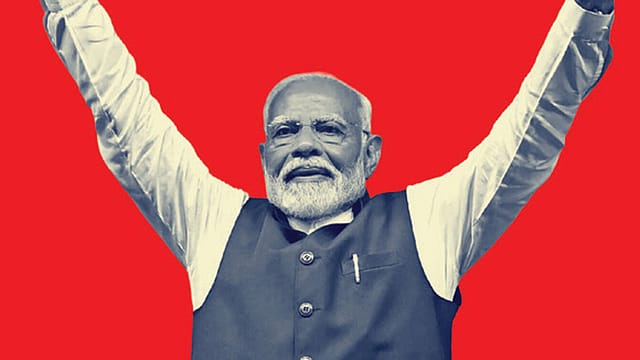
LOSER IS DONALD TRUMP’S CHOSEN WORD for any leader who dares to stand up to him. They are mostly found in Europe in the wake of the American threat to acquire Greenland. Loser can also be taken literally when you see them, Starmer in London or Macron in Paris or Merz in Berlin, on the electoral brink, as if there are not many leaders left in democracy’s homelands to keep pace with the ferocious velocity of take-back-control politics. Isn’t it time to turn the gaze to the East, though it is still home to the world’s last ideologically managed empire? Then there are any numbers of apologists out there to argue that unfreedom is a small price to pay for the wonders of capitalism with Chinese characteristics. The India story is pure democracy with all its ills, illusions and chaotic glories, but we have shown, repeatedly, that chaos breeds unity.
On the eve of the Republic’s 76th anniversary, India is not the place to watch the resentment against the Power of One. Rather, it is swaying to the Politics of One. What is it that makes Narendra Modi democracy’s most indulged politician in power, and that too at a time when leaders elsewhere are falling by the wayside (even Trump’s bluster is not matched by his poll rating)? There must be something about the leader who won’t wither away. Battles don’t scar him; they replenish his armoury. The Modi story is about how to get the best from the elemental emotions of democracy. This column is an examination of the how.

The MissOil Strike
03 Apr 2026 - Vol 04 | Issue 65
The War on Energy Security
CONVERSATION IS A CONTINUUM Two visible traits characterise leader-speak in democracies today. One: Owning the reality by projecting oneself as the ultimate deliverer, protector and destructor. The cult of the paramount leader is very communist even today, but, increasingly, it is sustained by the popular vote, like the American epic of kitschy machismo. India is a permanent thriller when Modi is on the stump, and he places himself at the vanguard to become its best narrator. When his opponent seeks solace in accusatory politics, a form of retailing grievances in a shrinking electoral space, Modi amps up his conversation with the nation—and never allows the boredom of repetition. The motifs of his storytelling chart the evolution of India’s politics of emotion. Dry reasons may win an argument; emotions win elections. Modi, the constant conversationalist, taps into them.
CONVICTION IS MORE PERSONAL THAN POLITICAL The so-called conviction politician is an ideal. Reality defies them, certainly when politics is about, to return to the cliché, changing with the volatile times. Most of them are struggling to reconcile change with convenience—ask any pol with a pragmatic approach to idealism. Modi remains one of the most trusted politicians because his nationalist core remains intact despite the shifts in political as well as cultural attitudes. He is not changing with the times. He is the change. It is this solidity of faith in his own mission that makes him trustworthy. It is a big deal considering pragmatism in politics is a synonym for moral elasticity.
HE IS TODAY WHAT THEY COULD BE TOMORROW Very few politicians can afford to market their biography. The past, for most of them, is a story that doesn’t inspire them. In this century, Barack Obama was one politician who turned his life story into a manifesto for change. His pre-presidential memoir, Dreams from My Father, is a more influential, and certainly better written, work than his post-presidential memoir. Turning his own story into a national saga of struggle and aspiration, Modi has come to epitomise in the popular imagination what the others too could become. The ordinariness of the outsider gets extraordinary only when he wields power. In his journey, they see their own. His power is a shared pride. Every election is a vindication.
NOT JUST IDEOLOGY BUT IDEAS OF FREEDOM TOO The Hindu nationalist is an easy identity. And it is a term of nationalist exceptionalism only in a country conditioned by the tradition of state-supervised secularism. Indians, for so long, have been told to behave, with good socialist-secular manners. The result: Being defensive about nation and religion. The Hindu nationalist is caricatured as a freak expression of an angry India emerging from the debris of the old socialist-secular pieties. Modi is not defensive about his Hindu nationalism, which does not constrain his chosen role as an ideas-rich politician. Such a politician matters in a country that may be one of the fastest growing economies of the world but is still abysmally unequal. It is the multiplicity of ideas, not the linear monotony of ideology, that makes Modi the choice of the poor and the rich, the young and the dreamers. Ideas, not ideology, win demography.
One election after another, India gets to know Modi a little more.