Might Is White: Donald Trump shares his views on race with Adam Smith
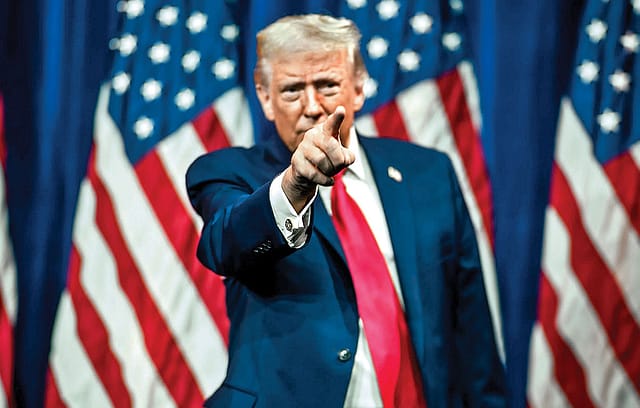
THE ANGLO-SAXON world is celebrating the 250th anniversary of Scottish economist Adam Smith’s book An Inquiry into the Nature and Causes of the Wealth of Nations. Published in 1776, the 1,000-page tome has long been regarded as a classical exposition of how free markets and competition create wealth for nations.
Britain was a young, relatively poor country in 1776. Till 1707, Scotland and England were independent nations. They merged in 1707 to form the United Kingdom. The year 1776 also marked the founding of the United States of America as an independent nation. US President Donald Trump intends to celebrate the country’s 250th anniversary on July 4, 2026 as a validation of his own presidential legacy.
Adam Smith’s book was published at a critical time in world history. Just as the US declared itself independent, Britain was tightening its grip on another new large colony 8,000 miles away. India fell to the British first in Bengal in 1757 and then in the rest of the subcontinent.
But as Duvvuri Subbarao, former governor of RBI, wrote in an op-ed in Hindustan Times, “There is also a deeper irony in Smith’s legacy. Two hundred and fifty years after he wrote The Wealth of Nations, much of the world—including India— remains preoccupied with the poverty of nations: How to reduce it, how to make growth inclusive, how to ensure opportunity reaches the many and not just the few.”
In 1776, when the Wealth of Nations was published, Britain’s Industrial Revolution had just begun. The extractive colonisation of India would fuel it, lifting Britain from penury to wealth in less than a hundred years. By the late 1800s, Britain was the world’s wealthiest country. Its Indian colony in contrast had been reduced from relative prosperity in the early 1700s to among the world’s poorest countries. Adam Smith could not have known at the time that the free market capitalism he espoused could apply selectively—to the coloniser but not the colonised.
How did the newly formed US react to Smith’s book? Founder Thomas Jefferson wrote: “In political economy, I think Adam Smith’s The Wealth of Nations is the best book extant.” America implemented Smith’s ideas of free-market capitalism to create the world’s most prosperous nation by the 1950s even as Britain, shorn of its remunerative colonies, slipped into economic ennui.
Trump is a fan of Smith’s views. But not many are aware that Smith’s racial bigotry, which few contemporary commentators dwell on, reflects Trump’s position on race. Smith’s published views on African slaves mirror the racism that has infected Trump’s second term as president. Trump has stopped all diversity schemes and, in a move seen as brazenly white supremacist, banned firms doing business with the federal government if they have policies combating racism in the workplace.
As I wrote in my book Era Of India: From Impoverished Colony to the World’s Third Largest Economy, “Adam Smith’s bigotry has rarely been challenged by contemporary Western historians though his book was first published in 1776, a period when the transatlantic slave trade from Africa to America was at its cruellest. Smith, examining the wealth of nations in over 1000 pages, barely touches on the horrific European trade in African slaves on which the wealth of many English and Scottish businessmen was built.”
Smith regarded white people unsuitable for doing the work African slaves in America were forced to do. He wrote: “The profit and success of that which is carried on by slaves must depend
equally upon the good management of those slaves.”
Trump’s thought process isn’t as divorced from Adam Smith’s as might be expected considering they lived 250 years apart. Trump dismisses victims of the Iran war, many of them children, as collateral damage. His communications team has used memes and videos on the war, the Washington Post wrote, that have caused outrage among US military veterans.
Trump recently ended a 165-year-old US tradition of carrying the signature of the US treasurer on American currency notes. Instead, $100 bills will now carry Trump’s signature along with treasury secretary Scott Bessent’s. Smith advocated open markets and free trade. Trump’s tariffs have achieved the exact opposite. The two men may share common views on race but differ sharply on trade.