Maduro in Imperial Magic Realism
A wintry London, where both mainstream Conservatives and Labour are deep-frozen as radicals from the Right and Left keep rising, is a good place to ask whether Nicolás Maduro deserves the lamentations, mostly coming from a Left bereft of heroes—and an imperialist bogeyman. It’s not just because a dash of the Pravda can’t be missed in the pages raging against Trumperialism. Sir Keir Starmer, the prime minister, uber socialist at home—squeeze the rich and who cares if they flee the island at the same speed with which immigrant boats hit the shores—is an impeccable moralist on the global stage. Ukraine is lucky to have someone like him as its defender, along with the equally damaged and fellow internationalist Emmanuel Macron. Unlike the Left from the chattering class, Sir Keir was very cautious in his response to Maduro, who, all said, was spared the Saddam Hussein treatment: being whisked away in your pyjamas and handcuffed is less humbling than being ejected from a spider hole, his captors peering into the open mouth of the bearded, dishevelled man who in power styled himself as Ba’athism’s Nebuchadnezzar.
Starmer didn’t publicly cry for Maduro, as he did for Alaa Abd El-Fattah, who not long ago called for the killing of Jews and burning down Downing Street. The repentant hatemonger and freshly minted British citizen was brought home from Abdel Fattah el-Sisi’s Egypt with much fanfare. On Maduro, Starmer just stood by America, saying not much about the capture itself. But Kemi Badenoch, the Conservative leader, whose party has just overtaken Starmer’s in ratings in the hopeless race for Nigel Farage’s challenger, has shown her right ideological credentials by supporting Trump’s action as morally appropriate. Not that every Conservative was as forthcoming as she was in appreciating Trump’s contribution to what the Wall Street Journal calls “hemispheric hygiene”. For the neocons, regime-change was an ideological impulse. For MAGA conservatives, it is an instant adventure, even though Trump claims he is only updating the doctrine of his 19th-century predecessor James Monroe, who wanted to protect Latin America from European colonialism. The new coloniser controls from Beijing.

Iran After the Imam
06 Mar 2026 - Vol 04 | Issue 61
Dispatches from a Middle East on fire
Which brings us back to a question that is certain to anger professional anti-imperialists: Can there be imperialism with a moral content? A blue-blooded “imperial” historian like Niall Ferguson will argue that imperialism of the British variety had modernised the colonies whereas America has miserably abdicated its imperial responsibilities. He was not making a case for expansionism but for applied idealism. Lately, America was retreating to its domestic anxieties at the cost of its moral duties beyond, best illustrated by the three Obama terms—two original, one pastiche. Trump, too, was world-averse in the beginning, unless the world was an arena where he could browbeat his rival. With Maduro, as Badenoch says, he has given imperialism a moral context, even if some will find the method questionable. A world without Maduro in power, as the one without Saddam, is a better place. The Republic of Fear, the term used by the dissident writer Kanan Makiya to describe Saddam’s Iraq, is applicable to anyplace where torture, starvation, election-theft, and instruments of mass dehumanisation are supervised by the dictator.

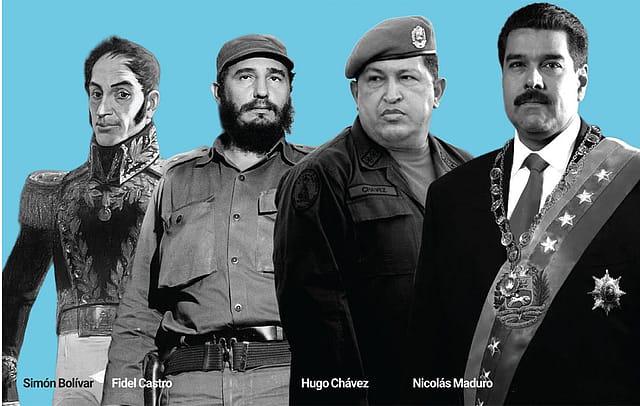
Not to the romantics on the Left, floating cheerlessly in a world without heroes. Latin America was where they could find enough ideological grit, and where revolution was pure thriller, inhabited by revolutionaries who resembled Jesus. If Che was revolution’s most idolised martyr and its most retailed pop cultural souvenir, Castro, the cigar-chomping maximum leader, retained the aura of the ultimate anti-imperialist in power. Even though the maintenance of the revolution was such a strain on the socialist state, he kept the iconography of communism alive, inspiring the Left worldwide. Maduro’s predecessor, Hugo Chávez, was a Castro parody. Chavismo, the ideological system he built around his own personal mythology, was, in practice, anti-American machismo, with Simón Bolívar, the original liberator, an invocation. Chávez built his cult as Castro lite, in a country that was falling apart economically, despite sitting on the world’s largest petroleum reserves. In Latin America, every dictator perfected the art of mythmaking, and they all wanted to be an updated version of Bolívar. It took a Gabriel García Márquez, in his The General in His Labyrinth, to humanise Bolívar, make him lesser than his colossal historical size. Fiction has redeemed the cruel histories of Latin America, and imagination remains home to its archetypal liberator-tyrants, like the Dominican Republic’s Rafael Trujillo in Mario Vargas Llosa’s The Feast of the Goat. Reality is not as epic; it’s as bathetic as a Trump-miming Maduro ending up as a “narco-terrorist” picked up from his panic room in a night raid by the angels of imperialism. Maybe it is geopolitical magic realism for the 21st century.
POSTSCRIPT: If art is the alternative you need in this winter, Caravaggio’s masterpiece, Victorious Cupid, currently on display at the Wallace Collection, should be everyone’s ideal destination in London. Caravaggio’s Cupid, a blushing naked boy with eagle’s wings and a roguish smile, two arrows, one red and the other black, in his right hand, his left hand touching his bottom, and at his feet an abandoned lute and violin, is a true-to-life declaration of “love conquers all”. For the connoisseurs Caravaggio’s work is the pinnacle of “painting from life”, as opposed to the autonomy of imagination. On his canvas, everything—music or poetry or war—is secondary to the radiant power of love. Is there something extra-artistic that drives the popularity of a single-painting exhibition now? Maybe the headlines.