In the Realm of Francis Fukuyama
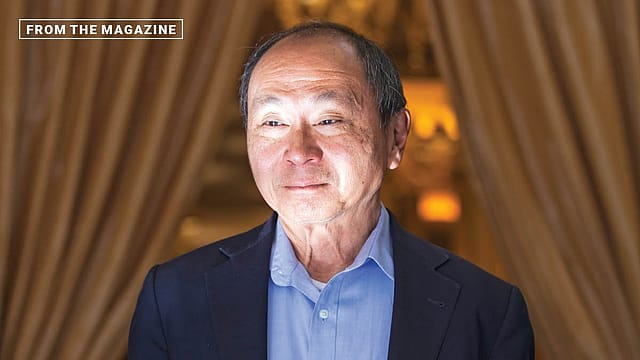
Francis Fukuyama went through something no other philosopher had ever experienced: He got trapped inside his own book title. In 1989, the year communism fell, Fukuyama wrote an essay titled ‘The End of History?’ which itself was born from a lecture he had just delivered. The question mark didn’t matter; his nuanced take on the Hegelian progression of history didn’t matter; and his argument’s indebtedness to Hegel’s interpreter Alexandre Kojève’s analysis of the French Revolution as the foundation of the liberal order didn’t matter either. It was freedom’s annus mirabilis and Fukuyama’s hasty “obituary” of history was misread as liberal triumphalism. When the essay was expanded into a book three years later, The End of History and the Last Man, the question mark was gone, and Nietzsche made an entry to make the title longer. And Fukuyama’s stardom soared as the philosopher who gave a sense of finality to one of the most bitterly fought wars of ideas. He has been explaining ever since that he never meant an end but only a pause, that he is not your sound-bite savant.
The title of his memoir, In the Realm of the Last Man (Farrar, Straus and Giroux, 286 pages, $29), shows he is not tired of explaining. Even more so in the liberal order mangled by the current leader of its original headquarters. The Wall may have vanished from Berlin; it has multiplied in the minds of the last men powered by identity. The question Samuel P Huntington, another political theorist who gave the post-communist world a catchphrase (the Clash of Civilisations) as popular as Fukuyama’s, asked, Who are We?, is being repeated with added nationalist vigour now. In the Hegelian endpoint of history, man, overcoming the master-slave divide, achieves the recognition that has eluded him for so long. The one who comes to take a bow is Nietzsche’s Last Man, suddenly denied the burden of a struggle. In his realm, “the extremism that we see on both the right and the left is in some sense a revolt against the flattened horizons created by liberal societies.” The pause is over. Still, the frisson that Fukuyama’s memoir generates doesn’t entirely come from his elucidation of grand theories.
The personal history of the Fukuyama clan cannot be separated from the snapshots of great minds and jargon-free introduction to big ideas.
The personal reveals the making of what Isaiah Berlin would have called a fox (who knew many things) as against the hedgehog (who knew one big thing). So we meet a young Fukuyama, now employed at the State Department, struck by the beauty of Federal-style furniture in the Secretary of State’s ceremonial suite. He would buy a book on how to build a Federal card table and, over five years, build one, the raw material coming from the walnut tree that fell down behind his house. By building, the philosopher who makes a living from abstractions celebrates the tangible: “I imagine my Federal card table will outlast me, and maybe handed down to my grandchildren long after they’ve forgotten about my books.” Carpenter, collector of workman’s tools, Bach aficionado, lover of vintage cameras, possessor of a rare Japanese sword, Fukuyama brings to his scholarly persona a rare cultural aura.
We walk with some of the great academic minds such as Allan Bloom (The Closing of the American Mind), Leo Strauss (the crisis of modernity), Samuel Huntington, and Seymour Martin Lipset (American Exceptionalism: A Double-Edged Sword), but Fukuyama, indebted to them all, is not in thrall to any. And we are unlikely to come across another public intellectual who can write a chapter on the virtues of changing one’s mind at a time when certainty is the most familiar ideological badge. His fallout with the neoconservatives on Iraq—he was an early supporter and realised the folly of it on the eve of invasion—is a classic case of why intellectual positions cannot remain immutable. Changing his mind on the Iraq war led him to “the critical importance of having a modern state,” a subject to which he would devote some of his most compelling arguments. It is the struggle for justice that tests the moral credibility of the modern state in any liberal order, which today is being threatened by the passions and pathologies that power the base of the so-called populist regimes. Can liberalism keep pace with such mad energy? Can the Last Man be at home in such a world?
Fukuyama won’t be short of ideas to give us an answer. He is, we realise as we glide across the realm of the philosopher pragmatist, to return to Isaiah Berlin, a fox with a hedgehog’s single-mindedness in search of a just society.