Crude Awakening: Only a long-term policy can avert an oil crisis for India
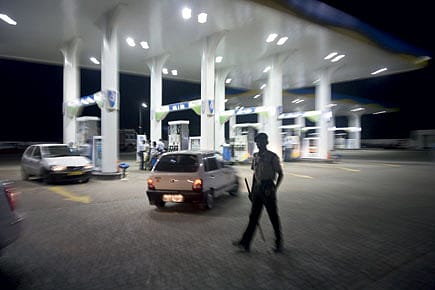
THE IRAN WAR has exposed India’s Achilles’ Heel: 90 per cent dependence on imported crude oil. Over the years, this has bloated India’s trade deficit and weakened the Indian rupee.
It wasn’t always like this. In the 1980s, India’s dependence on crude oil was 65 per cent. Bombay High was one of the country’s most successful oil drilling wells. ONGC, under its visionary chairman, Colonel (retd) Satya Pal Wahi, was on track to bring India’s reliance on imported crude oil down to 50 per cent.
Instead, in the post-Wahi era, India’s domestic crude oil production has stagnated. At its peak in 1989, Bombay High drilled and produced 476,000 barrels per day out of India’s total crude oil production of 700,000 barrels per day. Today, 37 years later, Bombay High’s output has plunged to 131,000 barrels per day. India’s total daily domestic crude oil production remains stagnant at 700,000 barrels, the same level as in 1989.
Successive governments are responsible for this failure. One of Narendra Modi’s pledges on becoming prime minister in 2014 was to cut crude oil import dependence from 78 per cent at the time back to 65 per cent as it was in the late 1980s. In what is among the Modi government’s biggest policy setbacks over the past 12 years, crude oil import dependence has instead risen to nearly 90 per cent.
The impact on India’s trade deficit and the rupee has been devastating. India today imports five million barrels of crude oil per day. At $100 a barrel, India’s daily import dollar outflow is $500 million (`4,600 crore). That is unsustainable. Even at the pre-war price of $60- 65, the cost of importing five million barrels per day was $300 million (`2,800 crore) per day. India’s annual crude oil import bill is over $120 billion—accounting for a majority of India’s trade deficit.
The Reliance-BP partnership to drill oil in the KG basin has faltered, frequently hobbled by litigation with both the UPA and NDA governments. Cairn’s efforts in Rajasthan, too, have lagged behind targets. As Fortune magazine observed recently, the failure goes back a long way: “One of the biggest deterrents has been an inconsistent policy framework. India launched the New Exploration Licensing Policy [NELP] in 1999 with the objective of opening the country’s sedimentary basins to global oil companies. The policy did manage to attract companies such as Reliance Industries, BP, Cairn Oil & Gas (now part of Vedanta Ltd), ENI, and BHP Billiton into exploration activities. Yet, the programme did not lead to a steady stream of major discoveries.
“Exploration remains an inherently risky business—industry estimates suggest that only about one in five exploration blocks ultimately yields commercially viable hydrocarbon reserves. Companies often spend billions of dollars on seismic surveys, geological studies and drilling before confirming the presence of oil or gas.
“Given these risks, global explorers typically seek long-term policy stability of at least 15- 20 years before committing large capital investments. In India, however, the terms on return on investments and contractual frameworks have changed several times. Under NELP, the government followed a production sharing contract [PSC] model, where companies were allowed to recover their costs before sharing profits with the government. Disputes over the interpretation of cost recovery provisions soon surfaced, leading to disagreements between operators and the government.
“In 2016, the government replaced the PSC framework with the Hydrocarbon Exploration and Licensing Policy (HELP), shifting to a revenue-sharing regime. While the move was intended to simplify the system and reduce disputes over cost recovery, it added another change in the contractual structure.”
Mani Shankar Aiyar was minister for petroleum and natural gas in the UPA1 government.
I interviewed him for our business magazine, Business Barons, at his office in 2005. He was openly critical of the way the petroleum ministry operated. Within 20 months, he was shunted out.
As Aiyar pointed out in a recent op-ed in the Indian Express: “My successors did not prioritise energy security, concentrating instead on procuring as much petroleum and gas as could be procured from foreign markets, thus raising our external dependence to 90 per cent and leaving us even more dependant on outside sources instead of focusing on our own domestic sources of supply.”
It is a price of long-term policy failure that India continues to pay.