Brave New Republic: The power parade of India has a purpose
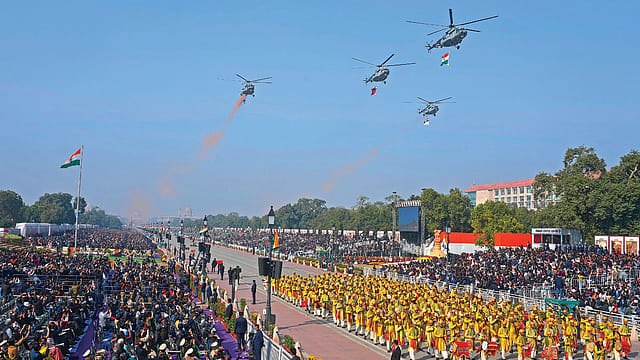
I HAD A RATHER quiet but no less eventful Republic Day. Instead of watching the pageant on TV, I spent an-hour-and-a-half with a distinguished former diplomat and famous writer. “I have never seen as much patriotism as is evident, indeed superabundant, now,” he observed. “We wear our pride in the Republic not just, as it were, on our sleeve, but have it pinned to our chest.”
“But here’s the catch,” he said, returning to the topic of conversation, “The love of one’s country, even motherland, is, after all, a passion for something abstract.” I leaned forward, wondering where this was heading. A punch line was sure to follow, after the intended, even practised pause. And it did come.
“To me it seems that if we really loved our country, we would love its people, its flora and fauna, its rivers and lakes, its mountains and deserts, above all its villages, towns, and cities. But do we? Worse, do we love our fellow- Indians? If fraternity is one of our constitutional values, isn’t it at its lowest ebb? Instead, we revel in numbers, in statistics, and, sadly, mega events which, more often than not, are meant to distract and divert us from the ground realities.”
As India marked the 76th anniversary of its Republic Day on January 26, 2026, the nation was awash in a sea of saffron, white, and green. Parades, flag-hoisting ceremonies, and cultural tableaux dominated the landscape, from the grand Rajpath, now Kartavya Path, to humble school grounds in remote villages. This year, the celebrations felt particularly passionate, amplified by digital fervour on social media and state-sponsored events.
I love India, always have. More than ever, I realise with what immense sacrifice and against what great odds we built this great country. Such, truly, as is the envy of the world. We have everything we need—and much more—to rise to even greater heights. Pride in ourselves, in our ancient past, is of course needed, but shouldn’t we really focus on the present, even the future?
And when it comes to patriotism, the distinguished diplomat-writer was surely right: we all love India, but do we love Indians? “No, I don’t,” said a society lady to whom I asked this question. “It is not that I love my country any less,” she said, her voice rising a couple of decibels, “but Indians! I can’t stand them. Look at us—how uncaring we are to one another, how shabbily we treat not just our servants but our social or economic inferiors.”
I saw that she was about to get even more worked up. “And how we lack civic sense,” she continued, “how we litter the streets, throw our garbage everywhere, deface parks, public gardens, beaches, rivers, monuments, even temples…. We show no courtesy to one another, we are so aggressive, never queuing up for anything, but trying to push ahead. In Delhi, we drive atrociously. Two and three-wheelers are even more erratic, even dangerous. And the buses are a law unto themselves; they don’t even follow the traffic rules. No vehicle in Delhi is unscratched. Abroad, too, we have now started behaving badly, singing and dancing in front of famous landmarks, then posting these obnoxious ‘reels’ on social media… We treat fellow-Indians badly enough, then what of animals? Our cruelty and callousness is unimaginable, despite all our claims to non-violence. Do you know how many strays they’ve slaughtered just this past week…?”
I thought about the thoughtful message that may autos in Delhi carry: “Be kind to animals…pashu par daya karen….” Next, I knew she would complain about the toxic air we breathe in the capital, so I deftly turned the conversation to her latest hobby, bhajan clubbing. “Oh,” she gushed, “It is divine. Literally. And look at all those young people singing and dancing to Hindu hymns and chants. It’s spiritual—and sexy! A high without drugs or substance abuse….”
The Republic of India was born on January 26, 1950, when the Constitution came into force, transforming a newly independent nation into a sovereign democratic republic. Drafted by visionaries like BR Ambedkar, it enshrined justice, liberty, equality, and fraternity as foundational pillars. These ideals were not abstract; they were meant to bind a diverse populace fractured by colonial rule, Partition, and centuries of inequality.
Seventy-six years on, India stands as the world’s largest democracy, with remarkable achievements. Our economic growth has catapulted us to the fourth-largest economy, technological leaps in space exploration and digital infrastructure, and a vibrant cultural export through Bollywood and cuisine have also made their mark on the world. The “Amrit Kaal” narrative, envisioning a developed India by 2047, fuels hope. A hope I share as an eternal India optimist.
My day was special also because it began with a visit to a Digambar monk. I took advantage of the deserted streets, for he lives far away. Delhi looked so lovely on a cold winter’s morning. Even the daily-wage earners, who were walking to work even when the whole country was shut down, had a sort of swagger. They were scrawny, but held their heads high. The street urchins selling polyester Tricolours also giggled and played at the intersections knowing somewhere
in their bones that the country belonged to them.
The monk was listening to patriotic songs when I arrived. He smiled at me and said, “Ganatantra Diwas ki bahut shubhkamanyen/Many good wishes on Republic Day.” Then he added, “But do give a thought to those who are not as fortunate as you.”
Indeed, how can we forget that below the festive gloss, India’s human development indices reveal stark disparities. Over 800 million people rely on free foodgrains, urban slums burgeon with migrants fleeing rural distress, and in the poor classes, women are often hungry and overworked and children malnourished, even stunted.
What was lacking in our patriotism, I wondered, if it tolerated such a low quality of life for such a large section of our population? Of course, the rich in their guarded and gated communities breathed the same air. In that sense, isn’t pollution India’s greatest equaliser? Also, all Indians, urban, semi-urban or rural, suffer similar indignities of poor infrastructure, terrible traffic, and civic collapse.
India’s show of strength and military might in the Republic Day parade is, no doubt, necessary. It is not merely a reminder or throwback to our imperial past, but the signifier of our resolve to great-power status again. After all, only boots on the ground command respect in a highly insecure and militarised world. But the new Republic also demands everyday acts of nation purposiveness and ordinary compassion. Not just year pageants and ornamentalism.