Blind to Growth: Indian social scientists need to focus on the development story
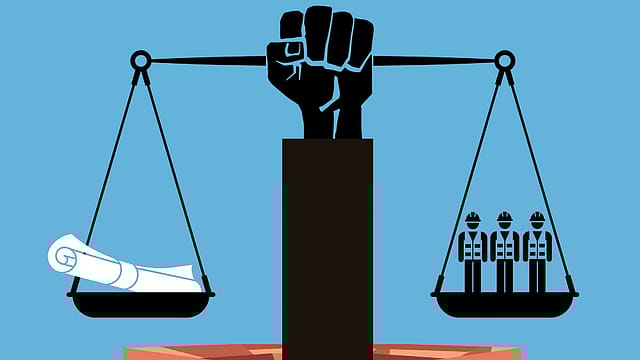
INDIA IS SOON to emerge as the third-largest economy. This economic rise indicates a vibrant developmental growth but India’s global resurgence is not supported by research from the social sciences. Most social scientists usually engage in building narratives that critique the social framework and developmental growth with excuses thrown in. That is, they escape from researching the success of development initiatives or the rapid social changes in India. They mostly focus on stereotypes of poverty, atrocities and exclusion while highlighting the country’s weaknesses. They work is on themes that allow them to criticise governance and policy.
Why is this so? The answer lies in the making of Indian social science itself. In independent India, especially in and around the 1970s, scholars returned from Western universities and took chairs and positions at prominent universities. Most of them were left-leaning intellectuals. Arvind N Das had written about how, when social science research institutes were established under the Indian Council of Social Science Research (ICSSR) in the 1960s and thereafter, many such scholars who were working towards the social changes they had envisioned joined these institutes. And they produced students who extended that intellectual legacy in a certain direction. Many stuck with their conventional definitions of progress, development, and social change. They failed to see Indian society and economy were undergoing rapid changes that ruptured the old perceptions about development.
That’s one side of social sciences in India. On the other, many social scientists based in the West, Indian or not, who work on Indian society and economy, seem impressed by the narratives created by a few Western and US universities. Their influence affects social scientists in Indian institutions. In this process, a meta narrative of social science has risen which focuses mainly on the lack of success. These lines of research are homogenous and usually fail to document the dynamic changes and speed of development in India. They do not talk about the upward movement of the poor to the lower middle class and of the lower middle class to the middle class, etc. They miss the fast circulation of money in India and how it has ended the stasis of rural India and has been gradually altering the monotony of village life. Such scholars don’t observe that while some atrocities do occur, Indian society is largely one of engagement, adjustment and local discursive strategies to resolve problems. The social sciences in India need to acquire the ability to see and then analyse the modes of social life which could provide an alternate paradigm for the rise of a new India.
To sum up, first, Indian social sciences need to respond positively to the ongoing growth and development. Second, beyond data, we need to document the social impact of this economic growth. Third, social scientists need to let go of their old politically determined stereotypes about India. Fourth, social sciences in India need to collaborate with Western academia but also contest its positions and arguments. Fifth, we need to strengthen research and collaboration in a planned manner with other countries and develop ourselves as effective anchors and leaders in global social science.
The government is working on transforming research infrastructure through the Anusandhan National Research Foundation (ANRF) and the newly introduced Viksit Bharat Shiksha Adhishthan Bill, 2025. These efforts can strengthen Indian social science research to compete with Western scholars researching not only India but also other parts of the world. Under the leadership of Prime Minister Narendra Modi, known for his socially rooted politics, and Education Minister Dharmendra Pradhan, who understands social science, we can look forward to a qualitative change in our social science research and its role in carving the future India.