A Matter of Pride: What Rahul Gandhi doesn’t get about Adivasis
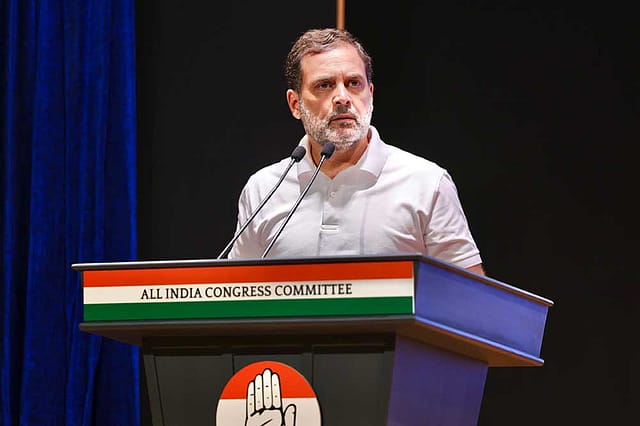
WORDS ARE NEVER mere labels. They carry a universe of meaning that shapes the present and future of societies. We must therefore be conscious of the terms we use to define the identity of any community. The Adivasi-Vanvasi binary has resurfaced in Indian political debate. What is striking is its journey from colonial anthropological texts into the heart of contemporary Indian politics. Political groups, social activists, and NGOs working to mobilise tribal communities have increasingly invoked this binary. Recently, Rahul Gandhi raised the issue at an Adivasi Adhikar Sammelan, criticising RSS and BJP for referring to tribal communities as Vanvasi. He argued that the term Adivasi better protects their traditional rights over forest resources. However, the term Vanvasi does not sever communities from those same forest resources either.
The word Adivasi carries within it an implicit divide between earlier and later settlers, generating a contested identity that has fuelled mobilisational conflict. The origins of this divide lie in the colonial Census. In 1891, colonial anthropologist HH Risley introduced anthropometric measurement and divided Indians into two racial categories—Aryan and Dravidian— based on skin colour and nasal indices. He and his contemporaries promoted the notion of aadi nivasi (original inhabitant), projecting Dravidians and non-Aryans as the indigenous population and Aryans as outsiders. This concept of mool nivasi-Adivasi was thus a product of colonial anthropology, later adopted by some Dravidian politicians and early Dalit and tribal leaders.
Subsequent archaeological, anthropological, and linguistic research has challenged this framework. The excavation at Rakhigarhi and linguistic studies by scholars such as Ram Vilas Sharma and Bhagwan Singh have dismantled the Aryan invasion theory, demonstrating that the Aryans were native to this land. This research has also shown that Indian civilisation emerged organically across distinct geographical regions— hills, river plains, and forests—without requiring the arrival of outsiders. Migration between regions certainly occurred, shaping local demographics, but the notion of a fundamental divide between original and later settlers has been exposed as a colonial myth, constructed to divide and rule. The term Vanvasi, used by some RSS pracharaks and BJP leaders, appears in the Ramayana and other ancient texts to denote communities settled in forest zones. By recognising their ancient presence in those landscapes, the term affirms traditional rights over forest resources without constructing an adversarial distinction between aadi (original) and uttar (later). Either term may be used depending on context.
What must be avoided is the deliberate stoking of identity meanings that lead to social conflict. Whether by academics or politicians, the reinvention of divisive colonial frameworks, knowingly or otherwise, risks lasting harm to social cohesion. Such terms may serve short-term electoral purposes through aggressive community mobilisation but they create long-term negative narratives that come to dominate the selfunderstanding of communities and others’ perceptions of them.
Tribal communities constitute 8.6 per cent of India’s population, scattered across forest regions in states such as Madhya Pradesh, Chhattisgarh, Jharkhand, Odisha, Gujarat, and Telangana. They play a decisive role in electoral outcomes across several states, and political parties have developed distinct methods of engaging with them. Congress tends to evoke a conflicted, dissenting tribal history to generate political mobilisation. BJP, by contrast, seeks to cultivate community pride and aspirational confidence, presenting tribal communities with a developmental identity and calling them Janjati. BJP-led governments have institutionalised occasions to commemorate tribal heritage, such as Janjatiya Gaurav Divas, celebrating icons who contributed to the making of the Indian nation and society. The past is a reservoir of many kinds of memories and narratives. What one chooses from it, and why, reveals far more about the present than about history itself.