A Dying Revolution
REVOLUTIONS DIE IN THE BLOOD of the first dreamer. Or that is what we have seen in history’s soiled pages of liberation. Between the origin and the finale, it is a long passage of power and euphoria, paranoia and pathology, fear and control—and of slogans that ridicule reality. Revolutions, always, need constant surveillance; the panopticon can never afford to be kind for the simple reason that the sovereignty of happiness is always under the threat of the counterrevolutionary. In the end, the street becomes one with the conscience; tanks and guns can’t win the battle for a lie.
The initial promise of a revolution is projected as a rejoinder to the profanities of nobility. There is invariably a Romanov before a Lenin: the excess of freedom and the anger of justice. When Lenin landed at the Finland Station in what was then Petrograd from exile, it was a prelude to the heroism of ideology, which in its sales pitch, painted a future brighter than what Christianity did—and without the symbolism of the cross. Revolutions would have a different set of symbols, all bringing out the systematic burial of freedom in the wastage of a dream.
There is a similar Iranian story. When Ayatollah Ruhollah Khomeini arrived home from exile, he too was a revolutionary with his own Book of Deliverance. He too launched a tomorrow with a moral content, as opposed to Iran’s last Shah Mohammad Reza Pahlavi’s monarchic hedonism. Iran’s own Romanov could have jackbooted the first stirrings of the revolution. The Shah underestimated the social legitimacy of the revolutionary, and when his reign became untenable, he fled the country.
The birth of the Islamic Republic replaced ideology with faith. It was the 20th century’s first revolution in which the mandate passed from man to God. The Ayatollah, with his flowing beard and piercing eyes, was an angry prophet, though he was in no hurry to open the Islamic Gulag. He was quick to put the American Shaitan on a rhetorical trial. Every revolution needs an enemy, within and without. America had the resonance of the demonic for the purest of them all raging against cultural decadence. It was a familiar script: first the external enemy necessitated by the urgency of nationalist mobilisation; then the war on the internal one, persistent with questions, daring to break the enforced idyll, all those Book-defiers.
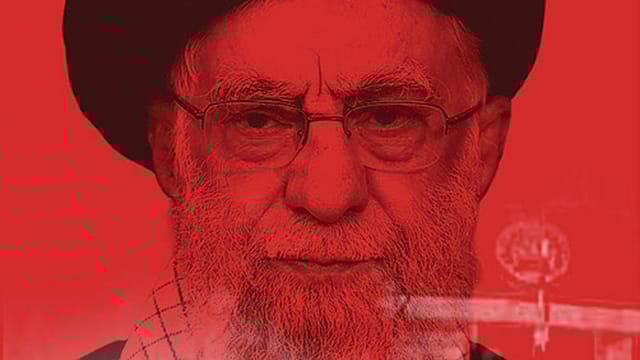
Iran’s wars, both internal and external, intensified with the rise of Khomeini’s successor, Ayatollah Khamenei, currently the world’s longest-serving tyrant. He turned the theocratic dictatorship into the world’s most resourceful exporter of revolutionary terror. Within, the prisons swelled with enemies—the young, women, activists, artists… He achieved a terrifying balance between brutalisation at home and proxy terrorism abroad. The international retailing of the revolution has resulted in a network of terror focused on Israel, and by association, America. As spiritual guide, weapons supplier and financier, Iran is there behind every missile fired from Yemen by the Houthis, every attack on Israel by the Hezbollah, and behind the permanent terror campaign of Hamas in the name of Palestine. Apart from the collapsing economy, torture chambers, and cultural stifling, the revolution’s legacy in its 48th year is an incendiary Middle East. Even as the revolution unravels at home, its legacy remains a dark reminder elsewhere.
And it is unrealistic to believe that Donald Trump can accelerate the demise of a moribund revolution. In his most desperate moment, every revolutionary resorts to maximum repression when a people overcome fear. Iran, with its key terror executives already assassinated and its nuclear facilities badly crippled by America’s bunker busters, is at its most vulnerable phase. Trump, whose bombast cannot conceal the shrinking of his presidency, only wants to teach the shaky regime a lesson by the targeted bombing. A restoration of democracy, which means the elimination of the theocratic state, or even a Maduro treatment to the Ayatollah, is not what Trump wants in Iran. It is just another entry in his glossary of self-mythification. It is not the idealism of a Wilsonian but the impulses of a narcissist that drive Trump’s internationalism. A limited missile lesson by Trump, some Iran watchers think, may be appreciated by the Ayatollah. A whiff of martyrdom can rally nationalist sentiment. Iran needs a rescuer more meaningful than Trump. As meaningful as Iranians.
Revolution dies under the weight of its lies. In Iran the last gasps of a liberation theology that shook the Islamic world in 1979 are set against the surge of resentment. Torture chambers have never defeated resistance in the history of unfreedom. The groundswell of courage that rattles the scriptural dictatorship can afford any number of catalysts, including Trump’s America. Missiles fired from an American warship, whenever they come, can only add some atmospherics to the denouement of the last doddering revolution.