Undeliverable: The Unrealistic Demands on Gig Workers
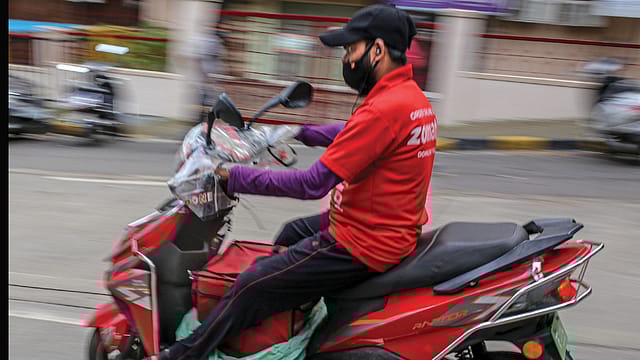
Earlier this week, at the Centre’s intervention, delivery aggregators have started ending the 10-minute delivery promise from their delivery services, fulfilling a key demand of gig workers’ ‘unions’ and some political parties. Last year, with the notification of the four labour codes, gig workers were brought under the ambit of the social security infrastructure hitherto available only to workers in the formal sector.
The accession to these demands, made in a shrill debate conducted online, go some distance in addressing the concerns of these workers even as online delivery aggregators watch these developments with unease in what has been a one-sided debate against them. The reality is, of course, very different from claims of ‘unfairness’ of gig work and ‘exploitation’ of these workers in a sector that is one of the fastest growing in the Indian economy and has generated jobs at a pace unmatched by any other area with the possible exception of construction.
In contrast to the shrill rhetoric about fairness, equality and safety, the numbers cast the story in a different light. The controversy over 10-minute delivery being a risk to these workers and the poor wages in the sector peaked early in January this year when owners and promoters of these companies were forced to come out in the public and defend themselves.
Soon after the controversy broke and the strike was launched, Deepinder Goyal, the founder of Zomato, presented a very different picture with a different set of numbers. Taking to X, he stated that if a delivery partner were to work for 10 hours every day for 26 days a month, he would earn ₹26,000 in gross earnings. Subtracting for fuel and maintenance, which amount to around 20 per cent of earnings, a delivery partner would get ₹21,000 in a month. This is based on the 2025 average earnings per hour (EPH), excluding tips, for a delivery partner on Zomato. This EPH stood at ₹102 in 2025 and was ₹92 in 2024. Delivery partners get all the tips given by customers.

The Liberation of Bengal
05 Jun 2026 - Vol 04 | Issue 74
A silent revolution ends the reign of fear
Goyal added, “In 2025, the average delivery partner on Zomato worked 38 days in the year and 7 hours per working day, reflecting true gig style participation rather than fixed schedules. Only 2.3% of partners worked more than 250 days in the year. Demanding full-time employee benefits like PF, or guaranteed salaries for gig roles doesn’t align with what the model is built for.”
These numbers have been disputed as being “too optimistic”. In one report, published in the Indian Express on January 14, a fortnight after Goyal put out the earnings calculation, a journalist spent three days working as a delivery agent for three different gig economy firms. He went on to write that, “At Rs 355 at the end of six deliveries, Zomato yielded the most earnings, followed by Blinkit at Rs 313.27 (11 deliveries), while Swiggy brought in just Rs 114 (6 deliveries)—a figure diminished by the platform’s penalty system that docks Rs 30 every time a worker turns down an order.”
After writing at length about the “inequities” of the gig system, the journalist went on to, grudgingly, admit: “While it may not be impossible to achieve these numbers, it requires workers to commit to impossibly long hours, stay logged during peak hours, accept most orders, and work with minimal breaks, all of which takes away from the flexibility of gig work and makes it resemble formal, full-time work, without any corresponding benefits or safety nets.”

This admission of sorts—that the money sums quoted by Goyal are achievable but they don’t yield the desired benefits—lies at the heart of the misguided comparisons that inform criticisms of India’s gig economy. They can be rebutted at multiple levels.
The first is the economic level. Elementary economics says that below a certain wage—that may differ according to age, educational, regional and locational profiles—a person will not choose to work and will instead look for work elsewhere or will opt out of the labour market. This is the reservation wage below which labour supply will not equal labour demanded by firms.
The monthly earning for a gig worker put out by Goyal, ₹21,000, should be compared with official data based on National Accounts Statistics (NAS) and the Household Consumption Expenditure Survey (HCES). NAS and HCES are based on different conceptual and methodological approaches and present different perspectives on consumption and income.
The 2025 NAS pegged per capita GDP at ₹2,15,955 in 2023-24. Per capita Gross National Income (GNI) at ₹2,12,981 and Per Capita Private Final Consumption Expenditure (PFCE) at ₹1,29,967. These figures are based on current prices and not on constant 2011-12 prices. Figures based on current prices are better for comparisons of the kind in question. The first advance estimates for GDP, released earlier this month, further bump up these figures. The provisional estimates for 2024-25, for per capita GDP stand at ₹2,34,859; for per capita GNI at ₹2,31,462; and for per capita PFCE at ₹1,44,165.
Divide all these figures by 12 to get a monthly figure and one can see that 2₹1,000 is still higher than all these aggregate sums. But an even better comparison can be made using the HCES 2022-23, the one set of estimates that has been analysed threadbare by economists (and activists as well). The government released a more recent edition of HCES in December 2024 that updated figures from 2022-23 to 2023-24.
If one goes by HCES 2022-23 data, the bottom decile, or the bottom 10 per cent of the population, had a monthly consumption of ₹1,578 in rural areas and ₹2,024 in urban areas in 2023-25 while the top decile had a monthly consumption of ₹8,570 in rural areas and ₹16,611 in urban areas. Even if one assumes that gig workers consume everything they earn, their earnings are still higher than the top decile in urban India.
The 2023-24 edition of HCES has figures for Monthly Per Capita Consumption Expenditure (MPCE) for various states. For making comparisons for the gig economy, it is important to compare these figures for labour surplus states such as Uttar Pradesh (UP) and Bihar, states with a net outward migration towards metropolitan areas like New Delhi and Mumbai. The all India MPCE (rural) in 2023-24 stood at 4₹,122. For UP, this figure was 3₹,481 and for Bihar ₹3,670; both well below the all-India figure.
Given these statistics, is it surprising that workers from these and other states continue to enter the gig workforce? The choice is stark: either they stay back home, earn and consume much less, or come to zones where gig work is available. There are no reliable studies, profiles and statistics about the income conditions of these workers before they joined gig platforms, their social conditions—the villages they come from and their background as farm workers or labourers—and a full comparative analysis is difficult. But beyond the rhetoric of exploitation, it is abundantly clear that these workers choose to enter gig work as that offers a better option in contrast to what they have back home.
One more point needs to be made here: these workers and their families back home are not in the grip of destitution and hence, allegedly, they have to enter “voluntary exploitation” in urban India. In the last five to six years, the Centre has greatly expanded the welfare net in rural India. The problem for rural areas in these states is that there is no economy worth its name: income earning opportunities are non-existent, unless, of course, one counts the erstwhile Mahatma Gandhi National Rural Employment Guarantee Scheme (MGNREGS) as income. The quest for work brings these workers to big cities. This is hardly the stuff of exploitation as has been alleged by certain political parties and commentators.
IN 2022, NITI Aayog issued a report on the nature of gig work and the gig economy in India. The report outlined a set of policy recommendations for gig workers. These recommendations included paid sick leave; health access and insurance; occupational disease and work accident insurance; retirement/pension plans and other contingency benefits; and support to workers in case of irregularity of work. If one looks around, a slew of such social protections have been launched by the Centre that ranges from the Ayushman Bharat Pradhan Mantri Arogya Yojana to the Atal Pension Yojana. These schemes offer affordable social protection and if made use of in a rational manner, take care of a major portion of social security concerns for workers in the informal sector and that includes gig workers. There is, of course, more that can and should be done.
It is interesting to note that these schemes have been launched by the Centre even as state governments ruled by the opposition, that seeks to mobilise gig workers, has done little in tangible terms except making noise.
The problem with the equity and equality arguments is that they are based on non-economic criteria. These criteria sound good in theory but in the rough and tumble of daily life they present stark choices. Consider the facts. Almost all gig workers are unskilled and had it not been for gig platform work, they would be looking for manual work in the areas from where they hail. Demands like a minimum of 4₹0,000 per month in wages would bankrupt any company in these domains. This figure is almost double that of what a gig worker can earn on a net basis. The only way to achieve this level of income is to either dramatically increase the net cost of goods and services being delivered to consumers, be it rides in cabs operated by aggregators or food and groceries delivered by platform workers. That will erode the price and convenience advantage that powers the growth of platform companies. If that were to happen, the workforce employed by these firms would be out of work. Is that even a choice? The critics have not bothered to answer this question even as they moralise their way to unrealistic arguments.
The equality argument is similarly flawed. At its root is the claim that a society that is highly unequal economically ultimately faces growth headwinds. Superficially, this claim is plausible. How does it square with facts? Consider two: consumption as a percentage of India’s GDP stands at 56 per cent and has been nearly constant for a while, and India’s real GDP growth is in the 6-7 per cent per annum range. Even if one were to admit that India is a highly unequal society—and it is a fact that India’s income Gini remains elevated even as consumption inequality has declined—how does one explain such massive consumption and growth figures? (India is a $4 trillion-plus economy, depending on what figure one uses for the rupee-dollar exchange rate.) High income inequality eroding the very basis of economic growth is a problem for Western economies, not for India. Here it is a shibboleth deployed for political purposes. The moral sheen behind such claims is just what it is: a patina behind which unstated but very real political arguments lurk.