‘Mother of All Deals’ Coming Today: India, EU Set to Announce Trade Agreement
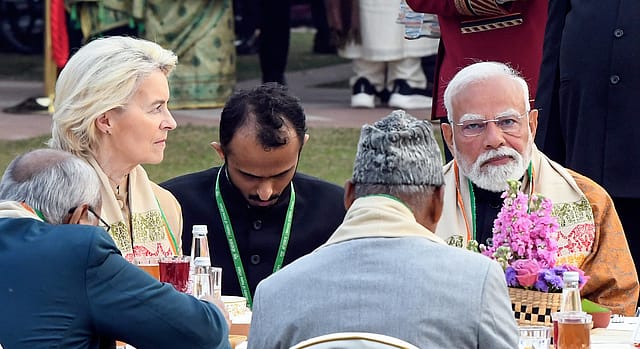
After nearly two decades of negotiations, pauses, relaunches and recalibration, India and the European Union are set to announce what both sides are calling the “Mother of all deals” today, one of the most consequential trade agreements in recent global economic history.
The India–EU free trade agreement (FTA), concluded successfully on Monday and slated for announcement at the India–EU summit on Tuesday, brings together two economic giants that together account for nearly one-fifth of global trade and around a quarter of the world’s population. Beyond tariffs and trade flows, the deal signals a deeper strategic alignment at a time when global supply chains, geopolitics and economic alliances are being rapidly redrawn.
Commerce Secretary Rajesh Agrawal confirmed that negotiations have concluded and described the agreement as balanced, forward-looking and transformative. While the formal signing will take place after a legal scrubbing process, expected to take five to six months, the deal is likely to enter into force sometime next year.
At the heart of the agreement is a long-standing ambition: to unlock trade and investment potential between India and the EU by lowering barriers, opening markets and integrating supply chains more deeply. Negotiations were first launched in 2007, stalled, and then restarted in 2022, reflecting how much the global economic context has changed.
The Abandoned Kejriwal
01 May 2026 - Vol 04 | Issue 69
Brain drain from AAP leaves Arvind Kejriwal politically isolated
European Commission President Ursula von der Leyen framed the agreement as a deliberate geopolitical choice. “India and Europe have made a clear choice, the choice of strategic partnership, dialogue and openness,” she said, adding that the partnership demonstrates to a fractured world that cooperation remains possible.
European Council President Antonio Costa echoed that sentiment, calling India a “crucial partner” for the EU and underlining the shared responsibility to protect a rules-based international order.
Why the Deal Matters
In pure trade terms, the numbers are already substantial and growing. The EU is India’s second-largest trading partner in goods, accounting for 11.5% of India’s total goods trade. In 2024 alone, EU–India trade in goods exceeded €120 billion, with EU imports from India worth €71.4 billion and exports to India valued at €48.8 billion.
Over the last decade, bilateral goods trade has doubled. EU imports from India surged 140%, while exports to India rose 58%, reflecting expanding commercial ties even without a comprehensive trade pact.
Trade in services tells an even stronger story. In 2024, EU–India services trade crossed €66 billion, more than doubling over the decade with a growth of 243%. Key sectors include IT and digital services, telecommunications, professional consulting and transport—areas where India’s strengths align closely with European demand.
Foreign direct investment further underlines the depth of the relationship. With over €132 billion invested in India, the EU is currently India’s largest foreign investor.
What Changes With the FTA
European Union Trade Commissioner Marcos Šefčovič described the pact as the “mother of all deals” because of its sheer scale and impact. The agreement is expected to significantly reduce India’s high import tariffs, which currently run as high as 150% in some sectors, opening parts of the Indian market that have long been inaccessible to European exporters.
At the same time, sensitive sectors on both sides will be excluded, ensuring that liberalisation remains targeted rather than disruptive. The result, Šefčovič said, would be a free trade area covering nearly two billion people, creating one of the world’s largest economic corridors.
For Brussels, the deal is also strategic, part of a broader effort to diversify trade ties beyond the US and China. For India, it aligns with a gradual opening of markets to foreign investment and deeper integration with global value chains.
Beyond Trade: A Strategic Partnership
The deal will be unveiled at the 16th India–EU Summit in New Delhi, hosted by Prime Minister Narendra Modi, with von der Leyen and Costa representing the EU. Leaders are expected to adopt a joint comprehensive strategic agenda, spanning four pillars of prosperity and sustainability, technology and innovation, security and defence, and connectivity and global issues.
EU leaders have already signalled momentum beyond trade. Vice-President of the European Commission Kaja Kallas said the EU is seizing the opportunity to deepen cooperation, announcing that an EU–India Security and Defence Partnership will also be signed, covering maritime security, cybersecurity and counterterrorism.
Symbolically, personnel from EU naval missions Atalanta and Aspides are participating in India’s Republic Day parade for the first time, underscoring how economic cooperation is now intertwined with security and strategic trust.
A Deal Years in the Making
Around 6,000 European companies already operate in India. With tariffs lowered, services opened and investment protections clarified, that number is expected to grow. For India, the deal promises greater access to European markets, technology and capital. For Europe, it offers scale, growth and diversification.
After years of negotiation, the announcement today marks not just the conclusion of a trade deal, but the beginning of a new phase in India–EU relations, shaped as much by geopolitics as by economics.
(With inputs from ANI and yMedia)