India’s Economy Under Pressure as Brent Crude Crosses $100, Says Report

India’s economic outlook is facing renewed pressure as geopolitical tensions in West Asia push crude oil prices higher. A recent Union Bank of India report lays out how disruptions in a critical global oil route are rippling through inflation, currency stability, and financial markets.
Why is the Strait of Hormuz so critical?
The Strait of Hormuz is one of the world’s most important oil transit chokepoints, and any disruption there has immediate global consequences. According to the report titled "From Hormuz to the Rupee: War, Oil and the Global Repricing of Risk", the situation is already severe.
It noted that the Strait of Hormuz is “still functionally shut and Brent trading above $100/bbl, the backdrop does not bode well for global or domestic macros and markets.”
The report further warned that “higher oil keeps inflation risk alive, delays central-bank easing, pressures current accounts, tightens financial conditions, and weighs on risk assets, especially in energy-importing economies,” highlighting India’s vulnerability.
How is this impacting India right now?
India, which imports nearly 85 per cent of its crude oil, is already feeling the effects. The surge in oil prices has effectively created what the report describes as an economic burden.
“As the escalation of the Iran-Israel conflict disrupted flows through the Strait of Hormuz, pushing Brent crude oil above $100/bbl... this translated into a visible 'energy tax,' with the rupee sliding to record lows near 95 and equities correcting on CAD and imported inflation concerns,” the report said.
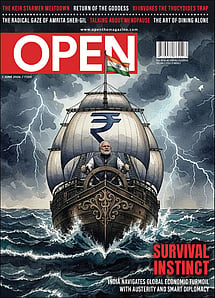
Survival Instinct
22 May 2026 - Vol 04 | Issue 72
India navigates global economic turmoil with austerity and smart diplomacy
The Indian rupee, in particular, has been under sustained pressure. The report observed that the currency “exhibited a modest depreciation bias... as strong global dollar momentum, intermittent capital outflows, and elevated geopolitical uncertainties outweighed otherwise resilient domestic fundamentals.”
What is the RBI doing to stabilise the situation?
The Reserve Bank of India has stepped in to manage volatility and maintain stability in financial markets. Measures include tighter forex exposure norms and liquidity support.
“The RBI's Monetary Policy Committee (MPC)... maintained the policy repo rate unchanged at 5.25%, while reiterating the neutral stance,” the report said, adding that the central bank remains ready to act if volatility intensifies.
Are there any signs of resilience in the economy?
Despite mounting pressure, some indicators offer limited relief. India’s merchandise trade deficit narrowed to $20.7 billion in March 2026, helped by reduced imports of bullion and energy.
However, the broader outlook remains uncertain and heavily tied to oil price movements.
What risks lie ahead for inflation and growth?
The biggest concern is sustained high oil prices. The report cautioned that if disruptions continue, “Brent is likely to hold in the $100-110 range, risking fuel price pass-through and CPI drifting above 4%.”
It also underlined how sensitive India’s economy is to oil fluctuations, stating that “every $10/bbl move in oil price” can significantly widen the current account deficit and push inflation higher.
Looking ahead, the rupee is expected to remain under pressure. “The INR is likely to trade with a mild depreciation bias... as elevated Brent crude oil prices, evolving geopolitical risks, and a firm United States dollar offset relatively stable domestic fundamentals,” the report said.
What ultimately determines India’s economic outlook?
The trajectory of the West Asia conflict will be the key factor shaping India’s near-term economic outlook. Oil prices and global financial conditions remain the primary triggers.
The report concluded that India’s fortunes will depend largely on how the geopolitical situation evolves, with risks firmly tilted to the downside if disruptions persist.
(With inputs from ANI)