Geopolitical Tensions, Expensive Crude Push Sensex And Nifty Lower
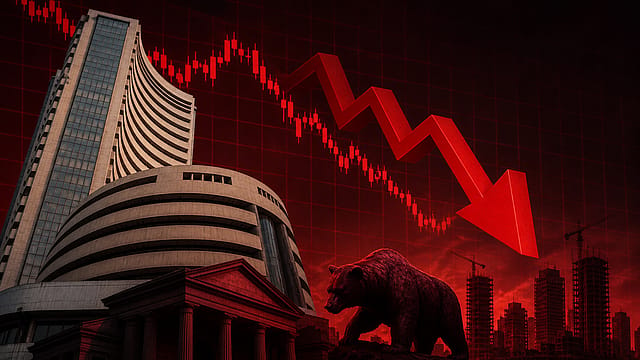
Indian benchmark indices opened sharply lower on Friday as rising crude oil prices, geopolitical tensions in West Asia, and persistent foreign investor selling weighed heavily on investor sentiment.
The BSE Sensex slipped 443.89 points, or 0.57 per cent, to 77,400.63 in early trade, while the NSE Nifty 50 fell 113.65 points, or 0.47 per cent, to 24,213.00.
The selloff reflected growing concerns that a prolonged spike in oil prices could worsen inflationary pressures, weaken the rupee, and hurt India’s import-heavy economy.
Why Crude Oil Is Suddenly A Major Market Concern
The biggest trigger for the decline was crude oil crossing the psychologically important USD 100-per-barrel mark.
At the time of filing this report, Brent crude rose 0.97 per cent to USD 101.03 per barrel, while crude oil prices gained 0.82 per cent to USD 95.59. Gold prices also climbed 0.82 per cent to USD 4,724.76, indicating increased demand for safe-haven assets amid uncertainty.
For India, which imports the majority of its crude oil requirements, higher energy prices typically translate into elevated inflation, higher transportation and manufacturing costs, and pressure on government finances.
Rising oil prices also tend to weaken the Indian rupee because more dollars are needed for imports. A weaker rupee can further discourage foreign investors from increasing exposure to Indian equities.

Exclusive: To the Heavens and Back
19 Jun 2026 - Vol 04 | Issue 76
Shubhanshu Shukla relives the space odyssey that put India into orbit
Banking And Auto Stocks Lead The Fall
The pressure was most visible in sectors that are sensitive to interest rates, fuel costs, and consumer demand.
The Nifty Private Bank index declined 0.96 per cent, while the Nifty Auto and Nifty Oil & Gas indices fell 0.87 per cent and 0.78 per cent, respectively.
Financial services and PSU bank stocks also traded lower.
However, the broader market picture was not entirely negative. Selective buying in FMCG, IT, and pharmaceutical stocks helped cushion the decline in benchmark indices.
Geopolitical Tensions Continue To Keep Investors Nervous
Market participants remain focused on escalating tensions in West Asia, which have created uncertainty across global financial markets.
VK Vijayakumar, Chief Investment Strategist at Geojit Investments Limited, said the global market response has been uneven despite geopolitical stress.
"An important market trend amidst this crisis is that despite this geopolitical tension some markets are doing extremely well while some others are performing poorly. South Korea and Taiwan are the star performers this year with 71% and 40% returns YTD. These excellent returns have been generated by a few AI stocks," Vijayakumar said.
He also highlighted the central role crude oil is playing in determining India’s market trajectory.
He further stated that crude oil remains the biggest variable for Indian markets, and any easing in US-Iran tensions could provide strong support to equities as well as the Indian rupee.
Why FIIs And DIIs Are Pulling Markets In Different Directions
Another important theme shaping Indian equities is the ongoing tug-of-war between Foreign Institutional Investors (FIIs) and Domestic Institutional Investors (DIIs).
Foreign investors have remained cautious amid dollar strength, rising global uncertainty, and concerns over India’s energy exposure. Domestic investors, however, continue to absorb much of the selling pressure.
While FIIs remain tactical and inconsistent in their approach, robust domestic participation through SIP inflows and retail investing has provided resilience to the broader market.
This divergence has created an unusual market pattern where benchmark indices remain under pressure even as segments like midcaps, defence, capital goods, and power stocks continue to outperform.
Broader Markets Continue To Show Strength
Despite volatility in frontline indices, broader market segments have shown remarkable resilience.
"In contrast, India, impacted by the energy crisis, has delivered negative returns with Nifty posting -6.96% return YTD. An important trend in India is the outperformance of the broader market. The Nifty Midcap index is now at a record high despite high valuations. Nifty is being weighed down by sustained FPI selling, particularly in heavyweights in banking and IT," added Vijayakumar.
The continued strength in midcaps reflects sustained retail participation and confidence in domestic growth-oriented sectors, even as global uncertainty clouds near-term sentiment.
What Investors Will Watch Next
Going forward, investors are expected to closely monitor crude oil prices, developments in West Asia, US Federal Reserve commentary, and the trajectory of the rupee.
Any signs of easing geopolitical tensions or cooling oil prices could trigger a recovery in Indian equities. However, if crude prices remain elevated for a prolonged period, inflation risks and foreign outflows may continue to keep markets volatile.
(With inputs from ANI)