Dancing in the Dark: Mumbai’s dance bars reinvent themselves as orchestra bars
SOMETIME IN THE mid-1990s, Ramashankar Yadav boarded a train from his hometown in Uttar Pradesh, along with some friends who had to fly out of Mumbai for their new jobs in Dubai. Yadav didn’t really have much plans on how to spend his time in Mumbai, except to hang around with his friends for a few days till their departure, and then to return home. But on the train, he met a stranger who would offer him another alternative. “We became friends instantly,” Yadav says. “We started talking, ate together, and he told me everything there was to know about hotels in the city.”
This individual had worked in a number of small hotels in Mumbai, and using his connections, Yadav got the job of a cashier in a dance bar, later rising to become its manager. “The work was hard, but never dull. We would get to sleep only in the mornings, once the bars closed. We would put two tables together, place menu cards over them, and then sleep over it,” he says. It was hard work. But it was never boring and it paid well.
Business was good, and Yadav was enterprising. By 2001, he was running his own dance bar, a popular spot in the western suburb of Mahim. But then came 2005, the time when the state’s then Home Minister RR Patil banned dance bars, calling them a den of vice and obscenity. “Everything just went downhill from there,” he says.
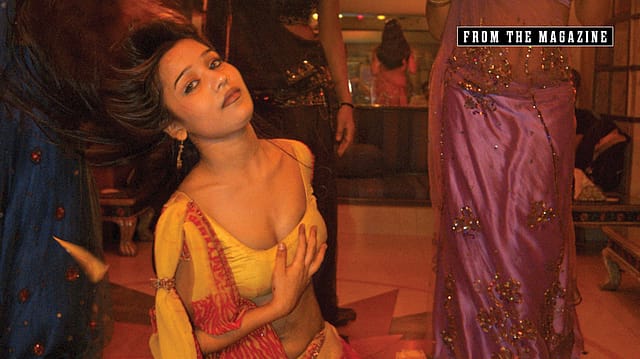
Yadav would get involved, along with owners from other dance bars, in a long drawn out court battle to get the dance bars restarted. Even when the court eventually ruled in their favour and allowed for the dance bars’ reopening, the provisions under which licences could be granted were so strict and the government’s attitude allegedly so hostile that the reopening of dance bars was on paper only. But owners like Yadav found a workaround. Instead of trying to procure licences for dance bars, they would get those meant for orchestra bars, which was more easily available and where the women could be employed not as dancers, but as crooners and waitresses. Although the owners of these bars, now called orchestra bars, insist that they run their businesses differently, with the female singers at most swaying while singing instead of dancing like before at dance bars, in reality, in many such bars, that distinction can be hard to miss. But it appeared it was working. The middle classes and politicians, so outraged at the idea of establishments where erotic dance was done, felt assuaged that it had shuttered down. The police, usually on the take (as alleged by many bar owners), were happy to look away. And inside these orchestra bars, some semblance of the past, of carefree bar dancing and patrons who turned up night after night, could be recreated. This now is under threat once again.
The Maharashtra government has introduced a Bill that moves the section under which licences for orchestras could be procured from the relatively easier Maharashtra Police Act to the stringent one that governs dance bars [the Maharashtra Prohibition of Obscene Dance in Hotels, Restaurants and Bar Rooms and Protection of Dignity of Women (working therein) Act, 2016]. “It has been observed that, to evade the restrictions imposed on dance performances in hotel, restaurant or bar room under the Prohibition of Obscene Dance Act... live music performances (orchestra) licenses granted under the Maharashtra Police Act are being used as an alternative for dance performance licenses in hotel, restaurant or bar room under the Prohibition of Obscene Dance Act. To curb this practice, the Government considers it necessary to bring live music performances (orchestra) within the purview of the Prohibition of Obscene Dance Act and to exclude the licences of the live music performances (orchestra) in hotel, restaurant or bar room from the purview of the Police Act,” the Bill reads. After the Bill was tabled, Pankaj Bhoyar, the minister of state for home who tabled it, told reporters, “In 2016, the Maharashtra government enacted a law to provide protection to workers employed in bars, hotels, and restaurants where alcohol is served… But in many places, we have observed that despite this law, in the name of orchestra, many wrong things are being done there.”

The news of this law came as a big setback to Udaykumar Shetty who runs an orchestra bar in Mumbai’s Ghatkopar area. “All these years of struggling with the government. And now again, we are back at it,” he says.
According to Shetty, the government’s motive behind this new Bill is not to regulate dance and orchestra bars but to close it down. Back in 2019, after the Supreme Court ruling striking down certain provisions of the 2016 law led to an air of hopefulness among former dance bar owners and workers, Shetty, along with around 25 other former dance bar owners, approached the government for licences, but, he says, none of them got it. “They just made sure you couldn’t get it. The police will come to your bar, find some small fault or the other, even though you are following everything as mentioned in the law,” he says. “Now, they are trying to get us to shut these orchestra bars too.”
Although they may have got licences to operate orchestra bars, it wasn’t free from pressure. According to the owner of an orchestra bar who requested anonymity, police officials or their sources often come to these bars and harass the staff and owners and ask for bribes. “Sometimes, they [the police] will say the singer is dancing, when really she is only swaying a bit while singing and claim we are breaking rules,” Shetty says. “How can you expect someone to sing and not even move a bit? It’s not like she is a robot.”
Yadav believes the current Bill is being introduced out of personal animus. “It’s an ego thing,” he says. “Because back in 2005, the government shut us down, but we went to the courts. That’s why they are going after us again.”
Since news of the new Bill began doing the rounds, owners of dance bars have again begun meeting to chalk the way forward, and are exploring challenging the Bill legally, when it comes into force. “That’s the only way,” says Yadav. “We won’t take things lying down.”
DANCE BARS ARE believed to have emerged in Mumbai sometime in the 1970s. Some have suggested that the exposure of migrants to similar establishments in the Gulf countries led to the early growth of such bars in the city. Mumbai anyway had a mujra culture that stretched back to the British era. And as the traditional patronage to dance forms like the mujra, lavani and tamasha waned and declined, the dancers of these forms found a new source of employment in the city’s growing dance bar scene. The first dance bar is believed to have opened in Nariman Point, then the business district of the city, in 1972. Called Sonia Mahal, it is said to have been run by a Parsi gentleman with a heart problem, who would often joke that the dancers were his “pacemaker”. In the next few decades, the city and its neighbouring areas would be dotted with dance bars. Women, many of them from dancing communities, would move from across the country to work in the city’s dance bars, and soon enough, an industry involving not just dance bars and their dancers, but also a parallel one involving waiters, tailors, taxi drivers, snack sellers, and so on had emerged.
This all came crashing down in 2005, when the government first went after these establishments as dens of vice and obscenity. According to Shetty, there must have been over 600 dance bars in Mumbai alone. Varsha Kale, an activist who worked closely with bar dancers and formed a union for them called Bharatiya Bar Girls Union, believes there were around 50,000 bar dancers and an ancillary staff of around 25,000 waiters and cleaners, whose jobs suddenly came under threat.
A long court battle would ensue for the next two decades, with the government trying to ban these establishments or introducing laws that would make their operation unfeasible, and the courts either overturning those laws or striking down provisions that it found unreasonable.
Dance bars were eventually made legal, but the government has remained so hesitant on issuing licences that many dance bar owners instead refashioned themselves as orchestra bars. Licences under this provision were more easily available, and unlike dance bars, which are to be shut by 11.30PM, they could stay open till 1.30AM. Not all the dance bars managed to reinvent themselves as orchestra bars. Of the estimated 600 or so dance bars in the city, around 250 of them became orchestra bars. According to Yadav, if you include the orchestra bars in the neighbourhoods outside the city, which make up part of the Mumbai Metropolitan Region, this number would go up to 500. “If every bar employs an average of 60 to 80 individuals, that’s counting orchestra singers, waiters and others, then you are talking about somewhere between 30,000 to 40,000 individuals in Mumbai and nearby areas,” Yadav says.
THESE ORCHESTRA BARS may position themselves differently from the dance bars of old, but that distinction can be very thin. The orchestras tend to be composed mostly of women, some of whom won’t even sing, but lip sync to recorded music. They will not dance but sway their bodies very slightly to remain within the bounds of law. Kale points out that, even the swaying must be restricted to their upper half, and moving their hips would be considered unlawful. Some of these bars have steel railings that separate the stage from the audience, but some of the ‘orchestra girls’ will dare to walk beyond the railings and to the patrons, to collect tips. Many of these establishments also employ women as waitresses. They will hang around the establishment with bottle openers, but appear generous in your tips, and you can have their company for the rest of the evening. “But how much can you really control?” asks Kale. “How do you define what is obscene or not? Where the swaying of your body when singing ends and dancing begins? Also, why should dancing be considered obscene in a dance bar, but item numbers be fine in our movies?” Kale asks.
Sometimes, the distinction between orchestra and dance bars vanish entirely. A video that went viral a few months ago, which some believe is the reason behind the government’s new Bill, showed a man in an orchestra bar in the city’s western suburbs, flinging wads of what appeared to be cash that lay in front of him like a small mountain, as a woman danced in front of him.
Fatima (name changed upon request), an orchestra singer in her mid-40s, who used to be a dancer earlier, says that the ban on dance bars didn’t hit her as badly as it did others. “I got married and found a job as a singer. But many other girls I knew, either moved back to their hometowns, where they suffered, or had to go into sex work,” she says. The news of the change in the licensing rules for orchestra bars now has her worried. “I feel like those old days [of the ban in 2005] might come back. All of us worry about losing our jobs. The money is not as good as it used to be during the dance bar days, but at least it is stable income,” she says.
Kale knows about the repercussions of those days well. Many of the dancers she knew suffered in the years after the ban. Some found jobs in orchestra bars, but many went into sex work, or returned to their hometowns, where they suffered abuse. One dancer she knows continues to call her looking for help. “She will call up randomly at 2AM or 3AM asking for help. Like once she called me from Goa in the night crying for help. She had gone with some old customer to Goa, and he had abused and abandoned her,” Kale says. This individual had become an alcoholic, got kicked out of one job after the other, and often got into trouble. Although now, it appears, Kale says, her condition has improved, and she has been employed as a cook for some women who work in an orchestra bar in Sambhajinagar.
“There are so many girls like her,” Kale says. “Their lives just crashed when dance bars disappeared.”
The orchestra bars that emerged in their wake may have provided a source of livelihood for some of them. But the women employed here had to conduct a tightly choreographed dance, one that catered to male desire and adult entertainment, and yet remained within an ambiguous interpretation of decency and law. According to the government, they have failed to do that.