Customers Buy Minutes. Investors Fund Years: Urban Company & the Cost of Instant India
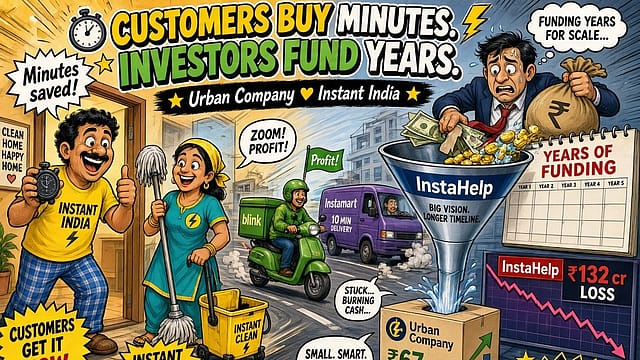
Urban Company’s businesses excluding InstaHelp reportedly generated ₹67 crore in adjusted operating profit in the June quarter. InstaHelp lost ₹132 crore on the same measure.
The established businesses were earning. The newest convenience promise was consuming more than those earnings.
That arithmetic puts Urban Company’s proposed fundraise in a larger frame. Its board will consider raising capital on October 16, just over a year after its stock-market debut. The amount and deployment remain unannounced; media reports suggest a substantial issue, with The Economic Times putting the proposed raise at ₹2,000–2,500 crore.
Across town, a grocery platform promises to save a shopping trip. A household-help platform promises to clear the sink. Both need people and operating capacity close enough to make the promise work.
Customers buy minutes. Investors finance the years required to make those minutes profitable.
THE IPO DOES NOT END THE RACE
Swiggy has already demonstrated how that financing works after a listing.

Zeroing In on ECI
09 Oct 2026 - Vol 05 | Issue 41
Constitutional legitimacy versus political opportunism
In December 2025, it completed a ₹10,000-crore qualified institutional placement. Disclosed uses included expanding and operating its quick-commerce fulfilment network, technology infrastructure and marketing. Its November 2024 IPO had been a financing milestone; another large equity raise followed.
Urban Company is now considering fresh capital while competing with well-funded instant-help challengers. Snabbit raised $56 million in April. Pronto completed a $45-million Series B with a May extension. Those rounds give the younger businesses resources to recruit professionals, enter neighbourhoods and acquire customers.
In quick commerce, Zepto performs a comparable competitive role against Blinkit and Instamart, although it has grown well beyond a fledgling challenger.
The pressure on listed companies is straightforward. They must explain present losses and future returns every quarter while deciding whether to keep investing in contested markets.
Private competitors face their own funding constraints. Public ownership, however, makes the cost of expansion visible at regular intervals—and gives shareholders another decision when companies seek fresh equity.
BLINKIT BREAKS THE EASY NARRATIVE
There is a tempting version of this story in which everyone delivers faster and loses more.
Blinkit complicates it.
In Q1 FY27, Eternal’s quick-commerce business generated ₹102 crore in adjusted EBITDA, equivalent to 0.6% of net order value. Net order value grew 86% year-on-year, and its network reached 2,443 stores.
That is an operating milestone, rather than proof that every expense has disappeared. Nevertheless, it establishes something important: rapid delivery can coexist with positive adjusted operating earnings.
Swiggy’s Instamart was at a different stage. Its contribution margin improved to negative 0.2% in the June quarter from negative 1.8% in the preceding quarter. Higher advertising income, more frequent customer orders and a wider assortment supported the improvement. Contribution margin measures revenue after variable costs; it is an earlier profitability milestone than earnings after the broader operating cost base.
The useful question is therefore what separates a network approaching sustainable economics from one still paying heavily to establish demand.
THE NEIGHBOURHOOD IS THE BUSINESS
The connection between groceries and household help becomes strongest at street level.
Both businesses need sufficient demand within a small operating area. Nearby orders can improve utilisation of fulfilment facilities and delivery capacity. Nearby household jobs can reduce the time professionals spend travelling or waiting.
Urban Company’s numbers illustrate that process. InstaHelp orders rose 43% sequentially to 3.82 million in Q1 FY27. Its adjusted EBITDA loss per order improved from ₹447 to ₹346, which the company attributed to network densification. Yet the segment’s quarterly adjusted EBITDA loss remained ₹132 crore, leaving the consolidated business with a ₹65-crore loss on that measure.
Growth was improving the economics without eliminating the cost of building the service.
The distinction matters for investors. More orders can be evidence that a network is becoming productive. They can also require further spending before demand is dense enough to support the capacity already created.
City counts and booking milestones tell only part of that story. The commercially valuable unit is the neighbourhood where customers return and available capacity earns its keep.
PEOPLE CANNOT BE STOCKED
Instant household help introduces a constraint that grocery platforms do not face in the same form.
A worker’s time cannot be stocked like a packet of biscuits.
Cleaning, dishwashing and other chores occupy a professional for the duration of the job. Travel, idle periods, training and cancellations affect how many assignments can be completed and what the worker earns.
Customers also admit someone into their homes. Trust and consistent service become central to repeat demand.
Quick commerce has inventory and fulfilment costs, but it can improve earnings through product mix, larger baskets and brand advertising. Household-help businesses must develop economics around paid work while maintaining reliable availability and acceptable professional earnings.
That makes InstaHelp, Snabbit and Pronto a test of how far the instant-commerce model can travel. The shared app interface conceals different operating problems.
HOW MUCH DOES THE HABIT COST?
Fresh capital gives competitors time to solve those problems. It can fund recruitment, availability and introductory offers while customers learn to use the service.
The decisive question is how much demand survives at prices that support the business.
Repeat bookings matter most when they improve earnings rather than require continuing incentives. Expansion becomes more persuasive when older neighbourhoods demonstrate a sustainable model that newer ones can reproduce.
Global quick commerce supplies a caution. Getir withdrew from its remaining European and US markets in 2024 after rapid expansion became difficult to sustain. That experience does not determine India’s outcome; Blinkit’s operating results already show why local evidence matters. It does demonstrate that capital and geographic reach alone cannot settle the economics.
Urban Company’s board meeting will establish what fundraising proposal it wishes to pursue. It will not, by itself, establish what InstaHelp can eventually earn.
The larger investment question spans both sectors: how much capital is needed to turn convenient trial into profitable routine?
Urban Company, Swiggy and Eternal have different answers emerging in their accounts. Snabbit, Pronto and Zepto are helping set the competitive conditions under which those answers must be delivered.
Saving the customer time is the proposition. Making that time pay is the business.