Charging Ahead: With EVs exceeding two million annual sales for the first time, India’s transition to electric mobility gains momentum
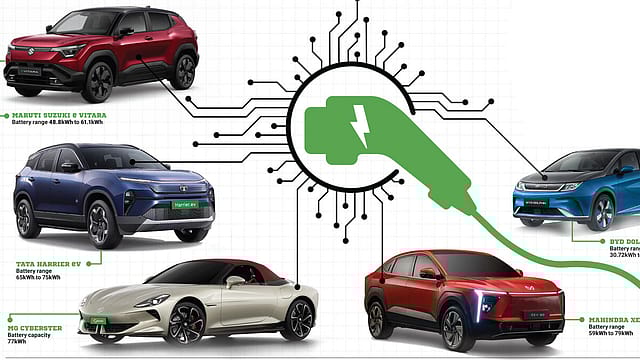
LATE ON DECEMBER 2, THE top bosses of Maruti Suzuki gathered at an event in Delhi to announce what one of its executives would later describe as the “dawn of a new era for electric mobility”. The event was meant to serve as much as a launch for the auto giant’s first electric vehicle (EV), the e VITARA, as an announcement for the creation of an ecosystem that could support it. “As we step into the electric mobility domain, we aim to enter with full readiness in terms of the product and the ecosystem,” Maruti Suzuki’s Managing Director & CEO Hisashi Takeuchi said. “The e VITARA has been designed and developed to minimise ownership hurdles, particularly around range anxiety. We are adopting a two-pronged strategy… first, by offering a vehicle with excellent driving range and… second, by building a strong EV ecosystem that ensures convenience and peace of mind for our customers.”
The e VITARA, a mid-size SUV, comes, it was announced, with a battery pack that can run up to about 543km on a single charge, which would make it one of the longest-range EVs in India. Several auto firms have announced EVs with such long ranges in recent times as a way to work around the limited, albeit growing, charging infrastructure in the country.
The firm also made a slew of announcements about the
over 2,000 exclusive charging points across 1,100 cities, tieups with Charge Point Operators (CPOs) and aggregators for more charging points, ensuring there’s a charging point, it claims, every 5 to 10km at key locations in the top 100 cities, upgrading its network of showrooms and service centres and training over 1.5 lakh staff members for electric vehicle operations, and offering Battery-as-a- Service programme, subscription plans and assured buyback plans. The fear of an EV running out of battery charge before reaching its destination or a charging station remains one of the biggest hurdles in EV adoption, and, Maruti Suzuki claims, it will work with its partners to have over 1 lakh public charging points by 2030.

Maruti Suzuki has been late to the EV game, preferring a more cautious approach so far. But it has now finally jumped in. The e VITARA, which is in fact being manufactured at its plant in Hansalpur, Gujarat, and is already being exported to a number of European markets, will become available for sale in India from next year. This new EV from the country’s largest manufacturer of passenger vehicles could provide a big boost to what is already shaping into one of the fastest growing automobile segments.
It is understandable why Maruti Suzuki wants to get in. Sales of EVs have been growing, and auto giants, nudged by the government, have introduced a slew of EVs to tap into this growing segment. Last week, the industry crossed a significant milestone, when EV registrations crossed 2 million units for a year for the first time. EV registrations stood at 2.02 million units on November 25, with a full month more to go, and well ahead of last year’s 1.95 million units for the full year.
Two-wheelers still dominate this segment. According to reports, they accounted for 1.2 million units or 57 per cent of total EV registrations this year. But it is really in the passenger vehicle category, which includes cars and SUVs, where the growth has been most explosive. The total numbers of course pale in comparison to two-wheelers, and the base figure is low in this category. But registrations in this segment saw a 57 per cent jump compared to last year, from 99,429 units by the end of November last year to over 1.56 lakh units this year. Add to this the growing presence of electric three-wheelers and buses.
“There is no doubt today that consumers are convinced about EVs…. What has also happened is that this year we have seen the big OEMs [original equipment manufacturers] participate in a big way. So in the two-wheeler industry, we have seen Bajaj entering this space, which means more competition from the top players. Similarly in cars, the key players have introduced multiple models,” says Puneet Gupta, director-India & ASEAN Markets, S&P Global Mobility. “Obviously, there are big challenges and limitations. But overall, the ecosystem is falling in place. And one big thing is that the government remains firm and consistent with their mission to push EVs in India.”
Experts like Gupta believe that India has now reached an inflection point when it comes to the EV industry, and from here, the adoption of these vehicles would be quick and large. “If you look at the industry, this year we may be close to 5 per cent penetration [in EV sales]. Generally, when the EV market touches around 4 or 5 per cent, that’s the time when the real movement starts in terms of increasing market share,” Gupta says. “The initial 3 to 4 per cent is the most difficult for any country. Once you reach around 4 per cent penetration, the customer will start to have a little bit more confidence. I think we have reached that inflection point. Hopefully, in the next two or three years, we should start seeing a good jump.”
ENTHUSIASTS OF ELECTRIC vehicles in India usually hesitate to buy EVs due to the lack of supporting infrastructure, specifically the easy availability of charging stations. But it was the dearth of petrol pumps itself in the state of Goa that was a major motivating factor for Vaibhav Chhabra to go electric earlier this year. “That was one of the biggest factors, given that I live in the village of Olaulim in North Goa,” says Chhabra, 35, who runs a makerspace in the area called Maker’s Asylum. “Apart from not having to look for petrol pumps as my fuel source, I have always wanted to give EV a shot, but it had to be a powerful enough vehicle for me to enjoy the experience of driving. The Hyundai Creta EV, which I ended up buying, ticked all those boxes.”
The car company installed a charging station in his house. And thanks to the presence of solar panels, his Creta is largely charged for free, on renewable energy. But Chhabra insists, quite like most EV users in the country, that going electric cannot be mistaken for a money-saving venture, for it is not, given that the EV variant of most mid-segment cars usually costs ₹4-5 lakh more than the standard version. The other obvious drawback, at least for Chhabra in Goa, is that he hasn’t driven his new EV out of the state, his travels currently limited to South Goa and back because a single full charge roughly converts to a mileage of 380km (even though the manual claimed to be about a hundred more).
But those are just about all the negatives, wholly outweighed by the positives of owning an EV, according to Chhabra: “The driving experience itself is excellent, especially its fabulous I-Pedal feature, which is what the Creta’s regenerative braking system is called.” Regenerative braking, for those not in the know, allows the vehicle to be driven and brought to a complete halt using just the accelerator pedal, which in turn saves more energy, increases efficiency as well as the vehicle’s range.
If power and size were priority considerations for Chhabra, they were for the Nairs too, but at the opposite end of the measurement spectrum. Lata and Govind Nair, a retired couple who live in Chennai, had driven a Maruti 800 car until as recently as 2024. So, when it was time to find an electric replacement this year, they were drawn towards the lithe chassis of the MG Comet EV, essentially for its resemblance to the 800. “I have had no complaints since we made the switch,” says Govind. “In fact, even on Chennai’s roads, which can be very trying at times, especially for a smaller car, I have only positive experiences to report. Right from its turning radius to how the car handles the potholes.”
When asked if he would recommend the transition to EVs to his family and friends, Govind said, “Absolutely, it will be a most serious consideration for all car owners in this country going ahead.”
As EV sales take off, the competition among auto firms in this segment is also getting intense. Until a few years ago, Tata Motors, with its first-mover advantage and its slew of EV offerings across different price points, dominated the scene. Today, however, JSW MG Motor India, Mahindra & Mahindra and many others are snapping at its heels. Of the auto firms, JSW MG Motor has been particularly aggressive. Its share of the EV market among passenger cars has risen from 20 per cent last year to, according to reports, nearly 30 per cent now.
A lot of that success has come on the back of its Windsor EV, which has become a runaway hit. Said to be the highest-selling four-wheeler EV, it has already sold over 50,000 units in just about a year. “With the Windsor, we realised that the technology was not the barrier. Indian customers were looking for an EV that offered the right balance of space, comfort, range and premium features while providing a compelling value proposition,” says Anurag Mehrotra, managing director, JSW MG Motor. “The MG Windsor ticked all the right boxes, making it a true gamechanger.”
JSW MG Motor also got the product support right. It separated the cost of the battery from the car by offering a Battery-as-a-Service model, reducing the upfront cost of the EV to under ₹10 lakh. It also introduced a buyback programme, guaranteeing 60 per cent of the vehicle’s original value after three years, and offered a lifetime battery warranty, boosting confidence in the product. “Early adopters became strong advocates, and positive word-of-mouth amplified our growth… Windsor offers an exceptional value proposition and an impressive combination of ABC: Price of an A segment car, with outer dimensions of a B segment car, and interior space of a C segment car,” Mehrotra adds.
Windsor might have been the runaway success, but JSW MG Motor’s other EVs have also done well. The firm recently crossed the 1 lakh sales mark for EVs, and today, about 70 per cent of all its sales are said to come from EVs. “….our EV journey began in 2019—well before our first EV launch. We started by building an entire EV ecosystem, including charging infrastructure deployments. Our first EV was the ZS EV, and it was loaded with advanced tech features that were introduced in India for the first time… This was followed by the MG Comet, a unique city car [that was] perfect for navigating urban bustling streets with ease and comfort,” Mehrotra says.
An interesting trend within the boom in EV sales is the growing market for premium EVs. A number of firms have begun to offer models in the ₹60 lakh to ₹70 lakh range and upwards, which armed with bigger batteries, provide little range anxiety for its owners. According to data by Jato Dynamics, a leading provider of data and analytics to the global automotive industry, EV sales momentum shifted strongly toward higher-priced SUVs in the first half of 2025. The ₹25-30 lakh segment grew over 2,500 per cent, while the above ₹30 lakh segment surged 1,500 per cent, even as mid-range SUVs in the ₹15-20 lakh and ₹10-15 lakh bands declined by double digits.
“When the EV [market] started around seven or eight years back, people used to buy it with the mindset that it will save overall costs. But there has been a complete change in mindset… Obviously for penetration to grow, you can’t leave the masses. But the aspirational consumer is looking for more high-end, premium EVs,” Gupta says.
JSW MG Motor has itself launched two such models, the MG M9, which it dubs “The Presidential Limousine” and which starts at the price of ₹69.90 lakh [ex-showroom], and the MG Cyberster, a sportscar, which is available for around ₹75 lakh (ex-showroom). “Customers now seek out-of-the-box choices that reflect their personalities and help them stand out... In the first five months of 2025, luxury EV sales surged 66 per cent, reaching 2,027 units versus 1,223 last year. Clearly, the opportunity in this segment is immense,” Mehrotra says.
The biggest hurdle towards mass EV adoption remains the fear of running out of charge before reaching a charging station. The charging infrastructure may be growing. But can it keep up with the rapid sales? Some poor experiences and word of mouth could quickly sour public sentiment against EVs. Anshuman Divyanshu, CEO-EV at Exicom, one of the leading EV charging technology providers in India, believes that the fear of a poor charging infrastructure is overblown. “If you look at the numbers today, there are more than 25,000 charging stations in India. Every year, the number has been growing at a very fast pace. Broadly, almost all the highways are covered in terms of charging infrastructure. And also considering the fact that a lot of organisations have been setting up charging infrastructure in their premises, either for their employees or their fleet partners, I will say the charging infrastructure in sheer numbers is pretty decent,” Divyanshu says, as he points out that the most popular category of EVs, the two and three-wheelers, are usually charged at home or at shared premises like a Metro station. In some big markets, he points out, battery swapping is also emerging as a growing option.
WHAT IS A question though, he says, is whether the charging infrastructure is reliable. “So, that is an area where I think we are still lagging because the quality of hardware, the quality of power infrastructure in the country, as we move towards upcountry markets, is not consistent and that impacts the overall experience for the end customer,” he says. “The good part is everybody recognises it, right from the government at the Central level, the state level to charging infrastructure stakeholders. I think all the stakeholders are working to create a much more cohesive infrastructure in the country,” he says.
The market for charging EVs, Divyanshu points out, is constantly evolving towards mature solutions. India is moving faster, he says, than people imagine towards megawatt charging, which he describes as the holy grail of charging. “Today, we are able to develop a charger for an OEM that can fully charge an EV with a 400km kind of range within 20 minutes, which is pretty decent…. Megawatt charging will mean that you will be able to charge EVs in 5 to 7 minutes, which is generally what you take to fuel your car, or 10 minutes if you have to fuel a truck or bus,” he says. “All the markets are working on it… India, I think, will mature at the same time as Europe and China for this technology.”
In Auroville, Helmut Wolf purchased a Tata Nexon EV last year, primarily because of its clean-energy option. The 140km between his home and his son’s in Chennai consumes less than 50 per cent of a fully-charged Nexon battery. “Charging my car costs me less than a cup of coffee,” he says. “Everybody has to decide for themselves if an EV fits their driving requirements. It fits mine because of my limited distance requirement and for me, personally, driving is a utility, not an experience.”
Unlike with Wolf, driving is very much an experience for Ismail Ali, a businessman from Bengaluru, who bought the high-end Mahindra XEV-9e in August this year, mainly because “it looks so sexy.” The XEV-9e is only the latest among his family’s four cars, but the only electric option among the lot. Amid such a fleet, the savings are immediate. “I was spending ₹40,000 a month on fuel until I bought the EV,” says Ali. “Now, because I use the EV over the others, my fuel expenditure has come down to a monthly cost of ₹15,000. So, yes, for me it is very cost-efficient, even if I paid that cost upfront. Saving ₹25,000 a month on petrol, I cannot possibly complain.”
(With Aditya Iyer)