Animal Spirits: Inside the booming pets-propelled industry
AT SEVEN YEARS OLD, Mumbai-based Plowy is a minor celebrity in her own right. She appears in television campaigns and magazine editorials. She endorses a range of products, from luxury hotel chains to cruelty-free grooming brands. Her social media, packed with posts from travels and GRWM (Get Ready with Me) Reels, commands the attention of her Instagram followers, who are well over one hundred thousand and growing every day. It is not a bad life, especially considering that Plowy is a cat—her name derived from a Polish word that echoes her fur colour.
Plowy lives with corporate lawyer Manisha Sharma and her spouse, Hitesh, who is a business executive. Manisha has vivid memories of bringing Plowy home in 2018 settled in a pink basket and meowing till she fell asleep to the sound of music. They started an Instagram account a year or so later, posting pictures of the cat—videos were still at a nascent stage and pet accounts comparatively rare. “Plowy started getting attention and people would wait for her pictures. We posted whatever she did; we also travelled with her and people would ask questions about our experience,” Sharma says. “We did have early-movers’ advantage. Pet accounts were new at that point. Nowadays, there are so many.”

Products and brands for pet grooming and care comprise the majority of Plowy’s many endorsements. “Our pets are like our children so we don’t promote anything that may be harmful for them,” says Sharma, emphasising that they are particular about comfort and limit indulgences like GRWM videos for short periods. Behind the scenes, which don’t make it to Reels and social media content, Sharma and her spouse pour time into caring for Plowy—be it giving her company during campaign shoots or travelling with all her essentials during trips. “Her safety and wellbeing come first because Plowy is our priority. Pets don’t speak, so we have to be responsible for them.”
Having animals at home is not a new phenomenon but the number of Indians who are adopting—or buying—pets has risen exponentially in recent years. In tandem, they are also reimagining the place animals have in households. Pet owners are passé—people with pets think of them as family. Case in point: Gaia, a two-year-old indie who lives in Mumbai with Aakriti Mathur, a director and producer, and Prateek Nair, a media sales and marketing executive. Mathur says that she and her husband love animals and have always wanted pets. Being full-time professionals and living in apartment spaces initially seemed like limitations, but the couple decided about two years ago that they had hit a steady rhythm. The deal-breaker was a picture of Gaia among a little of newborn pups, who had been rescued after their mother had died from a snake bite. She was the runt of the litter, but a “scrappy, stubborn girl” and it was love for Mathur at first sight.
Its repertoire, visible at its stores, ranges from grooming products, bedding and serveware to design-first accessories and clothing. One of the ventures Narang is most proud of is nutrition— foods and treats that go “beyond ‘fills the stomach’ to supports a life stage, a lifestyle, a body”. Nutrition has emerged as one of the most competitive categories in the pet care segment in the last couple of years. Last year, Indian behemoths announced their entry into the category: Reliance Retail with Waggies, Wipro Consumer Care with HappyFur and Godrej Consumer Products with Ninja dog food. Meanwhile, pet food company Drools Pet Food Private Limited received a minority investment from Nestlé SA.
Big businesses are raising the stakes in a segment where a number of startups have found loyal customers as well as funding. In 2024, Abhishek Agrawal and Kartikeya Gupta launched Smylo, a cat food brand specialising in preservative-free products. Reportedly generating monthly sales worth ₹55 lakh, the brand received funding worth ₹75 lakh on business reality TV series Shark Tank India and was valued at ₹75 crore. Zoomies, Benny’s Bowl, Right4Paws are among other pet nutrition startups which have raised funds in recent months. Last year, in October, Nestlé Purina Petcare and DSG Consumer Partners hosted Unleashed by Purina, a pet tech meet up in Bengaluru that brought together 35 investors and 66 startups, including Smylo, Supertails and Absolut Pet.
Nutrition has become a major market mover. “Pet parents still heavily rely on highly processed foods, and preservative-filled foods and treats without fully understanding the quality or nutritional balance, or even species-appropriate feeding,” says Gaargi Prehar, author of the recently released titled, The Barkery Book (HarperCollins India). “I wanted to change this mindset and make pet nutrition feel more approachable, emotional, and creative as well—without compromising on health.” Prehar, based in Mumbai, also runs Puplords—a bakery that offers pet foods masquerading as cupcakes and doughnuts. The inspiration came from Prehar’s pet dog who had severe allergies. “His experience made me deeply aware of how limited safe, clean and transparent food options can be for pets with sensitivities. So, I began experimenting with recipes that focused mainly on fresh ingredients, functional nutrition, digestion and customisation,” she adds.
With The Barkery Book, Prehar aims to marry the creativity of her bakery with “simple, non-intimidating recipes” for readers to try. Nutrition and the pet’s needs are at the core, while the aesthetics are for their human companion. Together, these “open conversations around wellness in a soft and engaging way”. Visual impact also helps, Prehar adds, at a time when people often turn to celebrating major milestones for their pets, including birthdays.
THE MARKET HAS expanded far beyond nutrition and essential needs as pets have assumed the role of family members and companions in households. Pets now accompany their humans on vacations; they celebrate birthdays, indulge in spa retreats and dress up in fashion goods. Brands and companies are catching up to the potential. Earlier this year, Air India announced a policy of allowing cats and dogs weighing up to 10kg (including the carrier) to travel in the economy cabin on select flights. According to a press statement released by digital travel platform Agoda in 2021, pet-friendly travel has doubled in India at an 87 per cent year-on-year growth. Travel platform Booking.com noted a massive surge in the Asia-Pacific region accounting for 2.3 million of nearly 15 million searches for pet-friendly travel around the world. Platforms such as Airbnb and others have created filters allowing visitors to search more easily for pet-friendly properties as people seek out vacations and properties that put the needs of animals first.
Take for instance Wag-A-Bond in Karjat, Maharashtra. Mumbai-based veterinary anaesthesiologist Kannagi Shanbag founded the pet-friendly resort as a space “where an animal feels at peace” and in a habitat that feels natural with its open forests and water bodies and a slow way of life. Even as the list of pet-friendly spaces grows, animal presence at hospitality properties can be conditional, subject to charges and with limited access in dining spaces, beds and other areas. “That defeats the space being pet-friendly, because it is not really inclusive,” she observes. “At Wag, dogs can be everywhere. It’s a pet-first space, even in the way our team interacts. We have two local women who have grown up with animals—their kindness towards animals comes first. Everything is built around the animal’s comfort.”
The open, unmanicured setting of Wag-A-Bond allows animals to be themselves, and it is built keeping in mind their vulnerabilities. Shanbag has seen a large number of adopted and rescued dogs arriving at the property—both indie and pedigree breeds, which may have had traumatic experiences in the past. Shanbag herself had a rescue dog “who was terrified because she had been thrown out of a moving car.” Wag-A-Bond eschews planned activities in favour of slow mornings, outdoor pursuits, home-cooked meals and the space for animals to be free—which brings a lot of guests, including repeat visits. The property was conceived with dogs in mind, but there are now many feline guests too. “Pets have become companions and emotional anchors for families, and people don’t want to leave them,” says Shanbag. “So travelling with them has become more rationalised.”
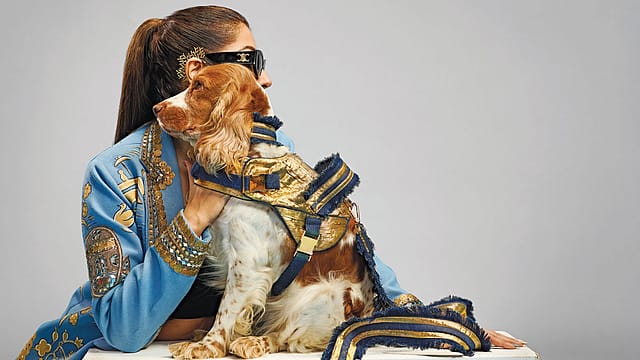
If travelling with pets is having a moment, so is dressing them up. Perhaps it is the impact of highly fashionable petfluencer accounts emerging across the world, but dogs and cats dressed up in miniature outfits are ubiquitous on social media, with a number of brands dipping their toes into the market—from Tommy Hilfiger, Hugo Boss and Prada to closer home with Shivan & Narresh which created a collection for Heads Up For Tails as early as 2019. Earlier this year, Jaipur-based designer Ashna Vaswani launched Kutta Couture, a line of fashion-forward accessories for dogs: collars, leashes and harnesses made from denim, velvet and Khadi with small embellishments.
Like many others in the vast world of pet-serving labels, Vaswani’s ventures emerge from her love for animals. Her dogs come to the studio with her, and she describes them as her strengths and emotional support systems. “I love dressing up, and I wanted to dress up my dogs. But it’s not comfortable especially for dogs, especially in the Indian weather and if they are furry,” she says. “But harnesses, collars and leashes are necessities. Why not make them a fashion statement too?”
Starting at under ₹2,000 for individual items and going up to ₹18,000 for a set of three pieces, Kutta Couture is positioned as premium designerwear for dogs. Vaswani started it as a small project and expanded it following many orders; the demand is not surprising. “More and more people think of their pets as their children. They want to give their pets the best of everything, just as they would for their children,” says Vaswani.
People are also memorialising their relationships with their pets. Earlier this year, the Alien Tattoo studio with outlets across India launched Pets Friends Forever (PFF), offering pet-friendly experiences, adoption-awareness and collaborations. According to the studio, the number of clients choosing portraits of their pets as tattoos, or symbolic designs, is on the rise. Pet photography is another growing trend with a number of studios specialising in shooting animals. Saloni Khatri, photographer and founder of Sniff Stories, started her venture in 2019 and noticed demand grow since the pandemic. Based in Indore, Khatri travels round the country for shoots and prefers natural, outdoor settings over choreographed images. “Pet photoshoots are usually planned when parents want them. But an animal has no use of it, so we make sure it’s a fun, beautiful and memorable experience for them. A majority of our shoots are imperfect—dogs running, chasing or playing in the mud,” she says. “If we don’t make them comfortable, you will not get a good shot because they will not be at their best behaviour. At every shoot, we spend time interacting with dogs till they are calm and settled.”
Khatri adds that her clients are often in the 28-40 age group—couples or single pet parents—though there are instances of larger families with children as well. She has observed an inclination among her clients for indies and adopted dogs. “Our majority is in Tier 1 and Tier 2 cities but the market is growing everywhere,” she adds, noting that she has also started travelling internationally for shoots.
As India’s pet market keeps growing, there are also countless stories of abandonment and unethical breeding. Vaswani aims to start an NGO for animals one day, and in the meantime, looks after stray dogs in her neighbourhood. “If everyone can take care of dogs in their neighbourhoods, we will make a better society. Stray dogs deserve to have better lives too.” Shanbag observes that veterinary care has developed but also become more expensive and emphasises on the need for affordability—the growing number of ailments among animals, including terminal diseases like cancer, necessitates it. As the market booms, she also adds the need for strong licensing and quality control.
Narang, who also helms the HUFT Foundation, notes that it is essential for brands to be cognisant of these issues. “Abandonment and unethical breeding are not just ‘sad stories’. They are outcomes of gaps in education, impulse buying, poor enforcement and the glamorisation of pet ownership without responsibility,” she says. According to her, brands can address it through education, not promoting ‘status breeds’ irresponsibly and supporting welfare work, vaccination/sterilisation drives, and community animal care. Pet care can’t only be about commerce, she observes, but also about compassion and coexistence. The aim, Narang says, should be “building a culture where responsible pet parenting is aspirational”.