The Body Remembers Itself: A Doctor's Atlas of Dance and the Brain
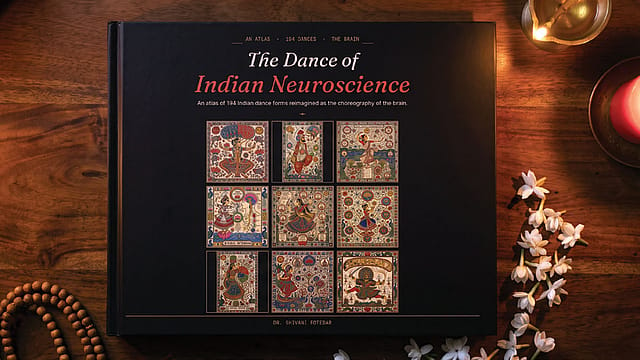
Somewhere between the amygdala and the anklet bell, between the descending pathways of the pyramidal tract and the fluid geometry of the tribhanga pose, lies a territory that neither medicine nor art has ever fully claimed. It is the realm where neuroanatomy meets cultural memory—the body knowing itself. In her remarkable debut work, The Dance of Indian Neuroscience, Dr. Shivani Fotedar, a young neuroanaesthesia resident based in Delhi, has done what few scientists or artists dare to attempt: she has drawn its definitive atlas.
The book’s genesis is rooted in a moment of quiet, clinical revelation. In her foreword, Fotedar recalls watching a post-craniotomy patient’s fingers make their first tentative movements across a hospital bedsheet in the dead of night. Where others might have seen simple involuntary motor recovery, Fotedar recognized a mudra. She saw the motor cortex rehearsing a subtle form of Bharatanatyam. That epiphany set off a multi-year pilgrimage across medicine and culture. Fotedar cataloged 194 distinct dances across India, pairing each style with its precise neuroanatomical counterpart.

Crucially, Fotedar does not limit her exploration to the classical traditions. She ventures deep into regional and folk forms, mapping everything from the high-energy bursts of Punjab’s Bhangra to the rhythmic rowing rituals of the Nicobari Hodi.
Writing in a voice reminiscent of Oliver Sacks’s clinical empathy and John Berger’s artistic acuity, Fotedar achieves a rare balance: a doctor’s scientific rigor paired with a dancer’s deep instinct for rhythm. Complementing her prose—each essay a tight, resonant 250 words—are striking Madhubani paintings rendered in the traditional Bihar style of Sita Devi and Ganga Devi. Replacing cold, sterile medical diagrams with vibrant folk art is a masterstroke; it reinforces Fotedar’s underlying thesis that the complex tapestry of the human nervous system is best illustrated by traditions that embrace intricate patterns.
There are books that merely inform us, and then there are rare works that fundamentally reorganize how we see the world. The Dance of Indian Neuroscience belongs unequivocally to the latter. It will force neurologists to look at their anatomy textbooks with newfound wonder and inspire dancers to feel the firing neurons behind every adavu. It is an essential, mesmerizing read for anyone fascinated by the mind, the body, and the timeless art that connects them.