Lost and Luminous
A woman stands over a bathtub on the cover of Meg Mason’s latest novel Sophie, Standing There. It’s an image bathed in pink and teal, with a dose of soft melancholy. It’s an aesthetic in keeping with the plot that follows Sophie Pattison, a sound technician at literary festivals who turns to books for comfort and connection in the wake of a collapsing marriage and friendship that leave her increasingly isolated. Intellectually driven, existentially lost and often solitary, Sophie is the kind of heroine who is becoming increasingly familiar.
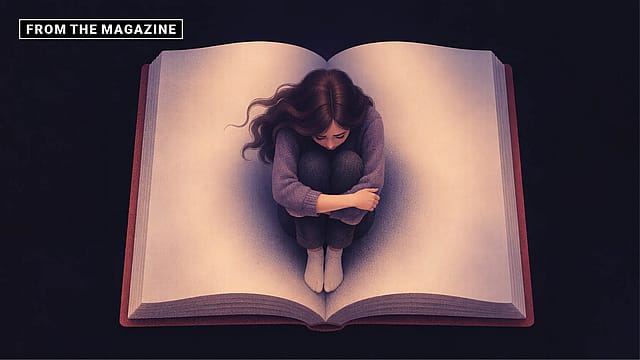
Browse any bookstore’s fiction aisle and chances are that there will be at least one book cover featuring a Renaissance painting or a loose dark silhouette of a woman offset by bright neon text. The protagonist might be a melancholic woman—angsty and existentially lost. Maybe she has spent all day in bed, thinking about life. Or at her unfulfilling job, with an uninteresting partner, and familial stressors that seem to make her life grey and muted. She is tired. And, probably white and upper-middle class. This is the basic premise of ‘Sad Girl Literature’, the literary genre that has emerged in the last few years and increasingly seems to dominate internet book culture and pop fiction.
Think Sally Rooney, Elif Batuman, Sigrid Nunez and Ottessa Moshfegh, among others, who have followed in the footsteps of Joan Didion and Sylvia Plath. I was raised on these writers, who found themselves at the height of their literary careers during the Covid pandemic. Sad Girl Literature became a contentious topic online. These female protagonists were depressed, erratic, and often unlikeable. Disassociation became an overarching theme. It feels like a rebellion against the typical female literary figures—such as Elizabeth Bennet of Pride and Prejudice, Jo March in Little Women and the titular lead of Anna Karenina—whose biggest struggles were romantic or familial. These modern women were different: they struggled with existentialism and meaninglessness. This seems, perhaps, to be reflective of the lockdown era: we were doing less and disassociating more.

Didion, in The White Album, wrote, “We tell ourselves stories in order to live.” She was right: we spend our lives reading and consuming content, stories of the chaotic lives of others, hoping to find our truths within them. We create art to move others, to relate to others. The media we consume morphs with the zeitgeist; each era brings along new relatable traumas, new forms of collective effervescence.
So what does it mean that this new relatable trauma seems to be a lack of action and worldly experience? And why does it seem somewhat unique to female characters? Didion falls into a niche subset of the western literary canon. Her essays and her public persona establish her as a writer who lived perhaps more in the internal than the external. Her writing isn’t genre fiction, plot-based or trying to suck readers in with, wild twists. This has become a more popular category of literature: fiction or non-fiction that acts more as a cultural commentary and attempts to provoke longer-lasting impacts on the literary zeitgeist. Arguably, Plath’s The Bell Jar also falls into this category—a novel about a woman who spirals into depression and struggles with the social pressures of womanhood in the US during the 1950s. It would obviously be untrue to say these novels have no plot—because they do—but the essence of the novel comes from the nuances in the protagonist’s narrative of the self.
In one of the most famous passages from The Bell Jar, Esther uses a fig tree as a metaphor for her life, in which each fig is another route she can take in her life: school, marriage, writing. “One fig was a husband and a happy home and children, and another fig was a famous poet and another fig was a brilliant professor, and another fig was Ee Gee, the amazing editor, and another fig was Europe and Africa and South America... and another fig was an Olympic lady crew champion, and beyond and above these figs were many more figs I couldn’t quite make out.”
In theory, there are infinite options for Esther. Yet she can’t make up her mind. She sees herself, “starving to death, just because I couldn’t make up my mind which of the figs I would choose. I wanted each and every one of them, but choosing one meant losing all the rest.”
Esther, who wants to write a novel, finally decides to grab the writerly fig but soon realises she hasn’t lived enough to write well. She struggles to write after sitting at her desk all day. “I needed experience. How could I write about life when I’d never had a love affair or a baby or seen anybody die? A girl I knew had just won a prize for a short story about her adventures…in Africa. How could I compete with that sort of thing?”
This seems to be a condition afflicting popular modern fiction. Selin, the narrator in Batuman’s Either/Or, reflects often on how little she has experienced. She goes to Turkey to work for a summer, writing for a travel magazine, as a Harvard student. She follows the itinerary carefully and militaristically. She fears the risks involved in going off the cuff. During a visit to a small town, she meets a man who is shorter than her and is “full of life” in a way she can’t see herself being. He jokes with everybody, and no one ever takes offense. He lives in the external moment, and Selin chides herself for living in the internal one. She overthinks too much to be as free as him.
The same concepts can be applied to dozens of books written by contemporary writers, with characters who lament their lack of experience and worldly traumas that have shaped them in interesting and unique ways. This can’t be just due to the pandemic, can it? That would be too quick an answer for too expansive a literary shift. There seems to be an overarching lack of risk-taking in younger generations—everything is unaffordable, and any risk seems to have higher consequences than they used to. Everything is filmed, recorded, and potentially career-ruining.
It seems more socially acceptable that for a woman to spiral out of control it must be completely solitary and only affect her. Her lack of mental stability is a problem she deals with herself, and she only confides in the reader. She isn’t allowed to be loud or ugly in her crises.
The Bell Jar is a reflection of Esther’s struggle to act. The novel ends with Esther sitting in a conference room with psychiatrists as they decide how to best treat her. In some ways, the ending signifies an ultimate renunciation of autonomy: Esther no longer has the power to decide which figs to eat. Perhaps the sad girl trope promises autonomy in another, lesser form: as its characters lose their external lives, they build complex ones within. But why doesn’t sad girl literature allow her to have both?