Holmes Alone: A debut crime novelist returns to her favourite investigators in fiction
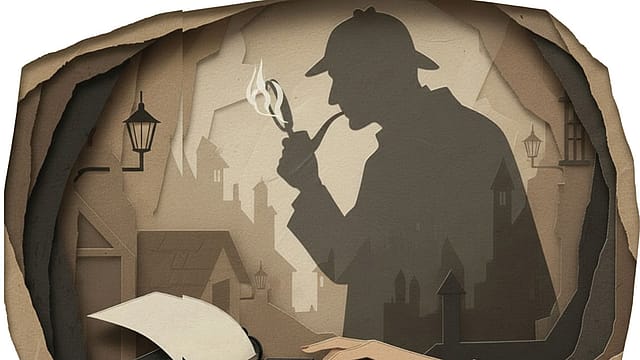
SHERLOCK HOLMES IS MY FAVOURITE FICTIONAL DETECTIVE. I AM DRAWN to his brilliance and eccentricities. Yes, he is egotistical and indifferent to other people’s opinions, yet he is charming to those he likes, kind to the vulnerable, a man of intense passions hidden under a deep reserve of logic. Sherlock Holmes is not Everyman. Far from it, in fact. Most of all, for me, Holmes’ X factor lies in how he responds to control. As a person, he shuns any attempt by society and individuals to control his behaviour and thoughts, and to shape his moral compass, the ethical values that direct his actions.
When it came to writing Blood Caste (Canelo Crime), a historical murder mystery set in late 19th century Hyderabad, I sent my main character down a similar pathway. Chief Inspector Soobramania of the Nizam’s City Police is a man who has shaken off society’s control by refusing to perform an expiation rite to reverse his excommunication from the Brahmin caste. Like Holmes, Soob walks a solitary path. He does not allow anybody—a caste-group, his family or Hyderabadi nobles—to create his moral compass. For Soob though, this is a far more difficult decision since at that time even more than now, a person’s identity was defined by caste and religion. An outcast did not exist for society.
But to make Soob spring to life on the page was much more difficult. We often come across writers saying the character came fully formed. In Soob’s case, his exterior came fully formed but his interior—that was one hell of a challenge. Here, Holmes was of no help. We don’t know whom Holmes cared for apart from perhaps Watson and Mycroft, his brother, and maybe the landlady Mrs Hudson. Nor do we have a sense of his inner life—what made him happy, cry, mourn, rage—since it is Watson narrating the story.
So I turned to another detective I find endearing: Agatha Christie’s Hercule Poirot. In her books I trolled for any clues that would let me get into Soob’s character without having to dig deep within myself—having spent most of my life
running away from uncomfortable emotions. Here too, I found little help. We know very little about Poirot’s life before he came to England as a Belgian refugee after the First World War. He had been a policeman before, but that’s all we know. Nothing about a marriage, lovers, family and friends. In any case the story is told from Captain Hastings’ point of view, so we know just as little about Poirot’s interiority as we did with Holmes.
Christie is quite upfront about how she created Poirot. In Agatha Christie’s Secret Notebooks (written by John Curran; published by HarperCollins), we discover that she knew she was “writing in the Sherlock Holmes tradition — eccentric detective [Poirot], stooge assistant [Captain Hastings], with a Lestrade-type Scotland Yard detective, Inspector Japp.” For Christie, as for Doyle, these quirks are key to solving the crime. In her very first book, The Mysterious Affair at Styles, Poirot’s mania for symmetry makes him notice the spills in a vase and leads him to the solution. In the short story, ‘How Does Your Garden Grow?’, he notices a border edged with oyster shells (not cockle shells), which were used to administer the strychnine.
Since Blood Caste is a murder mystery, perhaps focusing on how Soob solved the case would suffice, I thought. Perhaps, I didn’t need to delve into Soob’s interiority after all. What drew me to Holmes initially was his mind—logical, rational, a man of science who followed an inductive method of reasoning from observed details. These were the methods of brilliant Victorian scientists and the medical establishment. Last summer, at the Surgeons Hall Museums in Edinburgh where Doyle trained as a doctor, I saw the marvellous tools and inventions of the 19th century medical pioneers including Dr Joseph Bell, the real-life model for Holmes.
The University of Edinburgh’s medical department where Doyle enrolled in 1876, brimmed with eccentric and brilliant professors who excelled in induction—reasoning from the particular to the general (eg, these footprints are very far apart, only tall persons can manage such a stride, ergo, this person is tall). And Bell was the foremost among them, diagnosing ailments through the careful observation of the patient’s bodily features such as the gait, the scars, the position of deep marks on the fingers and so on.
I made Soob a naturalist—a botanist by training, a plant-hunter by hobby. It resonated with the European preoccupation with colonising the flora from the colonies, men and women like Joseph Hooker and Marianne North finding rare species in the Americas and the Himalayas and bringing it in Wardian cases (a specially constructed travel box) to Kew Gardens. I researched the natural landscape of the Deccan, the garden designs in vogue with the nawabs, the seasonal flowerings and wove those into the mystery.
The method Soob uses to solve the mystery at the heart of Blood Caste draws on Holmes’s inductive method of reasoning. A product of his Victorian age, Holmes favours reasoning logically from the ‘observation of trifles’ but also combines it with intuition. Holmes’s achievement, as one observer put it, comes from an uncanny ability to balance the physical evidence of the case with the more difficult subjective truths. One of my favourite stories is ‘The Blue Carbuncle’ where Holmes’s keen perceptiveness to size up the psychologies of those connected with the case helps him catch the culprit and free an innocent man.
In each murder, Soob collects details through interviews with suspects, examines the evidence in the crime scenes and has deep knowledge of imperial politicking. A fictional detective often absorbs the preoccupations and disinterests of his creator. My background as a political scientist led me to weave in imperial politics and its dynamics with the local ruler as an obstacle to Soob’s investigation. Doyle, a medical practitioner, made Holmes interested in science not politics.
UT IT STILL wasn’t enough to make Soob vivid on the page. So I delved into Poirot’s method. The psychological scars of the First World War saw a fresh interest in Sigmund Freud, Carl Jung and other psychologists. Influenced by this and needing an alternative to the Holmesian approach, Christie made Poirot refer to his ‘little grey cells’ in a nod to Holmes and then talk of the psychology of the crime. Poirot’s way of solving the case was to study the psychology of the criminal and the crime and match that to the suspect’s psychology.
In Blood Caste the story is seen through Soob’s eyes. Readers therefore, would have to be shown the psychology of every step in the solving of the case. And for that, readers needed to see Soob tussle internally with every element in cracking the puzzle.
Today’s crime fiction readers (I count myself as one) are adept at the forensics of fingerprints, scene of crime tells and can probably give you an exhaustive lecture of modes of murder. And with laboratories taking over much of the scientific work, Holmesian and Poirot-style observations on that front would not work as well.
So what makes present day murder mystery readers turn the pages? It is the internal tussles of the main character navigating relationships in their personal and professional lives. You can blame the explosion of psychological thrillers like Gone Girl and The Girl on the Train where high anxiety protagonists are the norm. Readers are made to invest in detectives with a lot of angst in their work, marriage and romantic relationships. For that, I had to find a way to crack Soob’s interiority.
But I continued to resist. Perhaps I could focus on the exterior, on the setting, I thought. That’s another aspect of the Holmes stories I like. The dark doings in foggy streets and gas-lit alleys, and desperate chases through dark moors and hunted by demonic hounds. These are very much the conjuring of an Edinburgh mind—Conan Doyle lived and studied there in the city of gargoyles and grimy streets. I drew on my teenage memories of the old city, its sooty streets, the smells of melted sugar and spices, the needle-thin alleys around Charminar, the decaying grandeur of the palaces.
Still not enough though to make Soob live on the page. We writers are urged to dig deep into ourselves, to narrow in on the traumas and the associated memories we carry. For a long time though, I preferred to focus only on the positive; the protectors were doing their job, I suppose. What I didn’t realise was that in writing Soob, I’d repeated that pattern. I had to crack into my own interior to make Soob’s voice ring true.
Enter internal family systems, IFS for short. It is a psychotherapist approach that identifies and addresses multiple sub-personalities within each person’s mental system. These sub-personalities consist of wounded parts and painful emotions and parts that try to control and protect the person from the pain.
Doing IFS with a therapist made me realise that at some point in my childhood I’d made the choice to be an observer of life, not a participant. And that had embedded itself in how I wrote Soob. I defused conflict, never put him in any real danger, and made things easy and less emotionally fraught for him and other characters. The realisation pushed me into introducing more conflict in Soob’s life: his refusal to perform an expiation rite and be readmitted into Brahminical caste and his struggle to be a man who held modern notions of equality and merit in a society that emphasised hierarchy and class.
Now Soob’s moral compass was coming into focus. The question—who would he let off and who would he hang—helped me calibrate it further. Here, I returned to Holmes and the question that frames his sense of justice: who is the villain he is trying to control. He punishes those like Professor Moriarty who attempt to control the fates of others, but when it is someone trying to shake off control by fate and institutions as in ‘The Adventure of the Blue Carbuncle’, he lets them go. In that story a diamond is stolen and hidden in a goose. After an intricate chase, Holmes allows the thief to get away, a poor man who’d never done wrong before. Holmes tells Watson, “I suppose that I am committing a felony, but it is just possible I am saving a soul.”
Contrast this with Holmes’ attitude to Professor Moriarty whom he calls the “Napoleon of crime” with “hereditary tendencies of the most diabolical kind... rendered more dangerous by his extraordinary mental powers...lurking at the centre of a web a ‘poisonous, motionless creature’.” An evil genius mathematician who manipulates nations and people to consolidate his power, a cold-blooded wielder of the dark side of logic, Moriarty is the perfect alter-ego to the brilliant yet moral Holmes.
Also important in Holmes’s idea of justice is the victim. The murder of a blackguard, murderer, abuser, blackmailer and career criminal by the wronged person is viewed by Holmes as natural justice and the murderer is allowed to go scot-free. In ‘The Adventure of Charles Augustus Milverton’, a blackmailer is shot dead by his victim; in ‘The Devil’s Foot’, the victim is killed for having committed a previous murder; in ‘The Veiled Lodger’, the victim, a circus master is a bully, domestic abuser and cruel to animals; and in ‘The Speckled Band’, the loathsome and cunning doctor murders his own stepdaughter and attempts to kill the second one but gets his just and ‘speckled’ desserts.
All these insights went into creating the story dynamics of Blood Caste and brought Soob to life on the page. None of it has been easy, not least because my self-explorations have been intense and highly uncomfortable. In this decade-long journey that has been tough, intense, yet fun, Sherlock Holmes was my constant companion. I would not have it any other way.