Best of Books 2025: Nonfiction
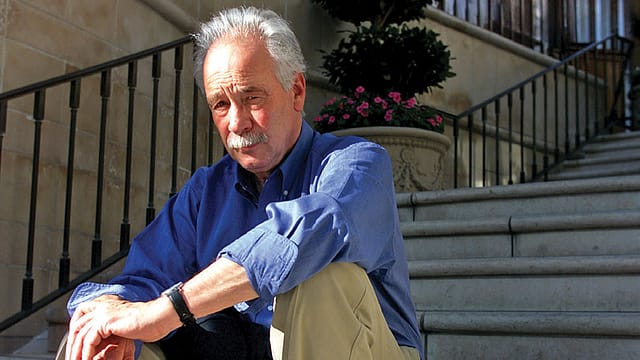
Raul Hilberg never asked the big questions but focused on the minutiae because the big questions didn’t get answers. International lawyer Philippe Sands began a historical and personal journey with East West Street: On the Origins of Genocide and Crimes against Humanity and The Ratline: Love, Lies and Justice on the Trail of a Nazi Fugitive which he concludes in 38 Londres Street: On Pinochet in England and a Nazi in Patagonia (W&N). The arrest of former Chilean dictator Augusto Pinochet Ugarte in 1998 in London— for crimes of mass murder, torture and disappearances committed by his regime after the September 11, 1973 coup—and his successful return to Chile changed international law. But in pursuing that story, Sands creates a double narrative by investigating the connection between Pinochet and SS officer Walther Rauff, a notorious Nazi war criminal whose name had come up in Ratline. Rauff, who had taken refuge in Chilean Patagonia, invented the mobile gas vans that murdered 90,000 European Jews before the death camps. Neither man paid for his crimes, but the Pinochet affair changed the definition of immunity for former heads of state. Never betraying his own emotions despite his involvement in the case and having lost family in the Holocaust (in fact, his aunt died as a child in one of Rauff’s vans), Sands has plotted a thriller built only on the chain of evidence— Hilberg’s empirical detail.
The 21st century began with the literary catastrophe of WG Sebald’s untimely death in 2001 at 57. Had he lived, what the author of Austerlitz, Vertigo, or The Emigrants might have become is not hard to speculate. Silent Catastrophes: Essays (Random House), translated with a critical foreword by Jo Catling, is certainly not the book to begin Sebald with, although these essays were his apprenticeship as a perceptive critic who would go on to become one of the most distinguished and distinguishable novelists of all time. It is actually two books, The Description of Misfortune and Strange Homelands, published in Austria in 1985 and 1991 respectively. Austrian literature’s “high incidence of ill-starred lives” is uncanny. Sebald, in self-chosen exile in England, felt an affinity with 19th-century German-language prose because “the writers all hailed from the periphery of the German-speaking lands, where I also come from”. That place being a stone’s throw from the Austrian border, his special love for Austrian writers, including his contemporaries, is understandable. The writers whose misfortunes and/ or exile within or without their Heimat feature here include Adalbert Stifter, Arthur Schnitzler, Hugo von Hofmannsthal, Elias Canetti, Kafka, Joseph Roth, Hermann Broch, Gerhard Roth, Peter Handke, et al. These essays anticipate the more literary collection in A Place in the Country (1998, trans 2013) and combine critical appreciation with biography, although they are marred in places by jargon which the more mature Sebald would dispense with. Yet they hint at the developing signature Sebald cadence, itself a legacy of the German-language writers he admired so much.

Bengal Thriller 2026: The Plot Thickens
17 Apr 2026 - Vol 04 | Issue 67
Mamata Banerjee faces her toughest battle

On the heels of Wolfgang Münchau’s enlightening Kaput: The End of the German Miracle last year, journalists Chris Reiter and Will Wilkes came out with Broken Republik: The Inside Story of Germany’s Descent into Crisis (Bloomsbury), tracking how the postwar West German miracle ran out of steam post-reunification. Wrong calls taken as early as the 1990s made Germany miss the digital age. The land of Merecedes-Benz and BMW, of Siemens and Bayer, mocked the myth of “German efficiency” by embracing the status quo and then taking disastrous decisions like abandoning nuclear power soon after Russia’s invasion of Ukraine. But the rot is deep and the authors show how mere constitutional patriotism has robbed Germans of national identity, leading to the reprise of ethnic nationalism via the AfD. Germany, economically, socially, and politically, is in decline and unlike past revivals, may not recover this time.