All Is Maya
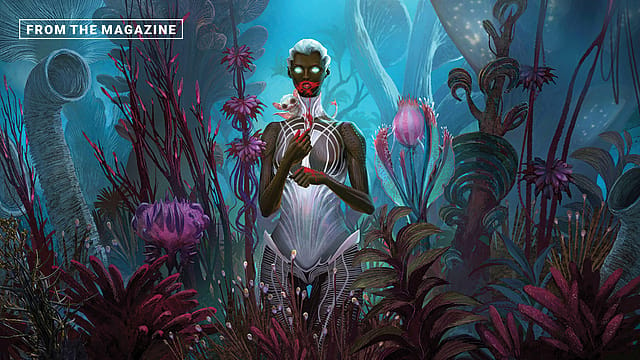
ANAND GANDHI describes mythology as “a parliament of ideas”. If a story offers an author’s perspective—their moral view of the world—mythology contains a much bigger universe within its folds. “It’s a place where consensus between ideas can emerge. It can invite contradictions and paradoxes,” says Gandhi. “You can have different views and perspectives, characters with completely different, even opposing worldviews.” It is a sprawling universe populated with possibilities.
Over the past five years, Gandhi and his longtime creative collaborator, game designer Zain Memon, have been slowly building their own mythology with MAYA. A narrative universe encompassing books, graphic novels, films, games, toys and other experiences, MAYA is a first-of-its-kind transmedia project rooted in sci-fi and fantasy exploring notions of power, control, truth and individual agency in the 21st century. Its first expression arrives in the form of the novel, Maya: Seed Takes Root, published by Authors Equity in New York. Launching globally this month, the novel, which is the first of a trilogy, also has an audiobook version read by actor Hugo Weaving, who is known for his iconic roles in The Matrix trilogy and V for Vendetta.
The story unfolds on the fictional planet of Neh, home to seven sapient species known as the svaanka, living in an equilibrium that feels delicate in the best of times. Keeping this planet and its population tethered, quite literally, is Maya—a tree network serving as a shared dreamscape for all the species to work, play, and socialise with each other. It carries the imprints of the living and the dead, a conduit for memories and every moment’s lived experience. To imagine life on Neh without Maya is impossible.
For the Divyas—powerful amortal beings who preside over the svaankas— Maya is a means of exerting control not by coercion but subliminal action. The Divyas are drawn from members of the various svankaas and chosen by trial; the announcement of a new edition of Divya trials in the novel sparks a series of events bringing key characters into contact. Kshar, a naag and covert agent with the Secret Coil, is trying to change the outcome of the trials and thus the course of history. Ayn is a rakshasi navigating her way into the trials and through the world’s prejudices with courage and intelligence. Tarkash is a Divya-scion of the garuda species intent on winning the trials with a plan nobody has ever tried before. And then there is Yachay, a manushya wildcard with a secret capable of disrupting the trials and the very fabric of life on Neh. His journey anchors Maya: Seed Takes Root.

MAYA is Department of Lore’s flagship property, which emerged from dialogues between Gandhi and Memon spanning several years. “It started with the universe, our desire to create a system that mimics the world that we live in but is also fantastical,” Memon says, noting that it determines their approach to storytelling. “We first decide the ideas and experiences we want to put out, and those determine the format and the medium.” However, he also highlights the specific merit of beginning their journey with a book. “Every large universe starts with the imagination of the audience. And nothing allows it to run as wild as the written word.”
Memon adds that their vision was to ground their storytelling deeper in sci-fi rather than the fantasy genre. Memon and Gandhi roped in geologists to create the planet, evolutionary biologists to help design the species, and economists to create the currency. Architect and educator Shikha Parmar and her students at CEPT University brought the world’s speculative architecture to life. There are complex gender and caste dynamics among the species and long histories. These will become the subjects of two upcoming books on MAYA’s lore and its built environments.
The world-building in MAYA also includes language. If Kosh is the “common tongue of Neh”, the native tongue of the manushayas and spoken by most svaanka, Tridha is a “complex computational language” spoken by two people on the planet, including Yachay (the other is yet to be revealed). Ezhu is native to the rakshasis, a language shaped by smell, taste and molecular perception, while Seni is a vaanar language distinguished by guttural sounds. There are 14 languages in development as well as learning resources for them.
For readers from India, many of the words in MAYA will be familiar. The names of the svaanka drift out of myths and epics and everyday words bear a striking resemblance to our own. Yet, as the authors point out, the words may have transformed and “turned inside out” in this universe. “Maya does not mean illusion in our world and rakshasi does not mean demoness,” Gandhi adds. “The only meaning that matters is the one we make slowly on the page through the reader’s immersion in the world.” Some words shift in their meanings in subtle ways—manushya, gandharva, Divya and others—while some continue to carry their inherited meaning, such as kulie.
These linguistic experiments also serve as reminders that the story’s “ideas, prescriptions and warnings are not just imaginations without a grain of reality”. Gandhi describes it as a narrative framework and a map to a deeper terrain. “It’s a cartographic project that allows us to understand the world around us and our place in it,” he says. In MAYA, a chhavi refers to a simulation of each resident of Neh shaped by their experiences and aspirations. MAYA itself can be read as a chhavi of our world, a fictional world conceived as a ‘living’ system for a variety of ideas and views to be presented and debated, to be contradicted and mutated.
It is impossible to read about the Maya trees, tethering millions onto its complex web, without thinking of the hyper-connected, digital-first lives humanity leads today. Questions concerning technological overreach, AI, climate anxiety, longevity and modern governance seep into every part of this fantastical world. In MAYA, dreams and nightmares comprise the grammar of existence—one inspires optimism while the other calls for caution. But as a character asks: “What if someone else whispers them into our minds, shaping our desires and fears?”
MEMON OBSERVES THAT storytelling creates a safer space to discuss and debate, enquire and critique. “When we start talking about complex, partisan issues—be it politics or tech and AI—it becomes very difficult to get everyone to listen. The lines have already been drawn and everyone comes with their own preconceived conclusion,” he says. It also resonates across geographies, Memon adds, citing readers from Bushwick to Bengaluru who have found ideas and instances in the book that resonate with their lives.
Building a community of readers and supporters has been intrinsic to the architecture of Maya. Its engagement began on the fundraising platform Kickstarter, where more than 4,000 backers pledged $426,356 to help realise the novel, making MAYA: Seed Takes Root the highest-funded debut novel in crowdfunding history. The community has grown in numbers and the backers get early access to stories and products, with their insights and feedback adding to the narrative universe. Following the first novel, Gandhi and Memon are gearing up to launch a tabletop game, which is recommended for both beginners and advanced players as the most accessible point of entry into the universe.
Gandhi and Memon have spent more than half a decade building a “monumental project”. Their lives are intertwined with MAYA. Memon says that it has enhanced their ability to grapple with complex questions and big philosophical ideas and translate them into storytelling. “Intelligence in the modern era is being able to hold a hundred variables in your head and still be able to make the right decision. Instead of simplifying and dumbing things down, stories should train people to understand complexity,” he says. MAYA is dense and layered, growing across different media and deepening with varied perspectives. “Our hope is that MAYA can grow into a shared mythology that invites other authors, filmmakers, game designers and artists to create their own vision within it,” says Gandhi. “Every mythology worth its name has outgrown its creator.”