What's cooking: Food is moving from the kitchen to the gallery
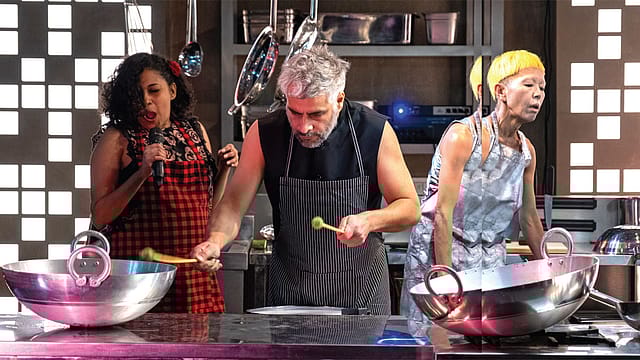
AMID A SEA of artistic treasures at the 17th edition of India Art Fair in New Delhi, Breakfast in a Blizzard stood out. Curated by the Nikhil Chopra-led HH Art Spaces, it was an open-air kitchen where, ironically, no food was served but plenty of flavourful conversations were dished out to an audience hungry for refreshing experiences. At Design Mumbai held last November, Spanish artist Lucas Muñoz Muñoz conjured an on-site café—a living artwork designed using upcycled furniture and other waste from a defunct hotel. The interactive work sat at the intersection between food, sustainability, dining, design and art. When I met Muñoz at the café, he quipped, “I don’t trust any artist who doesn’t cook.”
Call it an experiment in interdisciplinarity or simply conceptual gestures, food—or at least food as a motif and an object of investigation—is becoming ubiquitous in the art world. These days, it is difficult to walk into museums and art exhibitions without encountering something food related or food adjacent. Whether it is artist Rajyashri Goody’s politically-aware exploration of Dalit recipes, exhibitions such as the ongoing Calorie at Science Gallery in Bengaluru that question our relationship with food, or paeans to the sensorial memories of local flavours (case in point: Stories on a Banana Leaf at MAP museum in Bengaluru in 2021), a horde of artists and collectives are reimagining food. In doing so, they are transplanting the humble nosh from the domestic kitchen to the tremendously visual and cerebral universe of art and design.
Edible Issues is one such collective that has long explored India's food systems through the lens of culture, ecology, technology, sustainability and design. Elizabeth Yorke and Anusha Murthy are the creative spirits behind Edible Issues, which they founded in 2018. It has since grown into a wider collective that brings together collaborators from diverse sectors, such as sociologists, artists, scientists and academics, to help research and reshape conversations around both the beauty and politics of food as well as revive culinary memories that are fading away in the age of social media and shrinking attention spans. Year after year, their curation has built unique storytelling experiences around food, illuminating surprising and often overlooked aspects of the history of Indian regional cuisines, traditional practices, wild plants and biodiversity. Last year, at Serendipity Arts Festival’s landmark 10th anniversary edition, Edible Issues staged an immersive and participatory show titled Smell, Memory & Food Systems. Their curation, displayed at the old GMC building complex in Panjim, blurred the lines between art, food, farming and anthropology. It invited visitors to reflect on smell as more than just a nostalgic commodity. “Smell carries memory and emotions in a way that few other senses do,” reflects Yorke, explaining that through Smell, Memory & Food Systems, the idea was to unpack ethnographic connections between different kinds of scents and memory, identity and ecological change. “Human olfactory system is so biologically strong that smell directly hits the brain without having to process itself and create a core memory,” she adds. “It acts as a portal which transports us unknowingly into spaces and places that we may have left far behind. For example, in many neighbourhoods you could tell what your neighbours were cooking for lunch/dinner just by passing their homes and catching the aromas from their kitchens. Guess there was a time when smells connected homes with wider communities and that’s missing in our sanitised world today.”
Among the four distinct yet kindred projects that comprised Smell, Memory & Food Systems, artist Indu Antony’s Kitem nuste asa? recreated Goa’s disappearing culinary smells — the aroma of curry leaves, dried fish and wood-fire. In another exhibition titled Smell Trace, Ishita Dey created an olfactory installation inspired by the sheer variety of food cultures that commuters from various parts of the country carry with them on the long and adventurous Indian train journeys.
Undoubtedly, the primary reason why Smell Trace left such a strong imprint at Serendipity was because it challenged the conventional perception of what an exhibition could be. The show re-enacted scenes from a railway platform—train windows were designed specifically for the exhibition, food was placed inside enclosed boxes and people had to queue for tickets in order to get a glimpse of the display and smell the flavours.

Yorke has long nursed a desire to liberate food from the kitchen. She worked as a chef before turning to research, curation and the creative arts to spotlight her broader concerns which include sustainability, circular economy, climate change, consumerism and most importantly, the future of food itself. “Both food and art are powerful tools. For us at Edible Issues, the idea was to bring in multiple voices to inform and perhaps even influence the existing narrative about food, particularly at a time when our food systems are undergoing significant changes,” says Yorke, who is also the founder of a social initiative promoting circular food systems called Saving Grains. “Our goal is to deepen people’s understanding about food and create inclusive spaces that foster curiosity and joy.”
The Mumbai-based Parag Tandel is another artist whose work has often circled back to the fading aromas of the nearly-obsolete recipes from his childhood. For him, just as it is for the Koli community to which he belongs, the ocean remains an infinite forest. Tandel, who grew up in a koliwada village, in Thane, seems to probe food almost as if it were an “archaeological site.” In his interactive installation How to cook ‘Bombay’ Duck in various ways?, presently on show at Calorie in Bengaluru, the artist cast the Bombay Duck fish in reinforced concrete—echoing the familiar sight of fish drying along Mumbai’s shores but equally, a sharp commentary on the concrete jungle’s rapid urbanisation and marine pollution.
Continuing his fascination for the sea, Tandel’s installation The Last Catch at Godrej Design Lab last year resembled a shrimp—made using discarded bottles found along the seashore. His limited-edition cookbook Ek Bagal Mein Chand Hoga Ek Bagal Mein Rotiyan (2022) is probably his most poetic ode to the community, a manuscript of dry seafood recipes developed in collaboration with women from the Chendani fishing village. A “visual auto-ethnographer” of the Koli community by his own account, Tandel says that he started looking closely at food because it is a basic for human survival. “The Kolis came to Mumbai in search of food. Every migrant that arrives in this city today comes to earn a livelihood. A house or a roof over your head matters but food matters even more as you can still sleep on the street but you can’t survive without food,” explains Tandel, who credits his mentors at the MS University in Baroda (where he studied creative sculpture) for encouraging him to look inwards in his creative process and helping discover his true subject. He feels that when visual artists turn to food for inspiration, new ideas are laid bare adding an exciting dimension to the myths and mysteries of art-making. “While it is important what chefs, researchers, scientists and biologists have to say about food, somewhere when artists walk into this territory, they bring with them a unique creative perspective.”
THAMSHANGPHA ‘MERCI’ Maku also proudly calls MS University his alma mater. Maku, who has adopted the nickname ‘Merci’, was born in the Chandel district of Manipur and now lives in Vadodara. Much of his practice revolves around food and the memories of growing up. His project Don’t Die Starving, or ‘Buu Kataam lee seenacha ye’ in his native Mongmi dialect, is an evolving cookbook, born from a refrain he often heard as a young boy, a reminder of the war-torn uncertainties of his childhood days. “I don’t live in Manipur anymore, so food for me becomes a way to evoke my village and my people while being away from home,” says Maku, who initially wanted to become a chef. Don’t Die Starving echoes histories of trauma, displacement and deprivation, while somberly calling for resilience and resistance. Maku has collected over 130 recipes so far—including such local staples as mootnaa buthao taal (steam sticky rice cake wrapped in banana leaves), chagem pomba (rice porridge) and aanntoi angkaou (bamboo shoot salad). Having started the cookbook in 2023, he hopes to publish it in the future.
Inspiration does not always move in straight lines. In the case of artists Nihaal Faizal and Chinar Shah’s The Real Taste of India (2016-17), food was an incidental entity. “Food was an excuse to get at something else,” says the Bengaluru-based Faizal. That something else was consumer culture, the notion of branding and the internet. The idea for this exhibition can be traced back to Faizal’s college years in Yelahanka when Shah was Faizal’s occasional teacher; both had a favourite haunt named Taste of India. “Every city has a restaurant called Taste of India and what these places do is offer a souvenir-style experience of India, which often resulted in repeated signifiers—classical Hindustani music, butter naan, tandoori chicken and pictures of the Taj Mahal. Chinar and I thought why not make souvenirs of these very restaurants,” recalls Faizal. They made t-shirts, fridge magnets, mugs, a doormat etc, based on the information they found online about these eateries. Faizal, who’s also the co-founder of the publishing house and curatorial practice Reliable Copy with artist Sarasija Subramanian, later worked on a curatorial project titled at the kitchen table. Showcased at Bengaluru’s 1Shanthiroad Studio/Gallery in 2021 and at Ark Foundation in Vadodara from 2023-2024, it featured a range of food-inspired artworks, from David Robbins’ long-term vertical Ice Cream Social (which began with a painting exhibit at a Baskin Robbins outlet in Manhattan in the 1980s and evolved into a novella and a TV show pilot) to Pushpamala N’s deeply ironic film, Rashtriy Kheer and Desiy Salad.
Despite Faizal’s frank assertion that “I have everything to do with food as a person and nothing to do with food as an artist,” and even though no actual meal was shown or served in the gallery, somehow food was the glue that made both these projects possible. Whether a deliberate choice or not, it's clear that food has been providing a new visual appetite to artists and creatives of all stripes in recent years. Over time, expect traditional boundaries between different disciplines collapsing even further—one bite at a time.