The Vanishing Act
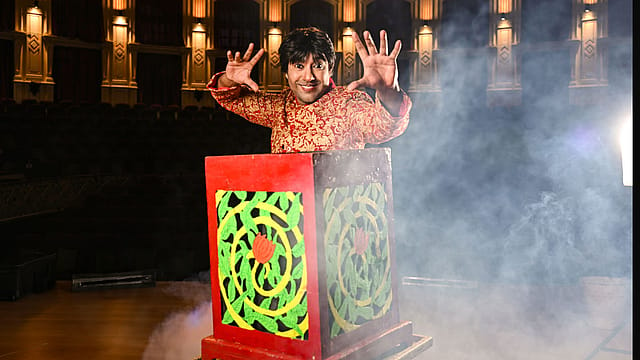
THE DARK STAGE of the auditorium is lit only with the disturbing flashes of a powerful neon red light. On and off and on again, at a rapid frequency, causing a queasy effect of being in the operation theatre of a badly lit government hospital. The children in the audience squeal uncomfortably, even as their parents throw protective arms around little shoulders and quieten them with whispering words of comfort. The widespread shushing is fast replaced by screams, first on the speakers and then in the aisles. In the middle of the stage is a man inside a vertical contraption, his arms fastened by leather belts to the sides.
He is Pouroosh, the headlining magician of the show and even more significantly, grandson of the legendary Indian illusionist, PC Sorcar, thus a third-generation scion to the country’s most famous family of magicians.
Amid these terrifying lights and screams, a man lies down in a prone position on a stretcher. The stretcher is dragged towards Pouroosh’s back, and the assistants ensure that the objects—vertical and horizontal—coalesce. The prone man is then coaxed, skull-first, into the standing magician’s spine and Pouroosh throws his head back to indicate great pain, a most jarring image heightened by the screaming sound-effects that have turned guttural. Now even the adults in the audience, especially the grandparents, gasp. A few slowly-ticking seconds later, the man pushes through the front of Pouroosh’s stomach, dramatically ripping through the cardboard wall of the contraption. Once he emerges fully, the crowd breaks into peels of applause, which turns raucous after the youngest Sorcar appears, in one piece, and takes an elaborate bow at the edge of the stage.
Just as the act labelled “Soul to Soul” ends and the stage is prepared for the next trick, the once-scared children giggle loudly in their seats, their mothers and fathers put away their recording phones, while the even older generation sigh nostalgically, their chatter laced with memories of how once this art form was mainstream enough for it to be televised at prime-time on Doordarshan, like when Pouroosh’s father, PC Sorcar Jr, made the Taj Mahal disappear for a couple of minutes on the widely-watched state-owned channel. On that day, his audience was several million strong, a quasi-nation collectively wondering what the secret to the optical illusion could be. Today, a much smaller number does the same inside the remarkably quaint Museum Theatre, located in Egmore, Chennai, a most apt colonial venue for this old-school magic.
“A good illusion is timeless. The secrecy to the performance has currency in every era, even with the youngest in today’s generation,” Pouroosh tells me after the show. I ask him if carrying forward the brand of PC Sorcar, which he goes by now, is a source of pride, pressure or the responsibility to be relevant in an age where every mystery is Googled and every trick can be explained on YouTube. Pouroosh smiles. “The tradition is my inheritance, and therefore my responsibility. So, yes, it is all three. So many people come expecting something fantastic from us. We have to live up to what my grandfather, father and uncles have given to society.”
Magic occupies a peculiar place in modern India. The language of illusion has never been more widespread. Artificial intelligence can generate convincing images in seconds, and every smartphone is capable of producing visual tricks that would have seemed miraculous a generation ago. Magic itself continues to exert a powerful hold on the imagination; few fictional universes have shaped childhoods as profoundly as JK Rowling’s Harry Potter, whose spells, wands and enchanted worlds remain a rite of passage for millions of children, even in India. Yet, the traditional stage magician has quietly drifted from the centre of popular culture.
There was a time when that was not the case. Through much of the latter half of the 20th century, the Sorcar name carried a celebrity that extended far beyond theatre halls. Magic specials, by Indian heavyweights or otherwise, were television events. I vividly remember, as a child, hiding behind a living room sofa during a David Copperfield performance, all two-plus hours of it, broadcast on DD Metro. Illusions became subjects of national conversation, and pre-social-media performers, such as David Blaine, occupied a cultural space somewhere between entertainer and folk hero. Today, the average Indian teenager is arguably more likely to recognise a YouTuber than a stage magician.
That shift raises an obvious question: what value does a live magic show hold in an age of constant explanations? Every famous illusion can be dissected online. Entire YouTube channels are devoted to revealing secrets that magicians once guarded fiercely. Audiences now arrive carrying devices that can instantly search for answers. The change is akin to the world of pro wrestling, which no longer protects the act of kayfabe—the practice of portraying punches and storylines as entirely genuine—but now embraces its fakeness.
For Pouroosh Sorcar, however, the internet has not diminished the appeal of magic as much as changed the conditions under which it operates. “Magic is meant to be experienced in person. It always has and always will be,” he says, now bereft of his cloak that constantly changed colours while on the Museum Theatre stage. “The emotions created by a live magic show cannot be replicated on a screen.”
The argument surfaces repeatedly during the conversation. Rather than viewing Instagram, YouTube and social media as competitors, he believes they may be creating a greater appetite for live experiences. “Young people are beginning to feel saturated by gadgets and screens,” he says. “They spend hours every day on them, but they also want to come out and experience something live.”
The audiences he encounters appear to support that view. During his current Chennai run, Sorcar has staged around 30 performances across nearly two months. Since returning to regular touring after the pandemic, he says he has performed more than 300 shows. “Tonight is my 310th and final show in Chennai for this season,” Pouroosh told the audience at the end of his final act of the night, where he held a white bedsheet as a façade, covering him in his entirety from the view of the seats. When the sheet dropped, he had vanished, only to reappear to rapturous applause at the back of the auditorium. Boys and girls, aunties and uncles, grandmothers even, lined up to shake his hand, almost as if only physical touch would prove that the man walking down the aisle wasn’t a hologram.

The crowds, he notes, are rarely defined by a single demographic. “Many people tell me they have seen my father perform. Some even tell me stories about my grandfather that I did not know myself,” he says. “At the same time, younger audiences bring a different energy. They cheer, react and participate in ways only that the young can. That energy lifts us performers as well.” If anything, Sorcar sees the challenge not as a lack of interest but as a battle for attention.
“Earlier, there was Doordarshan,” he says. “Today, there are countless channels, websites and social media platforms. Yet, magic has survived.” Audiences, he has of course realised, have more entertainment options than any previous generation, and magic is now forced to compete alongside everything else. Yet, some aspects of the art remain unchanged. Throughout the interview, Sorcar repeatedly returns to the idea of secrecy. “Magic is built on illusion,” he says. “What you see is not always there, and what you do not see may be present. Secrecy is our password.”
So secretive is the middle-aged man even without his cape that when I ask him his age, he replies: “I am as old as you think I am. You see, beauty, age and magic are all in the eyes of the beholder.” A quick Google search, however, reveals that he is 44, the internet proving once again to be the natural enemy of magicians.
Secrecy, however, is not the only one inheritance that Pouroosh carries. The other is a family history so intertwined with Indian magic that, at times, it becomes difficult to separate one from the other. Ask him about the origins of the Sorcar legacy, and he does not begin with television specials, disappearing monuments or sold-out auditoriums. Instead, he talks about his grandmother. “Much of what I know about my grandfather comes from her,” he says. “I was fortunate enough to grow up hearing stories about him until she passed away in 2010.”
Those stories, he says, rarely revolved around fame. They focused instead on work.
“One thing I learnt was his extraordinary dedication to magic. We live in a very different era today. They would sleep only four or five hours a night and devote the rest of their time to their work, their craft, which was creating illusions. He was constantly creating and writing new performances,” he says. “Their discipline and energy were exceptional. That is what allowed them to grow internationally and compete with the biggest global names in magic. There are legends like Houdini and Cardini: the name PC Sorcar belongs in that conversation.”
The reverence is understandable. Pratul Chandra Sorcar, better known as the original PC Sorcar, remains the most recognisable magician India has produced, a performer whose fame extended far beyond the country’s borders. Yet, Pouroosh is quick to point out that much of that fame was earned overseas. “My grandfather actually performed very little in India,” he says. “His career was mainly an international one. He started in Japan, then travelled through Europe and across the world.”
The Indian chapter of the story was largely written by the next generation. “It was after his death that my father and uncles carried the brand forward in India,” he says. “During the 1970s and 1980s, magic became a booming profession. Many performers emerged across India and the Middle East, inspired by the Sorcar style.”
That style is entrenched in the family, which he believes stretches further back than the Sorcar name itself. Before the family became Sorcar, he says their surname was Dev. One strand of family lore traces their ancestry to a magician named Atmaram Dev, who is said to have performed before the Mughal emperor Jahangir. “According to the Jahangirnama, two magicians from Bengal performed before Emperor Jahangir,” says Pouroosh. “One of them was Atmaram Dev, who performed an illusion involving an empty vessel from which water flowed continuously. We still perform a version of that illusion today.”
When he did, back at the Museum Theatre, pouring water from a large silver jug into a bucket labelled “Water of India” until it was empty and then doing so again, repeatedly, the audience was barely tickled, having seen greater feats of illusion and cleverer sleights of hand on this very stage. But during the relatively basic act, Pouroosh seemed most proud at carrying forward his family’s oldest legacy.
Whether history or apocryphal, both the performance and the narration of the origin story reveal something about how the Sorcars see themselves. Not merely as performers, but as custodians of a tradition that predates new-age entertainment such as cinema and television, and ostensibly even the modern nation itself. “Magic may be viewed as a dying art, but, as we know, it has survived a very long time,” he adds with a shrug.
Which is a clever, full-sleeve, card-behind-palm way to say that magic never did disappear, only the magicians did.