Wear and Declare: Designers are transforming jewellery into wearable art and bold self-expression
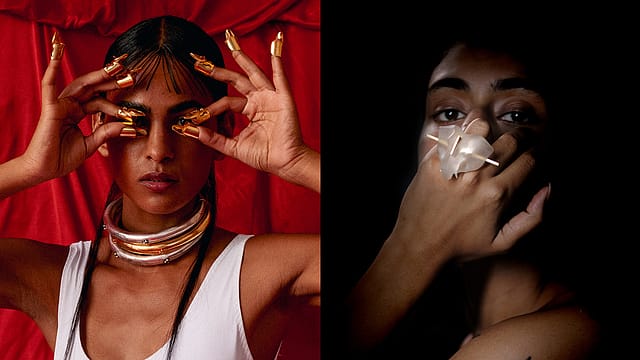
STARE IS A STATEMENT as well as an invitation. Fashion label NorBlack NorWhite’s first collaboration with jewellery designer Bhavya Ramesh gets its name from the idea of “protecting the unwanted gaze with all our eyes” and offers a collection rife with protective motifs—chillies and lemons, the moon, ghungroo, snakes, horns and fangs from traditional guardian masks, and the eye. It is a collection representative of Ramesh’s aesthetics, and marks NorBlack NorWhite’s second outing with jewellery—following an earlier collection with Jaipur-based label Kichu. “We have always admired jewellery design, the craft of adornment and it’s a huge part of our personal style,” says Mriga Kapadiya, who helms the fashion label with co-founder Amrit Kumar. “This would be our second offering in this space and for this time around with Bhavya Ramesh, the entire process has been deeply informed by how we both tell stories and build worlds—an added layer to making this an exciting and inspiring process, apart from the actually jewellery design.”
Jewellery is intrinsic to Indian design traditions and cultural expression, tied to rituals of shringar and moulded over centuries of distinctive craftsmanship that varies from one region to another. These pieces are conduits of memory and handmade dexterity. It is a mark of the versatility and exceptional beauty of these crafts that traditional jewels continue to be cherished, reinvented and styled in refreshing ways. This longstanding love for jewellery has also spawned a parallel movement where new labels are emerging to present original vocabularies of bling. In the hands of talented, of-the-moment designers, jewellery becomes more than beautiful adornment. They challenge notions of wearability, placement, proportion and aesthetics. They represent a new way of design thinking as well as a contemporary engagement with what we choose to wear.
Take for instance, Bhavya Ramesh— NorBlack NorWhite’s collaborator for Stare. Since 2018, when she started her eponymous label, Ramesh has come to be known for her elaborate nail crowns, eyewear, palm cuffs, webbed fingers and hairpieces inspired by mythology, fantasy and futurism as much as silver crafts. “At the core, I am driven by concepts, ideas and emotions,” the designer had told Open in a previous interview. Designer Suhani Parekh’s label, Misho’s sleek-meets-maximalist jewellery has found its niche in international markets, seen on the likes of Zendaya, Dua Lipa and Angelina Jolie. The label describes its designs as “modern architecture for the body”, and Parekh’s more ambitious designs include an anatomy-inspired Vertebral Neck Piece and gilded corsets.
As Indian fashion makes inroads into the global market, jewellery brands too are finding their moment in the spotlight, such as Hyderabad-based designer Ridhi Asrani’s eponymous label which has been spotted in shows such as And Just Like That or Emily in Paris. Another brand drawing international attention is Outhouse, the buzzy accessories brand by sisters Kaabia and Sasha Grewal. Beyoncé and Olivia Rodrigo are among its celebrity clients, and the brand also created pieces for Alia Bhatt and Kiara Advani to wear at previous editions of the MET Gala.
At Tirunelveli-headquartered label NO.NA.MÉ, designs are rooted in gender-neutral aesthetics and geometry. Think earrings looping like necklaces, rings that resemble armour and wrist ornaments that create the illusion of floating halos. “I enjoy challenging what people expect jewellery to look like or where it should sit. A brooch doesn’t always have to go on a lapel. An earring doesn’t always have to stop at the earlobe. Changing proportions or placement changes the relationship between the body and the piece,” says Smruti Mathisekaran, founder of NO.NA.MÉ. “At the studio, I constantly encourage my team to move away from preconceived notions and start by asking, ‘What else can jewellery be?’ That’s usually the question we keep in mind before we begin sketching or brainstorming. It opens up so many possibilities.”

Mathisekaran brings a background in interior and multi-disciplinary design into the brand’s grammar, and jewellery has become her favoured medium for its transformative capacity. “What fascinates me is its ability to completely change how someone feels without changing who they are. A piece of jewellery can make you feel sexy, confident or even all-powerful,” she adds.
With a variety of new experiments in designs and materials, such jewellery resists easy categorisation. One might term it as fashion, demi-fine, conceptual, avant-garde, surrealist, new-wave or simply, contemporary. What this array of jewellery certainly isn’t, argues entrepreneur Pooja Roy Chowdhury, is junk—a phrase that has dominated the non-precious jewellery market in India. Roy Chowdhury is the founder of NIMAI, a multi-brand retail platform and “makers’ collective” for independent jewellery labels in the country. Since 2013, when NIMAI started, the platform has spotlighted experimental jewels, alternative materials and innovative designers which Roy Chowdhury categorises as “curious mediums” on the platform. “Jewellery can be an intersection between art, crafts, design and fashion. It’s wearable art in the truest sense,” she says. “Over the past 10 years, the acceptance for jewellery beyond traditional mediums has increased. It’s also creating a new appetite among customers who want to look different and experiment.”
When NIMAI began, more than a decade ago with seven labels, the intention was, in fact, to highlight avant-garde and experimental jewellery. Over the years, the platform has expanded to include traditional and festive designs, with a roster of 150 names. But Roy Chowdhury remains committed to her original purpose and helms the onboarding process for every label herself; she observes that the number of experimental brands has consistently grown as designers realise that jewellery is “a viable career path” and business opportunity.
For independent jewellery designers running small businesses, scale and visibility emerge as the biggest challenges in a competitive market. Jewellery in India is a billion-dollar market, ranging from fine jewellery to a variety of non-precious brands and designs; its business potential has caught the interest of investment as well as a host of entrepreneurs who are launching new brands and platforms to capitalise on the opportunity. The abundance of jewellery is offset by a dominance of mass-produced, unmemorable designs. With gold prices surging, concerns about affordability and changing perceptions of diamonds and gemstones, customers are seeking affordable options and open to trying offbeat pieces. Yet, as Roy Chowdhury notes, commercial designs generate faster revenues and sales, and prove to be tough competition for smaller labels that work on trend-agnostic designs, handmade techniques, small-batch production and intimate retail strategies.
In a country known for its jewellery manufacturing capabilities and technical command, homegrown designers are still underrated. Roy Chowdhury adds that only a few independently-run jewellery brands find fame and mainstream appeal. “We need more awareness and storytelling around it,” she says.
POPULAR PERCEPTION OF jewellery is changing, albeit slowly. The target consumer has evolved. Brand promotions for jewellery have conventionally centred on women, positing them as the primary consumers of products. In contrast, contemporary labels often position their work as gender-neutral—not merely in campaigns but as a design philosophy. The ethos resonates with a wider consumer base. Take for instance, Kolkata-based Aman Pal who has been fascinated with jewellery since he was young. “Jewellery makes me feel very beautiful and empowered. There is a purpose to it,” says the 26-year-old digital content creator.
Fashion is central to Pal’s professional pursuits but his personal style is a form of asserting his identity—and a response to the experience of being invisibilised for years due to his queer identity. When he began dabbling with content creation and modelling, Pal recalls his style being more minimalist. “With time, I have started feeling more comfortable; over the last few years, especially, I have been experimenting more and curating my looks,” he says, emphasising the intention behind every choice. Eina Ahluwalia, The Yamin Collective and Earthaments are among his favourites. “I am particular about my associations, because jewellery is personal for me—it’s about expressing my identity. I am selective about what I wear, where I shop and whom I collaborate with.” His choices are driven by design, bold aesthetics, materials, colours; the history and storytelling of a design or label can also be a factor. “I like pieces that are not mass-produced, and I love to promote and support homegrown brands—especially gender-fluid and inclusive labels.”
As their fans grow, niche labels are finding new opportunities. When Mathisekaran hosted NO.NA.MÉ’s first pop-up in Delhi, people inquired if she was selling stationery. Over the years, she started displaying photographs of people wearing the pieces; if customers ask what a piece is or how it’s worn, she enjoys the conversation because “the design has sparked curiosity.” The brand’s clientele has grown, and so has their curiosity. “They want to hear the story behind a piece, understand how it can be styled in different ways, and they’re far less intimidated by bold jewellery than they used to be,” Mathisekaran adds. “What’s been especially rewarding is seeing customers who first bought one of our simpler designs, come back later and choose something much more sculptural or unconventional.”
In a culture where people increasingly like to be seen, and admired for their style choices, whether it is social media or offline spaces, jewellery is an instant attention magnet. A major transformation lies in the fact that bold and unconventional designs, often considered excessive or offbeat, are becoming more commonplace “People may stare, but there is a change. Many appreciate it as well,” says Pal. To those who say it’s too much, too extra, that is exactly his point. “It decorates your personality.”
In tandem, designers want their work to be noticed and chosen not only for its beauty (which remains de rigeur to the) but for its difference. “I think people today are looking for jewellery that feels personal and distinctive rather than just decorative, and it’s been incredibly encouraging to watch that change happen over the years,” says Mathisekaran. “At the end of the day, I want someone to pause for a second and think, ‘I haven’t seen jewellery like this before’.”