Threading through Inheritance: Crafts and culture became wearable stories at India Couture Week
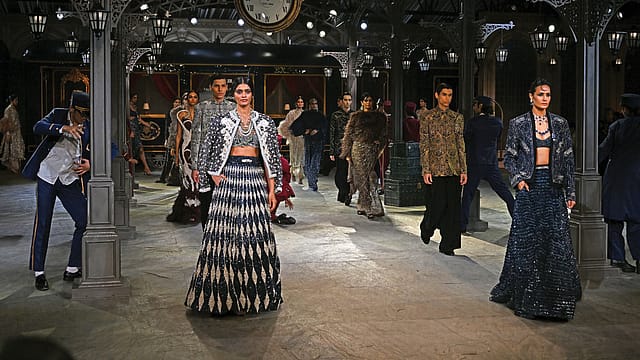
In 1928, Sarojini Naidu began her speech in the US introducing herself as an ambassador from an ancient nation to the youngest one. That speech, which celebrated India’s long history and the place of women in it, delivered by one chosen to be the nation’s ambassador, became the sound that marked the beginning of Masaba Gupta’s debut show at India Couture Week (ICW) 2026.Gupta’s moodboard has always featured Indias with a playful eye and a kitschy aesthetics. In couture, these have become “hyper-luxury, beautifully embellished motifs”. Chardi Kala, the collection, is rife with colour and spirit. “Fashion has always been a great mirror to society. Whether you like it or not, colours, textures, the size of a motif, the amount of gold work on something—all of these things signal what a society is really going through,” Gupta tells Open. “For me, optimism is in the hemlines. Optimism is when your lehenga can finally become shorter. Optimism is when you can wear a corset with a lehenga. It’s when you can style your jewellery in interesting and exciting ways—wearing it in your hair or on your forehead. Today, versatility is incredibly important.”
Close to two decades since its maiden edition in New Delhi, India Couture Week has come to represent a sprawling and diverse sartorial landscape. Indian couturiers no longer only cater to the Indian market or the diaspora—they are tracked in the fashion capitals of Europe, dress the world’s biggest celebrities and retail around the globe. Indian celebrities, no longer limited to movie stars, attend black-tie galas and major red carpet events from New York to the French Riviera dressed by Indian couturiers as often as European luxury houses.

It is “a monumental shift”, says designer JJ Valaya who belongs to the early cohort fashion designers in India. “There was no ‘fashion industry’. People did not understand the concept of wearing a person’s name,” he recalls. For Valaya, who describes himself as a cultural nomad, multiculturalism is a signature. His ICW collection showcase was titled SIDDI, borrowing its name from the Siddi community that descended from the Bantu people of East and Southeast Africa and came to live in India, and showcased one-of-a-kind ensembles with painstaking artisanal details. “For me, there is no difference between an artist and an artisan. When we bring the two together, in terms of mindscape and skills, exceptional things happen,” Valaya adds, noting that his practice is his way of preserving a part of India.
Indian couture conventionally centres on weddings and its abundance of ceremonies but its orbit is expanding as designers engage with new ideas and aesthetics. “We want to keep the glamour quotient alive but also draw from Indian culture and create a signature. We have crystals and feathers but also craftsmanship,” says Falguni Peacock who founded Falguni Shane Peacock with her husband Shane. Their ICW collection, Le Grand Voyage, assembled an array of influences from their travels and interest in history—think Byzantine architecture to the Taj Mahal embroidered on garments, elaborate threadwork offset with dazzling embellishments. “Everything that was part of the collection was put with intention. There was a story or a detail that inspired us, a memory or memory that we translated onto the garment,” Falguni adds.
Craftsmanship is one of the cornerstones of couture collection, and it is arguably one of India’s strengths—recurring across the lineup of designers at ICW. What distinguished the best collections was their designers’ point of view, the innate understanding that couture is a wearable form of storytelling. Stitched into it are stories of crafts, cultures and, most importantly, its makers.
Take for instance, Anamika Khanna whose collection, Moonlit Palace, was ICW’s inaugural showcase—hosted in Hyderabad before shifting to Delhi for the rest of the edition. Highlighting construction and ornamentation in equal measures, the collection combined stories of Barmer (with textiles co-created with women artisans and reinvented using dyes, embroidery and hand-painting) with artistic traditions from the Kalighat tradition of Kolkata. Weaving their own path through maximalism and minimalism, fluidity and structure, tradition and contemporaneity, the collection served as a reminder of why Khanna remains one of the country’s most remarkable design thinkers.
Tarun Tahiliani eschewed the runway in favour of a multi-sensory showcase that combined a museum-like display of designs and techniques from the designer’s atelier with an intimate presentation of conceptual couture. His collection was Ang (meaning body in Hindi), a couture translation of the human body—collarbones, shoulder blades, torsos and the navel carved onto to garments. Blending European corsetry and tailoring with an observation of Indian aesthetics and body types, Tahiliani narrated a story that played to his design strengths and ethos.
Rimzim Dadu narrated another story with INLAE, inspired by mother-of-pearl and inlay work. “When I started looking closely at inlay work, what really fascinated me wasn’t just how beautiful it is, but the process behind it,” she says. “We spent months experimenting with how different materials could come together with the same sense of precision and fluidity.”
In this growing space of Indian couture, Dadu notes that she focuses on staying honest to her design ethos. “Every collection is an exploration of a material, and if that exploration feels authentic, the point of view naturally comes through. That’s what couture means to me,” she says. “And most importantly, today’s brides and grooms believe that too—they don't want to remain frozen in time when it comes to their couture choices.”
Younger fashion consumers are also reshaping the designs we see on the runway. Another ICW debutant, Arpita Mehta’s Ceremonial collection juxtaposed her atelier’s signature mirrorwork with bandhani, Banarasi, kantha embroidery and tissue. An excess of embellishments fell short of enabling a considered conversation of the designer’s contemporary style with the craft traditions yet this was a collection filled with youthful designs—mermaid lehengas with tiny cholis and corsets, pre-stitched saris and more. As a social media post stated about the show, this were garments Kareena Kapoor Khan’s Poo (From Kabhi Khush Kahbhie Gham, a Noughties character Gen Z seems to love) would want in her closet. At Aisha Rao’s collection showcase, ‘Priyasi’ off-shoulder dresses and gowns, and sleek separates shared the runway with more formal Indianwear.
Jayanti reddy’s collection, The Gilded Era, featured black red carpet-worthy gowns, Victorian skirts with embellished topwear and minimalist lehengas with embroidered corset blouses. Cocktail gowns punctuated ornate red lehengas at Dolly J while Roseroom by Isha Jajodia was packed with a profusion of lace, pearls and Swarovski crystals, amping up the wedding-ready line of womenswear titled, Softly, Strong. Meanwhile Kunal Rawal, a designer who has built his eponymous label to cater to contemporary menswear and is one of the few designers in the category, showcased Rawalgarh—an expansive lineup of designs, concepts and ideas that have defined the label for the past 15 years—where black tie dressing met Indian textiles, utilitarian details matched festivewear and an softness prevailed over sharp tailoring.
It is one explanation, Masaba notes, for her extensive lineup. “We, as a brand, have a lot to say. We are multidimensional. We cater to different kinds of women. Through the vastness of the collection, I'm trying to say that today’s woman is no longer one or two stereotypes,” she says. The same, she observes, can be said for India. “When I think of India, I think of the many Indias. I think of the India we know and see closely, and then there are other Indias we haven't yet explored.”
In the final show of the season, Rahul Mishra too brought his own take on glocal, multicultural design. The showcase began with a walkthrough and preview of Devi, the newsmaking collection he showcased at Paris Haute Couture Week earlier this month. The collection translated ancient Indian sculptures from temple architecture—which has inspired numerous couturiers in the country—in breathtaking, impeccable embroidery and Trompe l'oeil emsembles. In a note, Mishra said that while many had found their own expressions of these sculptures, his intention was to explore if threads could “echo” the language of sandstone. He juxtaposed the collection with Indian festivewear, flush with colour and other embroidery signatures of the label. Actor Sobhita Dhulipala played the role of showstopper, entering the runway in a Devi bodysuit. But when a group of dancer performing at the show stepped up to wrap a lehenga around her, the ensemble became something else—an amalgamation of old and new, of crafts and shimmer, its own picture of the melting pot that is India.