The Great Indian Art Rush
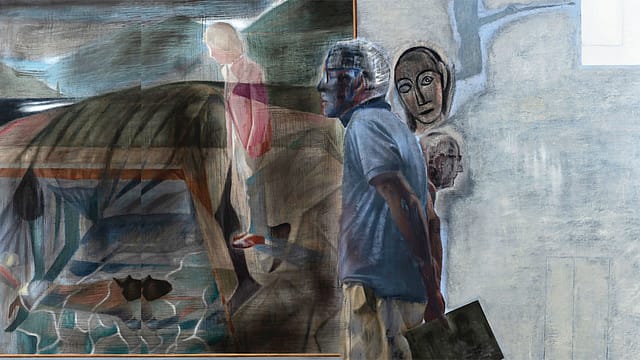
ONE OF DELHI’S MOST anticipated winter fixtures, the India Art Fair (IAF) grows in ambition each year. Its 17th edition, which began on February 5, brings together a record 133 exhibitors including 94 galleries and 26 new exhibitors. Thousands of collectors and art lovers arrive at the fair to get their fill while parallel events and exhibitions across the city and exclusive art parties add to the spectacle—a social gathering and platform for creative exchange as much as a commercial undertaking.
Jaya Asokan, director of IAF, notes the importance of the edition at a time when South Asian art is having a defining moment. “Artists from the region are finally receiving sustained international visibility, there’s a lot of market confidence and critical attention to South Asian practices,” she says. “India Art Fair has a key role in building and strengthening this ecosystem, supporting galleries and institutions and bringing the market together. Our focus now is on deepening this growth, making it sustainable, resilient and rooted from the inside out.”
The IAF team has made its focus on regional art ecosystems a key part of their agenda. Over the past year, programming in other cities including Mumbai, Jodhpur, Kolkata, Ahmedabad and Hyderabad expanded the fair’s impact and reaching a wider collector base. “Accessibility remains central to our vision,” Asokan adds. “A very confident, inclusive artistic landscape is the foundation for long-term cultural growth, and whatever we do at the fair revolves around that.”
India Art Fair is akin to the grand finale of an arts season in India that seems to keep growing bigger and brighter. Events such as India Art Fair or Kochi- Muziris Biennale, which began in 2012 and is now in its sixth edition, were once one-of-a-kind events. Today, they are among several fixtures in a packed calendar. Think Serendipity Arts Festival in Goa or Mumbai’s roster of events like Art Mumbai and Mumbai Gallery Weekend. Cities such as Hyderabad, Bengaluru, Chennai, Kolkata, Jodhpur and Jaipur have their own events. Meanwhile, a staggering array of exhibitions are in progress across the country, in galleries and white cube spaces, warehouses, malls and abandoned nightclubs.

If fairs, exhibitions and events are measures of a market’s potential, India is experiencing an unprecedented art boom. Its total value, estimated at around $330 million to $338 million (`3,000–`3,400 crore), may situate the country below globally dominant markets such as the United States, China or the United Kingdom. Yet, it is a market rife with opportunities and challenges, as art becomes more accessible and the ranks of collectors swell.
“The audience hasn’t changed. It has grown and diversified,” Aparajita Jain of Nature Morte gallery says, noting the transformation of the Indian art scene into an industry. People are “looking at art” not only in metros but also in other cities—an indication of how wealth is percolating into the country. “There is a lot more awareness. People are seeking art—they want quality, and to understand what denotes quality,” she adds. “We see more artists and galleries coming up, and there is a market for both established and emerging names. There is an appetite for everything.”
Shireen Gandhy, owner of the Mumbai-based gallery Chemoul Prescott Road, calls this a “third coming” for Indian art. Growing up in a family of gallerists—her parents Kekoo and Khorshed set up Gallery Chemould in 1963—Gandhy witnessed the first flush of success for India art in the late Eighties followed by the global boom in contemporary art during the early 2000s. In contextualising the present, Gandhy often turns back to those years. “There was a burst of money in the art market, but also a lack of education. We had great spaces, but hardly any footfalls beyond people from the art world,” she recalls. The goal of drawing people to galleries brought Gandhy and other gallerists to conceive of platforms such as Mumbai Gallery Weekend and Art Night Thursday, which has over the years drawn both locals and visitors.
Sunaina Anand, founder and director of Art Alive Gallery in Delhi which turns 25 this year, also highlights growth in viewership. “In the last couple of years, a lot of structured events have come up and collectives where galleries are coming together,” she says. “All these are strengthening interest and the culture of viewing art. It’s most essential to the industry—as more audiences view art, dialogues and communities grow.”
At the heart of this third coming, stands a growing number of people taking their first steps towards buying art or building a collection. The demographic has come to be loosely described as young collectors—their collecting journey being the main criteria, not age, though many are in their 30s or 40s. “There is a clear generational shift underway,” says Bhavna Kakar, founder of Delhi’s Latitude 28. “A younger demographic of collectors is entering the ecosystem—confident, well-informed, and far more willing to experiment than previous generations. Unlike earlier collectors who often gravitated towards established modernists or auction-validated contemporary names, this new cohort is open to discovering emerging practices and supporting artists at formative stages of their careers.”
Roshini Vadehra, director at Vadehra Art Gallery in Delhi, also notes the curiosity about artistic practices and mediums. “People are creating their own stories with their collections, so it’s not necessarily a trend-based collecting mechanism,” she says. “It’s more about the story one is trying to tell through the collection.”
This creates opportunities for contemporary art and younger names. The Young Collectors Programme (YCP) has been integral to India Art Fair’s activities over the past few years. “The response sometimes shocks us as well,” quips Asokan. “There’s a strong interest in process-based practices and experimentation, and art that reflects social, political and ecological concerns.” Interdisciplinary practices and less traditional media find takers, and even digital art is sparking curiosity.
Renu Modi, founder of Gallery Espace, observes textiles and ceramics among other media coming to the notice of young collectors. There is a renewed interest in genres such as abstract art. “What is very important is public art platforms— these have helped in the movement of art, material, medium, what people like,” she says. “We are seeing a lot of artists interested in technology, crafts and natural materials in contemporary art, and using space. There are geopolitical themes and work concerning memory, migration and ecology,” she says. All of this is culminating in a “robust landscape” of Indian art.
AS GALLERIES AND fairs multiply, artists find fresh opportunities and young collectors arrive in unprecedented numbers, new stakeholders and consumption patterns are beginning to redefine what it means to appreciate and acquire art. Interior designers and architects have come to play an outsized role, often sourcing art for clients or advising them on acquisitions. To be perceived as art collectors or have their art-filled homes in the pages of prestigious decor publications are high on the list of goals. Woven into the growth story lie questions of how this industry will cultivate a culture of sustainable patronage over social capital.
Abhishek Poddar, founder-trustee of the Museum of Art & Photography (MAP) Bengaluru, and a passionate collector observes that many artistic practices are increasingly leaning into a market tendency to create what is easy to sell, making their work seem formulaic. “Artists have generally always lived on the edge, where they are courageous enough to make art and thus convey something that normal people are not comfortable saying. They express it through their work,” he says. “But when artists start playing safe, innovation stops.” The definition of a collector itself has become ambiguous. “Is it somebody merely decorating their home? Is it somebody buying just because they get a good deal?” Poddar asks. “In the past, we had people who built a collection over 20-30 years and then they would turn that over to an institution because they wanted the thread connecting the collection to be seen. Now, people are often using art as just a trading opportunity.”
Saloni Doshi, founder of Space 118 Art Foundation, also notes the changing nature of the collector. The Mumbai-based Doshi is a first-generation collector who began acquiring art in her twenties. “It wasn’t considered cool to be a collector and I didn’t even tell too many people because there were such crazy reactions.” But Doshi kept building her collection, rooted in supporting living artists, finding the right value and living with it. Affordability was crucial, because Doshi began collecting during the boom period of the early 2000s and was spending her salary. But she found pleasure in contemporary art and engaging with artists. “I like growing with the artist. I like knowing their journey—their first solo, their second solo, group shows, biennales and fair—and seeing their trajectory and interacting with them,” she says.
Art’s prestige value becomes a way to climb the social ladder, says Doshi recalling instances of people buying what their interior designer suggested, commissioning art in specific sizes or colours to suit their homes and following a herd mentality—to buy the kind of art one’s peers may be collecting. “One becomes a collector, but they don’t have enough knowledge of who is up on their walls. I do not see connoisseurship anymore.”
Art yields returns but equating it with stocks is unacceptable to gallerists as much as collectors. “Art is surely an investment, but it’s an emotional investment more than a financial one. You need to resonate with it, understand it and respond to it,” Anand says.
Overcommodification is a concern. “A rapidly expanding market can sometimes prioritise visibility, speed, and recognisability over depth, research, and long-term practice. For artists— particularly younger ones—this can translate into pressure to produce work that conforms to market expectations or trend-driven aesthetics, often prematurely,” says Kakar, warning that this can erode the sector’s cultural and intellectual foundations.
IN RESPONSE, GALLERIES have an array of offerings —talks and panels, performances, publications, workshops and walkthroughs—to build engagement. “It’s about engagement but it also, frankly, comes from the challenge of getting people to come into the gallery space,” says Vadehra. “People find the gallery spaces intimidating; they feel that they are not going to buy, then they don’t, they shouldn’t be entering a gallery space. One is always trying to change that mindset, because artists love crowds, they love different kinds of people to come and engage.” Gandhy says viewership is a privilege she does not take for granted. “Even today, when my gallery is filled with unknown people, nothing gives me more of a thrill.”
Art exhibitions geared towards viewing and a museum-going culture—which remains nascent in India—are crucial. “When you have a very robust art market, but not a robust ecosystem for pedagogy or the understanding of art, it becomes more about speculation, and about what one can own rather than what is inherently behind the art,” says Poddar. “I am hopeful that this will change with more museums, thoughtful exhibitions, well researched publications and critical engagement.” This ethos reflects at MAP Bengaluru where exhibitions are designed with an eye on education.
Doshi founded Space 118 in 2009, a platform to support artists with grants, residencies, and mentorship and enable a culture of patronage with exhibitions drawn from her collections. “I feel strongly about my own region and supporting artists here—because they need us,” she says. “There is no art world without patronage.”
Art patronage in India has followed its own trajectory. “Art collecting was a system, a culture in the West. For us, it was royal patronage followed by rich, business families who built their own patronage,” Modi says. “What we are seeing is a changing patronage.” Serious engagement will sustain the arts, but that future may indeed emerge from this present abundance and confusion, in the tension between the fleeting and the enduring. To the connoisseur and the ignoramus alike, art has never been more seductive.
Collector’s Edition
Kiran Nadar, Chairperson, Kiran Nadar Museum of Art
ON COLLECTING ART
In the early years, I was drawn to Modernist and post-independence Indian art, captivated by the experimentation and narratives of that generation. Over time, my focus has expanded to include contemporary Indian and international practices, as well as classical, folk, and tribal art, reflecting the diversity and richness of our cultural heritage. Collecting, for me, is not only about personal resonance but also about creating a framework for public engagement. Through KNMA, this vision extends beyond acquisition—our exhibitions, educational initiatives, and public programmes are designed to foster dialogue, encourage critical thinking, and cultivate a culture of appreciation that connects artists, collectors and audiences alike.
A CREATIVE PURSUIT
Collecting art, from my perspective, is a profoundly creative and intellectual undertaking. While consuming art, whether experiencing it in galleries, catalogues or digital media provides immediate aesthetic and emotional engagement, collecting extends this encounter into sustained reflection and dialogue. It requires critical judgement, research, knowledge of artists and contexts, and an awareness of the relationships between works. Collecting is also stewardship, involving the care, interpretation, and sometimes sharing of works.
KNMA’S UPCOMING MUSEUM
We hope to invite audiences, whether collectors or those encountering art for the first time, into meaningful conversations about contemporary and historical practices, cultural identity and the ways art shapes our understanding of the world. Our aim is to create experiences that are both intellectually engaging and personally resonant.