The Bundled Bargain: On dogs, borders, poor millionaires, and the difference between being free and being sold freedom
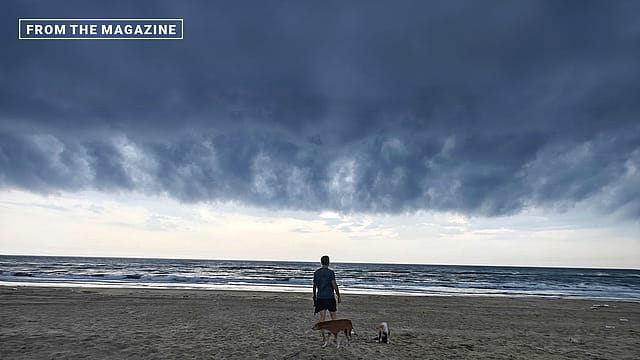
THE TIDE WAS OUT, THE SAND FIRM underfoot, a solid carpet for a decent stroll rather than the Marine-style obstacle course this Tamil Nadu beach becomes at high tide. Foam gathered along the waterline into loose whitish bundles, tumbling in twos and threes, dissolving before I could count them. Under my heels, where the last wave had thinned to a sheet of glass, small pockets of salt and trapped air popped the second my foot found them.
To the south, towards Sri Lanka, heavy clouds hovered, dark at the base, silvery above, already leaking. Underneath, I could glimpse the August rain arriving before it touched down, like a procession of tall, arched grey columns, hands tucked into ample sleeves, walking the sea towards me, heads bowed, unhurried. Medieval monks, my mind decided instantly, filing towards a refectory only they could see.
Then the dogs came.
Not ‘my’ Frankie who usually limits his battles to howling like Sinatra, hence his name. He was the one under attack. Three of them breaking off the dune grass at a dead run, teeth first, the fury of animals defending nothing you could point to. An olfactory memory of sand that had been theirs before it was anyone’s.
I ran at them yelling, arms wide, making myself larger and even sillier than I am, until they peeled off one by one, back over the wall of the construction site they guard. The beach went quiet again in the specific way a beach goes quiet after the threat of violence: waves indifferent, foam still filing past as though nothing had happened. And nothing had, really.
But one dog stopped at the bush line, before hopping over the wall, turned, and looked at me. Not afraid, not even angry. Weighing something. I looked back, thinking we were two mammals who had woken up that morning wanting the same modest thing, the right to walk a stretch of shore that didn’t ask permission of us. The unforgiving tide was already coming back in to take the argument away from both of us.
I turned inland and slowly walked home, Frankie trotting behind. Somewhere along the neighbours’ wall, past the casuarinas, a fire was lighting the sky, low and yellow, the kind of blaze you can’t quite place, someone’s rubbish getting burned, a ritual, or just a field in flames.
The dioxin-drenched smoke didn’t rise the way smoke is supposed to. It came apart in the drizzle instead, thinning into something closer to breath than fire, as it fell, unhurried, onto my head, my shoulders, the back of my hands, as if the sky had decided that today everyone gets a little of the burning, free of charge.
Over decades of writing about the world instead of simply living in it, as eternal observer, I have noticed that this is roughly how fear arrives too. Not as an announcement. As smoke from somebody else’s fire, drifting over a fence you didn’t know was there until what was on the other side started falling on you.
Longbeforetherewere constitutions, orborders, orthe word‘freedom’ itself, there was this: a species deciding it would rather build a wall against the thing it dreaded than go on sleeping in the open.
Every freedom we have argued about since is really an argument about which wall we already agreed to, and who got to draw its boundary while we were looking the other way, as a fire burned.
It’s the oldest transaction there is, older than any parliament, older than any flag. Hand over a portion of your freedom in exchange for not having to spend every waking hour defending the rest.
Most of the time we forget we ever signed anything, as we are born into the deal. We only notice the bargain again when someone new arrives, promising to renegotiate it, pointing to a bigger fear in return for a larger cut of what is left of our freedom. Across every continent I have lived on, a frightening number of us nod ‘yes’ gratefully, the way you say ‘yes’ to a stranger who offers to carry a bag grown too heavy to keep carrying it yourself.
I signed that bargain myself, first as a hopeful yuppie in America in the 1980s and 1990s, believing the Dream the way you believe something you have never actually examined deeply enough, and again, in 2022, as director of an American foundation in New York, wearing the kind of jacket that photographs well at a gala, fundraising among the ultra-rich, dining with millionaires and billionaires, some of whom, though I couldn’t have known it then, were three years away from becoming inflation-poorer for it. I was deep in the mission.
But then I had my Marcello Rubini moment, the one at the end of Fellini’s La Dolce Vita, where Marcello Mastroianni plays a reporter, Rubini, spending the whole film chasing other people’s glamour instead of writing the book he keeps promising himself. At dawn, worn out by one more party, Marcello ends up on a beach, and across a channel of water a young woman he had met once calls something to him he can’t make out over the wind. He waves. He turns back to the group. He never finds out what she said…

I decided to abandon that so-called Fellini-like ‘party’ of the Western world for a life near a village in Tamil Nadu because I noticed, the way you notice a stain you have had on your trousers for years, that I had spent too long being that Marcello, at that party, unable to properly hear the one message worth hearing. Nothing as tidy as a conversion, more like noise I got weary of enough to move where the noise was different.
WHAT I DID leave behind, at least, was the version of freedom that has you keeping up with the Joneses with money and recognition (until you finally meet the Big Jones nobody can keep up with), the brand of freedom post-war America has been selling the world ever since: not a philosophy, more a product line, with its own jingles and its own showroom lighting.
What I remember clearly of that world, because I recognise it as partly my own, is not a conversation but a look on certain faces newly arrived to the Dream, the expression of someone who has just been handed a key to a door they had spent years imagining, aided by exaggerated movies and TV shows with cheesy plots.
Not the vote, not the right to speak, though those who had never had them wanted those too. A humming refrigerator. A car with room for the entire family. Then enough money to escape the rental trap and afford a mortgage, which sounds like a burden until you have watched someone weep with relief at being allowed to take one on, thirty years of debt received as a sacrament. And then, of course, the wanting to become a millionaire. Hyper-heaven.
Nobody had lied to them. America did and does deliver on that idea of freedom, for many, the whole package. The fridge, the car, the thirty-year loan, and the sleep-at-night knowledge that no one is going to kick down the door at 3AM for something you said out loud, a guarantee that feels more fragile in these ICE-cold days. Sure, you might have to give some money to the National Rifle Association to keep your right to bear arms, so you can shoot anyone outside that mortgaged home, freedom in public being somewhat less guaranteed than that in private.
But somewhere in that packaging, two entirely different freedoms had been wrapped together and sold as one, like those irritating shampoo and conditioner combos nobody asked to be stapled together. The freedom from repression, the secret police or the paramilitary is not the same freedom as the freedom to finance the purchase of a Ford, then a Prius, then a Tesla, or a MacBook Air or the latest iPhone, however the official talisman of freedom is branded in the present.
Nobody in Washington or on Madison Avenue (where I have actually worked for six of my eleven American years) ever asked whether the second one was really freedom at all, because by the time anyone thought to ask, the two had been sold together for so long that unbundling them felt like an act of heresy against the very idea of “the free world”.
Since the 1980s, Europe has increasingly been selling a quieter version of the same thing. Less a fridge (but that too), more a promise: that nothing catastrophic, like another World War, would be allowed to happen to you again, and that a social floor would sit under your feet, thick enough you could stop calculating your own ruin every morning, or leave a hospital with your bank account still standing. That, too, is a real freedom, and a precious one. But it’s not the same as “being free”. A cushioned cage is still a cage, even a well-upholstered one, even one you would choose again given the choice.
Here, in the rural India I chose, after the long Fellini-like party in the so-called Western world, freedom hasn’t always been sold as abundance, at least not to me. It arrived, at first, stripped of the usual glossy packaging, closer to its oldest and least comfortable meaning: not the freedom to acquire, but the freedom from the compulsion to keep acquiring. Nobody taught me that as philosophy. Here in the countryside, it also came from logistics: the closest shop in this rural area is a 30-minute drive in challenging traffic, then a power cut puts your plans on pause, the parcel may arrive or may take one more week. You must be patient. Wanting less wasn’t wisdom. It was what the road allowed. And I’m aware that a calm you choose is a different animal from a calm you are stuck with as an inescapable condition. The context encouraged the enduring calm of a different rhythm. That’s my experience far away from the cities, at least.
That isn’t, of course, because India is free of its own “economy of status”; far from it. Long before malls arrived, there was, and there still is, gold: worn rather than banked, displayed rather than hidden, weighed out at weddings in front of witnesses. There was and there still is land, measured in generations rather than square footage, the kind a family holds on to for reasons that have nothing to do with its market price. Security here has always had its own bundled freedoms too: the freedom of never having to ask anyone for anything, the freedom of a family whose name still means something in its own village or neighbourhood. It’s a different currency, but it is still a currency, still passed down, generation after generation, as though it were simply how a decent life gets built rather than a transaction like any other.
That old bundle hasn’t been replaced so much as joined. A newer one now runs alongside it, same country, same generation sometimes, two different economies of security operating on two different clocks. You see it in the neon-lit malls rising past former coconut groves, the push for instant credit, the high-rises springing up along the coast.
India now feels like it is living in that tense middle ground, a nation where 50 per cent of the population is under 30, sprinting towards its own version of the same aspirational promise, signing up for the same bundle of endless credit and a taste of middle-class sanctuary.
For this generation, often the old security of gold and land stays out of reach, guarded in family vaults or waiting in the far room of inheritance. Instead, their entry into the dream arrives more frequently through a screen, broken down into painless monthly bites, a new phone here, a flight away there, a modern apartment rented one instalment at a time. It is perhaps a quiet uncoupling from the parents’ patient accumulation, replacing lifetime assets with a lighter, subscription-style way of living.
Still, writing from a rural corner of this land that first showed me the naked version of freedom, I find myself doing the arithmetic on the America that sold me the dressed-up one, freedom as the right to wealth, the rat race, uncaring of those left behind. And the underlying maths is startling. Last year America minted roughly 1,200 millionaires (in dollars) every single day, on average. Every day. That’s almost half-a-million of them in 2025, the equivalent to 40 per cent of the world’s millionaire headcount. Yet, over the same period, the purchasing power of the typical family didn’t just stall, it fell dramatically. Something is not working quite right in the very engine churning out private fortunes at record speed, while simultaneously leaving its median household poorer in real terms than it was five years ago, sixth-worst wealth gap among 56 economies.
There is a phrase for what this produces that I like better than any economic term: “poorer millionaires”. People who have crossed the threshold that once meant arrival, only to find the number buys a thinner slice of security than it bought their parents, the finish line receding even as they are told, correctly, they have crossed it. I have met enough of them to know the anxiety isn’t performed. It’s a freedom that consumes itself the moment you touch it.
Wealth, though, was never what was being measured in the first place. What we called “the free world”, for most of my working and travelling life, was “the rich world” dressed in freedom’s clothes because the clothes fit better on television than the truth did.
The rich world, it turns out, is not reliably free even on its own terms, since a person defending a fortune from erosion, from theft, from the market’s next mood swing, is not necessarily freer than a man defending a stretch of sand from three dogs he will have to see again on the next walk. He has simply been given luxury tools with which to be afraid.
I think, again, of that last dog on the beach, the one who stopped and looked back instead of running. He had nothing invested. No fridge, no thirty-year note, no portfolio thinning in real terms while its headline number climbed. He wanted one thing, to feel, for a moment, that the shore was his. He simply stood there, weighing me and the morning, entirely equal to the size of his own want.
Maybe that is the whole difference, in the end, between the freedom we keep being sold and the freedom that was never for sale to begin with. One requires a market, a currency, a story of victory someone else gets to talk about. The other requires a patch of sand, low tide, and the nerve to stand your ground on it without needing a number to confirm you are allowed to.
The last time I saw that dog, the water was already closing back over both our footprints, mine and his, without preference, without accounting, the way the sea has always done business with the free and the unfree alike. It doesn’t sell anything. It just comes in and takes back.