Seeing the Light: Cultural Exchange and Curatorial Practices
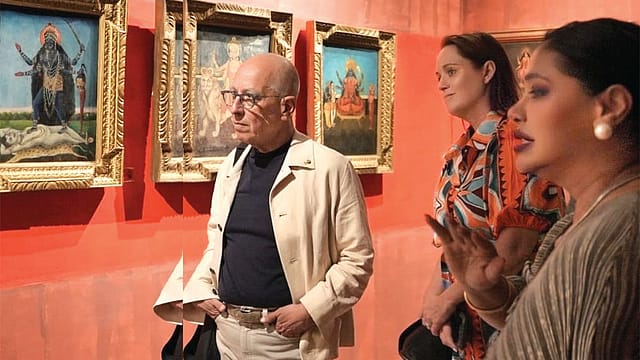
WHEN INHERITANCE of Light, Geographies of Loss opened at New Delhi’s Travancore House (January 12-14), it did more than present a multidisciplinary exhibition. It became a live site of encounter between histories, materials, and ways of seeing, bringing together senior museum leaders, cultural policymakers, philosophers, and artists in direct conversation with contemporary South Asian artistic practice at a moment when India’s visibility within global art discourse has remained uneven, often reduced to intermittent art-fair appearances and marked by long absences from major biennales.
The exhibition proposed light not merely as an aesthetic device, but as a cultural inheritance shaped by trade, labour, belief and power. I framed the exhibition as a series of guiding questions: What does it mean to see across cultures formed by uneven exchange and asymmetrical power? How do materials carry memory long before images do? And how might museums recalibrate authority in an era that increasingly demands shared authorship?
These questions structured a series of conversations with participants such as Martine Gosselink, Director of the Mauritshuis Museum; Robert van Laar, Director of the Drents Museum; Dewi van de Weerd, Ambassador for International Cultural Cooperation from the Netherlands Ministry of Foreign Affairs; Simon Mordant, Chair of the Board at MoMA PS1, board member of Tate Modern, Global Ambassador of Australia at the Venice Biennale, and founding member of the Museum of Contemporary Art Australia; and Karthik Kalyanaraman, academic, philosopher, curator and writer. Several of these figures had spent time in India in the preceding months, engaging with South Asian art making the discussions less observational than situated.
The exhibition opening and its aftermath unfolded not as a conventional panel, but as an extended, moderated exchange, one in which curatorial inquiry, institutional governance, philosophical reflection and cultural diplomacy met on deliberately equal ground that temporarily shifted the axis of global museum conversation to Delhi, and allowing India to be encountered not as a market or a national claim, but as a site of critical thought.
For Gosselink, encountering Mughal miniatures, Raja Ravi Varma oleographs, Dutch Bengals and contemporary South Asian works reopened questions at the very heart of Dutch art history.“To me, India is all about stories,” she reflected. “Behind every form and figure, there is a narrative to explore.”
She pointed to Rembrandt’s engagement with Mughal drawings, an influence rarely foregrounded. Seeing these lineages contextualised in India sharpened her curiosity: What did 17th-century Dutch painters make of the aureoles surrounding Mughal emperors’ heads? Circles of light that, to European eyes, signified Christian sanctity, but in the Mughal context marked imperial divinity and cosmic order.
“How complex Indian iconography must have been to Dutch painters,” she noted, suggesting that these encounters offered Rembrandt not only new motifs, but a form of epistemic confidence, evidence that the worlds he imagined had reliable sources beyond Europe.
This question of influence was taken further by Kalyanaraman, who cautioned against both celebratory and corrective simplifications. Influence, he argued, is never one-directional or innocent, but also cannot be reduced to appropriation alone. From Indo-Greek sculpture to Buddhist-influenced Hellenistic art, from Indian ideas of time shaping European philosophy to modernism’s deep engagement with African and Asian forms, what is repeatedly erased is reciprocity.
Rather than recasting Indian traditions merely as “co-producers” of European modernity, Kalyanaraman proposed a more radical reframing: a global art history that foregrounds constant oscillation, between borrowing and hardening, flux and definition, across all cultures. “No one,” he noted, “is special.” What matters is resisting narratives that freeze cultures into passive origins or singular centres.
The exhibition also foregrounded material histories—indigo, glass, pigments, textiles—that underpinned Dutch Golden Age painting. Gosselink cited recent research into Girl with a Pearl Earring, which revealed pigments sourced from Afghanistan, Central America, and possibly Asia, ultramarine more precious than gold, cochineal derived from insects, and even the “foreign” turban worn by Vermeer’s sitter. “These paintings were always global,” she observed. “We are only now learning how to tell that story properly.”
Yet she also offered a sobering reminder: access to light itself was once a privilege. In the 17th-century, only those who owned lamps and candles could truly see such paintings after dusk. Museums today preserve the best of the best, objects made for elites, while the lives and artefacts of the poor remain largely invisible. The ethics of illumination demand that museums hold this imbalance in view.
This ethical framing of light found philosophical depth in Kalyanaraman’s reflections. In Christian thought, light was once the active principle of manifestation, “Let there be light.” With the scientific materialisation of light in the 17th-century, particularly in Protestant
Northern Europe, illumination became something that struck the empirical eye, revealing objects of possession and wealth. Dutch Golden Age painting, he suggested, is inseparable from this transformation of light into matter.
By contrast, Indic traditions offer no single substantive word for light. Terms such as prakasa, jyoti or roca are adjectival, grounded in consciousness. Sight itself is understood as a transformation of mind—a vrtti. Islamic traditions, particularly Sufi and Shia thought, locate light (noor) as divine presence and moral order. Inheritance of Light exposed how museums might rethink experience itself: from spectacle toward ethical encounter.
For Dewi van de Weerd, the exhibition exemplified how museums are changing. “These kinds of exhibitions allow multiple voices to coexist,” she said. “They create platforms where visitors can approach a subject from different angles.”
In the Netherlands, museums are spaces for debate, experimentation and encounter. This includes grappling with colonial histories, but also with new technologies such as AI, which featured prominently in the exhibition. Cultural cooperation, she emphasised, must be sustainable and long-term, rooted in responsibility rather than spectacle.

RESIDENCIES, IN HER view, function as cultural infrastructure. Long-term stays allow artists to develop deep bonds, resulting in networks of “ambassador artists” who nurture exchange long after the residency ends. India-Netherlands programmes, from Kochi to Jaipur to Amsterdam, model this shift.
Robert van Langh of the Drents Museum found resonance in the exhibition’s focus on movement and material repair. Works such as Ajaysingh Bhadoriya’s fractured ceramics, Piyali Sadhukhan’s carpet-like works made of broken glass bangles, and M Sovan Kumar’s truck paintings spoke to Drents’ long-standing interest in archaeology, migration, and material culture.
“Things broken in the past can be put back together,” he reflected, “and become more interesting and more beautiful.” For van Langh, artworks are narratives where material and idea speak together. Museums, he suggested, must evolve from repositories of objects into stewards of material histories, places where beauty, labour, damage and continuity are read together.
These conversations extended beyond curatorial practice into governance and representation. Simon Mordant, a global figure across major institutions, emphasised that while boards must remain alert to ethical and reputational risk, curatorial vision must stay with directors and curators. Governance, he suggested, is about enabling ambition, not directing content.
India’s return to the Venice Biennale after a long absence sharpened these questions. While Mordant welcomed the return, saying that “India should be part of the conversation”, the appointment of a non-national curator raised debate.
Kalyanaraman’s response was pointed but nuanced. National identity, he argued, remains meaningful precisely because power is unevenly organised globally. But any notion of a singular “Indian” identity is a fiction. India is a multivocal, historically layered cultural horizon, no less hybrid than the global narratives museums claim to embrace.
Representation, in this view, requires being steeped in what he called “incoherent coherence.” While a curator need not always be a national, the asymmetry remains striking: “Will they let an Indian curate the French Pavilion?” he asked.
Across these conversations, a common thread emerged: exchange is never neutral. Whether through pigments, patterns, people, or ideas, cultural contact has always involved asymmetry. What matters now is how institutions respond.
Seen in this light, the exhibition became a proposition: museums can learn to see differently by standing elsewhere. For a few days at Travancore House, Dutch museum leaders encountered their own histories refracted through South Asian light, and left with the sense that the future of cultural exchange lies not in mastery, but in sustained, ethical attention.